
If a NoArchive or NoCache tag on your pages is there to keep Microsoft's AI answers away from them, check it before March 1. Microsoft will stop reading both.
In its October 30 announcement, Bing said the two tags will no longer count as a training or grounding preference after that date. I checked 30 large US and UK news homepages that evening, and 17 returned a page. Five of those 17 still carry a signal Bing is retiring: The Verge, Vox, BBC News, The Guardian US and NPR.
Most coverage framed the news as new controls added. I think the removal of an old one matters more, because a tag that quietly stops working protects nobody.
Bing's post lays out what happens to sites that do nothing.
Krishna Madhavan, principal product manager at Microsoft Bing, wrote in that post that pages using NoArchive or NoCache "default to Allow for grounding until Microsoft recrawls them and discovers your new AI Grounding preference." That applies to a site that has not recorded a temporary preference in Bing Webmaster Tools by March 1.
The replacement and the calendar
Bing is splitting the old tags into two preferences. AI Training is the shared signal, a __usage_ai-training user agent in robots.txt followed by Disallow: /. It comes from an IETF draft whose author, Kevin Kelley, lists Anthropic as his employer.
AI Grounding is Microsoft's own and works page by page. Bing says there is no site-wide robots.txt grounding preference. A page can be set to Allow, DisallowExtended or Disallow. The middle option keeps a page in Microsoft's own products, such as Copilot, but out of grounding services it sells to third parties, such as Web IQ.
Temporary grounding preferences open in Bing Webmaster Tools on December 15, 2026. Bing starts honoring the new preferences as it crawls on February 1, 2027. Sites that want to keep withholding content from grounding have to publish page tags and record the temporary preference before March 1.
Google followed the same day
Google announced that it plans to read the shared training token as a Google-Extended disallow, unless a site specifies Google-Extended itself. Its post, signed by John Mueller, says "We aim to support this new control along with other AI providers in 2027."
That post covers training. It does not describe a page-level grounding control. Bing is the only one of the two announcements that does, and it says the grounding settings do not change eligibility for traditional Bing search results.
The homepage check
I fetched 30 homepages around 19:00 UTC on October 30. Thirteen did not return a page, among them The New York Times, Reuters, AP and the Financial Times. Of the 17 that did, The Verge and Vox carry <meta name="bingbot" content="nocache"/>. BBC News and The Guardian US send an X-Robots-Tag: bingbot: noarchive header. NPR uses a general noarchive robots meta tag.
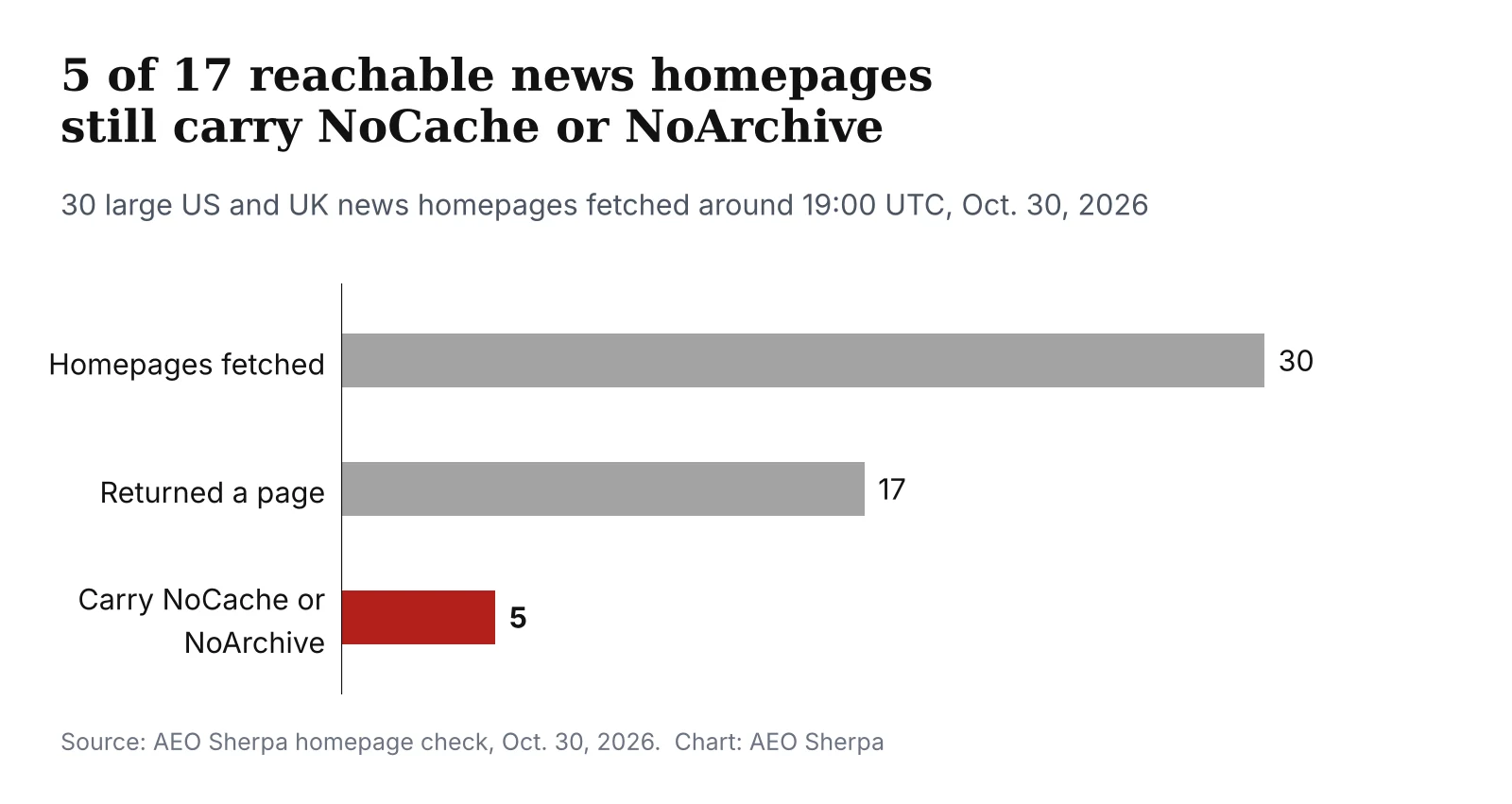
This is a snapshot of homepage markup on the sites that answered. It is not a measure of all publishers, and it cannot tell me why any of these tags were added. Article pages may differ from the homepages, and I did not check them.
My read
Bing is plain about the trade, and I respect that. Choosing DisallowExtended or Disallow, it says, means "you will see reduced brand visibility in AI experiences." That is a real cost, and each publisher should weigh it on purpose.
I object to letting a lapsed default make the choice. A publisher that wants out of AI answers needs to publish a page-level tag and record the temporary preference. A publisher that wants in can ignore all of it. Either way, a decision should replace the old tag before March 1. The worst outcome is a publisher that never knew the tag was doing something and finds out from a Copilot answer.
Free newsletter
The Sherpa Brief
One email a week on what changed in AI search, what it means, and what to do about it. Written for marketers, SEOs, and publishers.
Free. Unsubscribe in one click.