
You've probably asked ChatGPT about your drug, your device or your clinic to see what it says. That check does not tell you what a doctor sees.
OpenAI says it improved trusted clinical search in ChatGPT for Healthcare and ChatGPT for Clinicians, "including how ChatGPT finds, evaluates, and cites medical evidence." The clinician product's help page describes its evidence as peer-reviewed studies, public health guidance and clinical guidelines. Brand websites are not named anywhere on it.
My read: for the doctor audience, the routes in are publications, guideline inclusion, trial records and label data. Your own site is a smaller part of that picture.
OpenAI announced the change in a product post and a release note dated November 16, 2026.
Most of that day's news was about agents. OpenAI showed computer-use agents that move information between healthcare systems, and it added more than 20 new healthcare plugins. The health IT press led with that part. HIT Consultant covered agents and benchmarks, and Unite.AI covered the plugin list.
The grade OpenAI chose to publish
The search change got one section of the post. To test it, OpenAI ran a blind evaluation in which physicians reviewed answers to real clinical questions across specialties. Across more than 1,300 reviews, physicians rated the new version higher on all eight dimensions OpenAI measured. One of them is "source authoritativeness."
That is the dimension an SEO should notice. Physicians scored the answers on their sources, and OpenAI chose to publish that score. The evaluation is OpenAI's own. Skeptics on r/medicine said it does not show real-world performance and that the press release links no peer-reviewed study.
Where the answers come from
The help page describes the evidence the product uses. It says ChatGPT for Clinicians "finds and evaluates medical evidence from peer-reviewed studies, authoritative public health guidance, and clinical guidelines."
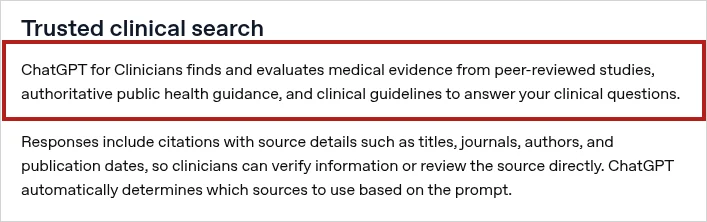
Citations show "titles, journals, authors, and publication dates," and "ChatGPT automatically determines which sources to use based on the prompt."
A second route sits on top of that. A clinician can install the Healthcare Public Data plugin and connect apps for PubMed, ClinicalTrials.gov, DailyMed, RxNorm, openFDA, CMS Coverage, CMS Open Data, Medicare Care Compare and the NPI Registry.
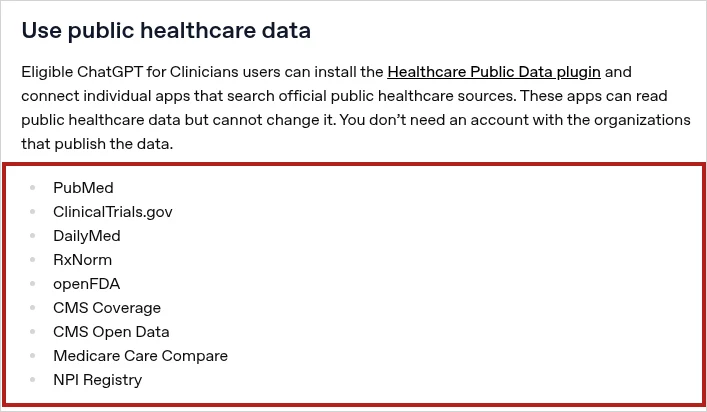
The help page says these apps can read public healthcare data but cannot change it.
ChatGPT for Clinicians is "free for eligible, verified clinicians in the U.S.," according to OpenAI. Glenn Gabe, an SEO consultant, flagged the update on X on Nov. 16: "Focus on health and medical? An update from OpenAI -> Clinical search and plugins for 'ChatGPT for Clinicians'". Karan Singhal of OpenAI described the goal on X the same day: "Care teams can use the tools they already rely on to look up clinical guidance, check insurance eligibility, or find the specialist on call, all in one conversation."
The help page does not say brand sites are blocked, and it does not rank its sources. It names the kinds of evidence the product is built to find, and a company's marketing pages are not among them.
What I would check first
What the AI can find about your brand across the web counts for more than your website, and for this audience OpenAI has described the evidence it looks for. For a drug, that points at the label on DailyMed, the trial entries on ClinicalTrials.gov, the papers in PubMed and the guidelines that cite them. When one of those records is out of date or thin, it is one of the places a physician's answer can draw from. I would check those records before I wrote another condition page.
Citations are still a diagnostic here. They show which records you could fix. The goal is a correct answer about your product when a doctor asks.
This also limits what visibility checks can tell you. I track AI visibility every week for clients in healthcare, among other industries, across ChatGPT and Google's AI surfaces. A check run in consumer ChatGPT shows what a patient might see. It does not show what a verified clinician sees in a separate workspace built around a different set of sources. Disclosure: my agency, ViewEngine, sells AI visibility work and builds its own tracking tools.
If you sell to doctors, fix the evidence trail before the brand page. I would rather have a clean label and a complete trial record than another page of copy written for the wrong reader.
Free newsletter
The Sherpa Brief
One email a week on what changed in AI search, what it means, and what to do about it. Written for marketers, SEOs, and publishers.
Free. Unsubscribe in one click.