
You probably manage AI visibility one domain at a time. Two reports on October 6, 2026 suggest your subdomains deserve their own decisions.
The first came from SEO consultant Lily Ray, who said on X that ChatGPT is running more site: searches. In her words, "your site's subdomains are being used more to inform its responses." The second is a change to Google's Search generative AI control page, which now describes how a child property can override its parent's AI setting and how the top-level domain owner gets notified.
These are different mechanisms, and I would not treat them as one. Together they make my point: a subdomain is now its own unit of AI visibility, and each one needs a named owner.
The Google half came first, at 7:41 a.m. ET, when Search Engine Roundtable reported the update. Barry Schwartz wrote that Google "has added information to the Search generative AI control page in Search Console about when a child property overrides the parent setting for AI controls." His report covers only that one documentation change.
Google's page explains the mechanism. It says that "by default, a property inherits its Search generative AI control from its closest parent that has changed its control to stop inheriting." A subdomain property such as blog.example.com counts as a child of example.com. Google says the default for every property is to include its content in these AI features, and a child property's default is to inherit from its parent. Anything nested further down follows the closest parent that set its own control.
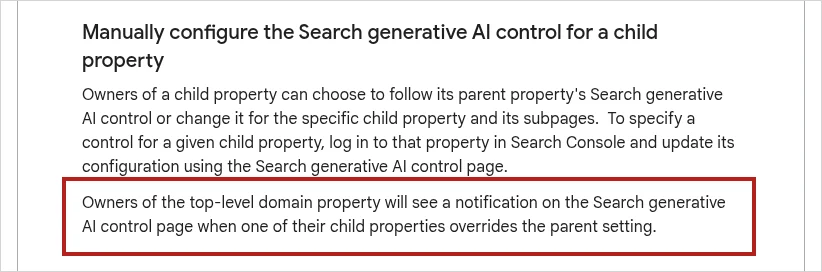
The owner of a child property can follow the parent's setting or change it for that property and its subpages, according to Google. Separately, Google says the owner of the top-level domain property sees a notification on the control page when a child overrides the parent.
The page adds that the control is not a ranking or inclusion signal for other parts of Search.
Glenn Gabe, an SEO consultant at G-Squared Interactive, welcomed the change on X. In his words, "You will now know when a child GSC property overrides the parent setting for AI controls." I have not confirmed that the notification is live in the Search Console interface. I am relying on Google's documentation for it.
The ChatGPT half arrived at 10:00
Ray posted at 10:00 a.m. ET. Her example was help.ahrefs.com, and she said she was looking at retrieved URLs in ChatGPT through the Resoneo plugin, for the query "top answer engine optimizations tools 2026."
She said "more" without giving a baseline. That makes this a practitioner's observation and not a measured trend. It rests on one example, and it does not show that every subdomain is read.
Her advice was direct. "I would start by taking inventory of all of your subdomains," she wrote, then asked whether you want that information available to LLMs, and told readers to think about staging sites. Her second point is the more useful one. Ray called it a chance to "review your help center, product documentation, forums, content hubs, and anything else that might live on a subdomain" and improve how the product and brand are framed.
That matters because, in my view, a page the model reads can shape an answer even when it is never cited. Retrieval and citation are different events. A help center that describes your product badly may still inform what ChatGPT says about it, and a help center that explains it well gives the model better material to work from.
Why the two belong together
Retrieval can expose a host's content to ChatGPT. Separately, a Google property owner can change that host's AI setting without the main site's owner choosing it. Both treat the subdomain as its own unit.
The two do differ. Google's setting governs Google's Search features, and nothing in either report says it blocks ChatGPT or protects a staging site. If you write a policy, write one for each mechanism. A staging host needs its own protection, such as access controls, and a Search Console setting is not a substitute for that.
My read is that the old picture, where AI visibility belongs to your website, no longer holds. It covers everything an AI system can find about your brand, and what it concludes after reading it. A help center or a forgotten staging host is part of that.
I would give every subdomain a named owner. Without one, a decision to opt a host out of Google's AI features, or to leave it open to retrieval, can happen by accident. I am describing a risk here, not a pattern I have measured. I would also read what those pages say about the product before an answer engine does.
Free newsletter
The Sherpa Brief
One email a week on what changed in AI search, what it means, and what to do about it. Written for marketers, SEOs, and publishers.
Free. Unsubscribe in one click.