You annotated October 8 to 15 in your analytics and moved on. Your window may be a day short.
Adobe's Cedric Huesler reported that tagged ChatGPT clicks were back to roughly 95% to 100% of normal by 9 a.m. PT on October 15. That is 16:00 UTC. Search Engine Journal carried the report, and he was measuring thousands of domains.
Other evidence points to a slower return. Spot checks in the ChatGPT interface, posted with server logs from one large shop on r/TechSEO, found no tagged links that afternoon and most of them the next day. SEO consultant Glenn Gabe saw the same lag.
My read is that the recovery was uneven, and the cautious annotation runs through October 16.
The analysis comes from a Reddit user, DrKJING, who had the server logs and GA4 of one large online shop and posted an hour-by-hour breakdown on October 16. The shop stays anonymous. The numbers are indexes against an October 1 to 7 baseline.
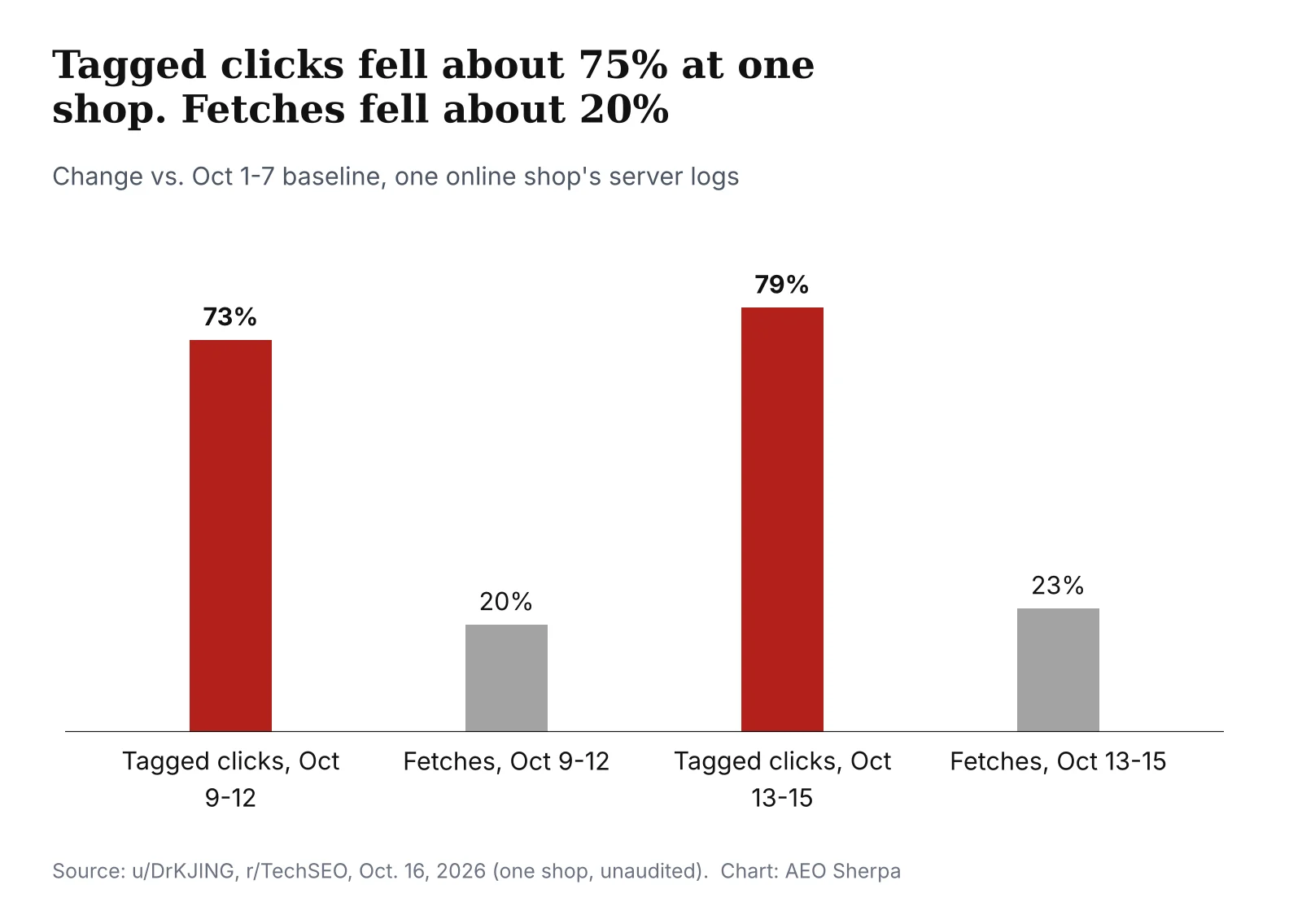
The poster puts the break inside one hour on October 8, between 21:00 and 22:00 UTC. Tagged ChatGPT clicks fell 73% across October 9 to 12 and 79% across October 13 to 15. Fetches by ChatGPT-User fell only 20% and 23%.
Tagged Perplexity clicks did not drop at all.
Huesler wrote that the fix began rolling out early on October 15. Delante, an SEO agency, updated its write-up to say ChatGPT has been adding UTMs again since that day. That is the version most of the coverage repeated.
The shop's logs show the start of the climb. Tagged clicks began rising around 14:30 to 15:00 UTC on October 15. In the 15:00 and 16:00 hours they were at 41% and 35% of the prior week. The logs end at 17:40 UTC, which leaves about three hours of recovery to look at. The log alone cannot say when this shop got back to normal.
The poster also ran mostly the same questions in ChatGPT from Germany. On October 3, 67 of 67 links carried the tag. On the afternoon of October 15, none of 82 did. On October 16, 71 of 102 did.
Gabe, who posted his own tests on X, saw the same thing. On October 15 at 19:35 UTC he replied to the news: "Not for me yet! I just tested in paid and free accounts and I'm not seeing utm parameters at all. Hopefully they are coming back and it will just take time roll out..."
The next day, at 12:35 UTC, Gabe wrote: "I'm now finally seeing utm parameters for ALL links in ChatGPT (in the answer, the main sources, and "More" sources.) Phew."
What the logs could not rebuild
The poster also tried to size the hidden clicks from the logs. The method looked for a ChatGPT-User fetch just before an untagged visit to the same product page. In the baseline week, only about 2.5% of tagged product clicks at this shop had a fetch of the same URL in the ten minutes before. That matching window was too thin to size anything.
One commenter, u/marintkael, suggested a reason. If ChatGPT builds answers from its own index, the page was read days earlier by OAI-SearchBot. That is a guess from two Reddit users, and I would treat it as one.
Answers pulled through the OpenAI API carried utm_source=openai before, during and after the outage, never chatgpt.com. A channel rule that only looks for chatgpt.com misses those clicks.
Wojciech Urban at Delante, whose agency sells AI visibility work, wrote that "this makes GA4 data an increasingly weak measure of how a brand is doing in ChatGPT." This episode shows one version of that weakness. A tag disappeared and the clicks changed labels, which says nothing about whether brands did worse in the answers. Disclosure: my agency, ViewEngine, sells AI visibility work and builds its own tracking tools.
I would annotate October 8 through 16, count utm_source=openai as AI traffic, and stop treating "fixed" as one date for every site. One shop and two people's spot checks do not prove how OpenAI rolled this out, and they do not need to. The date in the coverage was a benchmark for some domains, and the gap in your own data may run longer.
Free newsletter
The Sherpa Brief
One email a week on what changed in AI search, what it means, and what to do about it. Written for marketers, SEOs, and publishers.
Free. Unsubscribe in one click.