You publish a guide so AI answers can find it and cite it. Now picture the same guide written where no crawler and no rival AI can ever reach it. Space is that bet.
On November 20, 2026, OpenAI said it started rolling its Space workspace to Plus users ages 18 and older, and the release notes keep every shared page or presentation invite-only: no public links, and people on Free accounts cannot open shared pages. The launch post drew 2,976 likes, 214 reposts, and 359,319 views by Nov. 21, by X's counters.
My read: AI answers can only cite what stays public, and Space pages start private. The question now is which Space surfaces stay open.
The sharing rules are in OpenAI's Nov. 20 release notes, and the sites exception is on the Space features page.
The official ChatGPT account put up the launch post that evening. "Collaborate with others alongside ChatGPT to create interactive pages, slides, and sites," the post reads, which also promises mobile editing and smoother performance.
Andrew Ambrosino, who works on Codex and ChatGPT at OpenAI, posted his own feature list minutes before, with mobile editing, a redesigned Space home, and rebuilt threads among the additions. Greg Brockman, OpenAI's president, posted his own announcement minutes after the launch post. The three posts landed within the hour, all stressing self-updating pages and mobile editing.
Space replaces Library as the home for pages, slides, images, and files, OpenAI says, and pages can update themselves from connected apps such as Slack.
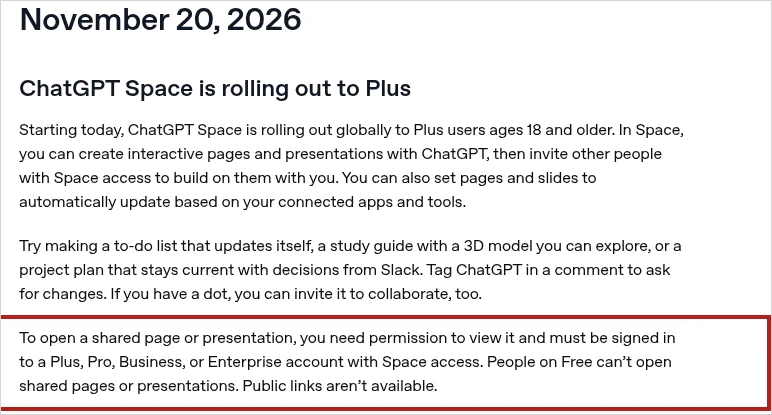
The release notes set the terms. To open a shared page or presentation, you need permission plus a Plus, Pro, Business, or Enterprise account. People on Free cannot open shared pages, and public links are not available.
The Space features page fills in the rest. Space is available on Plus, Pro, Business, and Enterprise plans, sharing runs on invites with view or edit access, and sharing a page does not share private chats or memory.
Sites are the possible exception. OpenAI says sites built in Space can be shared with a team or published for anyone to use. If that holds, published sites would be the one Space surface with a publicly reachable address, while shared pages and presentations have none.
Practitioners already feel the wall. "A paywalled deck gives OpenAI an upsell and gives you one more email to answer. ChatGPT Space is rolling out to Plus, but people on Free can't open shared decks. Build it with AI. Send it in a format your client can actually open," wrote xinxianhub on X.
The closed default has its defenders. Sharing a page exposes neither private chats nor memory. Collaborators see only what is on the page. TGWorldPlus argued on X that AI workspaces should default to private even when sharing is one click away.
The tech press has covered the rollout as a productivity launch, all features and mobile editing. CryptoBriefing, Mezha, and tbreak took the feature angle, and Meteoraweb wrote an explainer.
I track AI visibility every week for clients across AI Overviews, ChatGPT, and Perplexity. Citations are how I see what a brand can change in what the AI says. They are diagnostics, not the outcome. Nobody clicks a citation and buys.
When a workspace has no public links, its pages cannot serve as that public evidence. Independent mentions across public sources build the consensus AI answers lean on, and a workspace without public links cannot add to that consensus, whatever happens inside it. Published sites might still face outward, if OpenAI's publishing claim holds and search engines treat them like any other page. The test that would settle it is simple: publish one Space site, then check after two days whether Google indexed the URL and whether ChatGPT cites it. That is the surface I will be watching.
Free newsletter
The Sherpa Brief
One email a week on what changed in AI search, what it means, and what to do about it. Written for marketers, SEOs, and publishers.
Free. Unsubscribe in one click.