Your rank tracker says a client fell out of the top 10. Before that goes in a report, check whether the tool simply could not read the address.
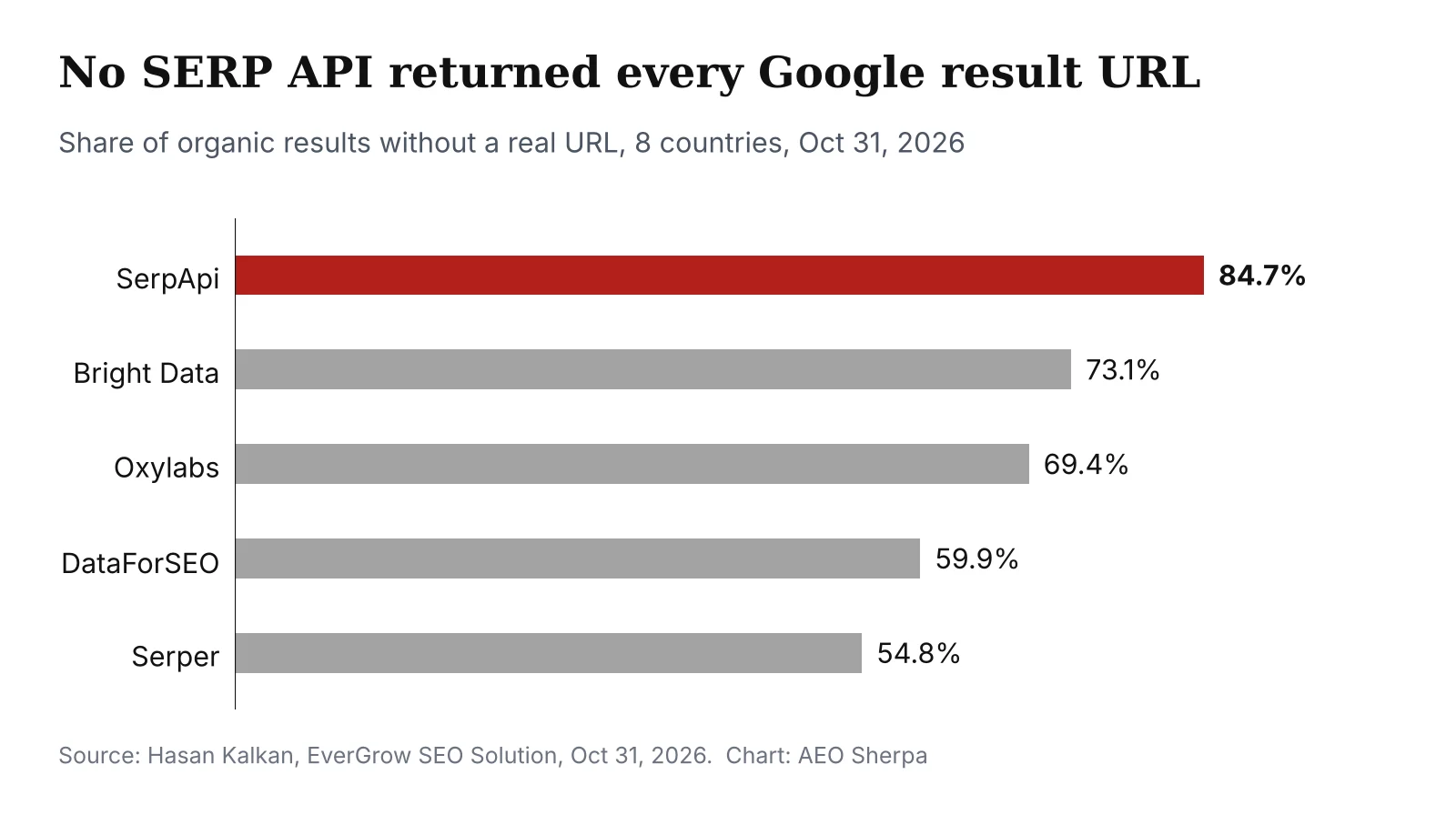
Hasan Kalkan of EverGrow SEO Solution sent the same queries to five SERP APIs in eight countries on October 31, 2026. In his published study, 54.8 percent to 84.7 percent of the organic Google results came back without a real destination URL, depending on the provider. In that snapshot, none of the five returned every URL in any country.
My read is that AI search work gets hit by this too. AI Overview references arrived with real links in Kalkan's data while organic results did not. Overlap stats matched by URL are probably biased low.
Kalkan posted the results on r/TechSEO at 14:59 UTC that day, one day after his first sample covered a single vendor.
How the test came together
That first sample began with an odd result in his own tool. On October 30 a site was "not in the top 10" for its own brand name, and the next request, reading the domain from a different field, had it at number one. He traced it to Google's goto links. Since summer Google has routed result links through google.com/goto, which Search Engine Land reported when Google confirmed the rollout in August.
Kalkan re-fetched his old DataForSEO tasks to see when it hit his data. From October 15 to 21 he found no goto links among 71,531 organic results. On October 30 he found 2,552 among 4,344, or 58.7 percent. He then asked DataForSEO, and its support replied that Google now limits how many goto links on one results page can be resolved in quick succession. After the first 5 to 6, support told him, an interstitial appears with a delay that grows to 40 seconds by the 15th link and sometimes 120 seconds.
The standard queue was supposed to resolve everything. On the morning of October 31 he reran 60 keywords and still got 61.0 percent back as goto links. So he built a broader comparison.
Five vendors, one pattern
He sent the same queries to all five providers in parallel between 12:24 and 13:28 UTC on October 31. The test used desktop requests, up to 170 results pages per provider, and 20 to 25 hand-picked queries per country. Kalkan describes it as a snapshot of one afternoon with hand-picked queries, and says he plans a new measurement on November 3.
Serper came out best at 54.8 percent without a real URL, then DataForSEO at 59.9 percent, Oxylabs at 69.4 percent, Bright Data at 73.1 percent and SerpApi at 84.7 percent.
Kalkan says he has no business relationship with any of them beyond a regular customer account. He wrote:
Switching providers doesn't solve it. Even the best provider in the comparison returned about half of the results without a real URL.
The shape differed by vendor. Serper returned a real URL for positions 1 to 3 on all 170 pages, then about 80 percent came back without one. Bright Data went from 14 percent missing at position 1 to over 90 percent from position 5. DataForSEO sat near 60 percent at every position, and SerpApi was already at 77 percent at position 1. SerpApi had told PPC Land in September that it was returning direct URLs again. Kalkan says DataForSEO support confirmed that evening that the standard queue is affected too and that its developers are investigating.
The wrapped links do not look the same everywhere. SerpApi and Oxylabs return a relative /goto?url= path, and Bright Data uses country domains such as google.de/goto. A filter for google.com/goto alone misses them.
One part of the damage is narrower than it sounds. Kalkan found the displayed domain readable for 91 to 99 percent of the affected results, and all 2,287 resolved links matched the domain shown. A tool can often still tell which site a result belongs to, even when the full destination URL is gone.
He also stresses what has not broken. Answering a reader who asked whether this only affects crawlers, he wrote that "a normal user clicks one result and the goto link just redirects them to the site." His advice was that "Search Console is the safe reference, since it counts at Google itself."
The vendors are not unanimous. A cloro co-founder replied in the thread that cloro is "at 100% of organic results" and invited a benchmark. Kalkan left cloro out because its terms of service bar benchmarking.
Why AI Overviews make this matter
In Kalkan's October 30 DataForSEO sample, organic results were wrapped at 55 to 61 percent across positions 1 to 10. Among 4,471 AI Overview references, he found no goto URL at all.
A study that asks how many AI citations also rank in the top 10. It has to line up the cited pages with the organic results, and the easy way is to match them by URL. The cited page shows up with its address on the AI Overview side, but on the organic side the address is often a Google redirect.
The page is in the top 10 and the match still fails. Overlap comes out lower than it is, and I do not know by how much, because I have not run that comparison. Disclosure: my agency, ViewEngine, sells AI visibility work and builds its own tracking tools.
My take is that this does not make citation-versus-ranking work useless. It means the match method belongs next to the number. An overlap figure built on URLs from an affected API, without recovering the destinations or matching on the displayed domain, tells you about the redirect as much as about Google. Until its author says which method they used, I would read it that way.
Free newsletter
The Sherpa Brief
One email a week on what changed in AI search, what it means, and what to do about it. Written for marketers, SEOs, and publishers.
Free. Unsubscribe in one click.