
You've heard the pitch. Let AI write hundreds of articles, and some of them will end up in AI answers.
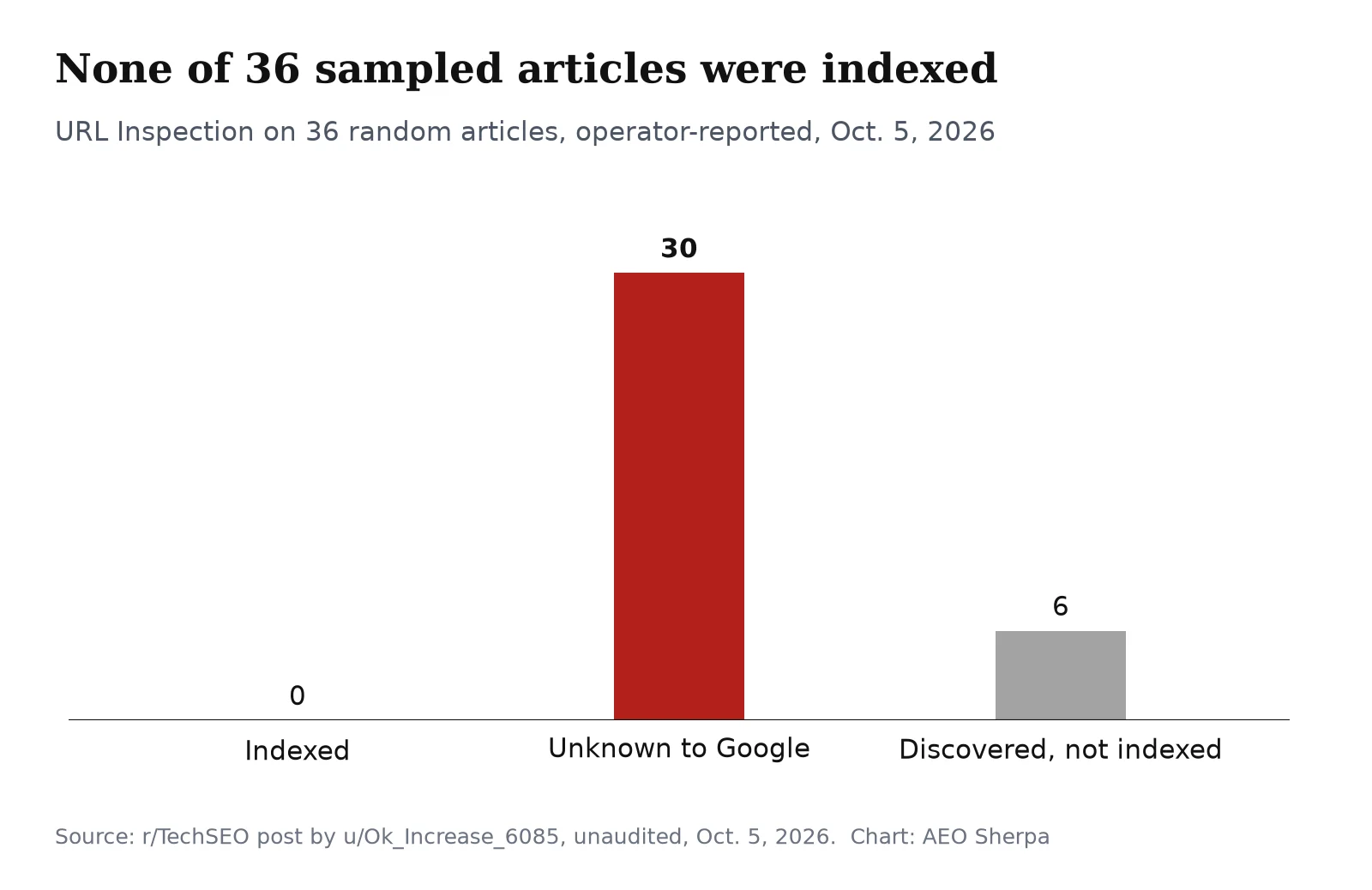
One operator has run that play since March 2025. Gemini has written 7,254 news articles for his site, and by his own Search Console numbers, Googlebot reads about four pages a day. Thirty of the 36 articles he checked have never been seen by Google at all.
If Google never fetches your page, AI Overviews and AI Mode can't cite it. This is what publishing ahead of your authority looks like.
He laid out the whole thing on r/TechSEO on October 5. The machine was simple. Every hour, a script grabbed a headline from a news feed, and Gemini researched the story with Google Search and wrote it up, drawing on a median of seven source sites. Every page said it was AI-generated. The site could publish up to 24 articles a day.
His Search Console numbers for the last 90 days read like a typo: 778 impressions and one click. Only 67 of the 7,254 articles had shown up in search at all, and Google News and Discover sent nothing. When he inspected 36 articles at random, 30 came back "URL is unknown to Google." The other six were discovered but never indexed.
The crawl stats show why. Googlebot made 1,070 requests in 89 days, and about 360 were for pages. That's four pages a day, for a site that publishes up to 24. Every day the pipeline runs, the pile of pages Google has never seen gets bigger.
Nothing looked broken. He found no penalty and no technical fault. His server answered in 445 milliseconds on average, and 89 percent of responses were the plain success code. The sitemaps read without errors, the NewsArticle markup was in place, and the homepage and section pages were indexed. "Google simply does not come," he wrote.
The replies split. One commenter told him, "You created something with zero value and Google is ranking it accordingly." Another wrote, "Google calls this 'scaled content abuse' FYI." A third said "publication velocity and crawl demand are completely out of sync," and suggested tracking the time from publish to first crawl.
That same morning, Search Engine Roundtable relayed a timeline that Google's Gary Illyes showed at Search Central Live in Barcelona. A new URL is typically discovered in about 20 hours. The slowest case is "weeks to never," and indexing end to end runs "months or never (quality)." Illyes told Search Engine Roundtable the figures were "an exercise to see if the audience can relate to the numbers we pulled internally." The operator's site lives in that last row either way.
Google said where it is looking, too. John Campbell of We Are Roast summarized its comments at the event, as quoted by Search Engine Roundtable: "Expect more spam updates. Google is dealing with a growing flood of AI slop. Expect more spam updates and new spam thresholds. Scaled, low-effort content is the risk."
If you publish with AI, the check that matters is simple. Compare the new URLs you publish each day with Googlebot's requests for new URLs in Crawl stats. When the first number is far larger, the extra pages add nothing Google or its AI answers can use. Pilot 100 to 200 pages before you scale a template, and scale only what Google actually reads.
He has since cut his sitemap from 7,215 URLs to the last 30 days, 247 pages. My guess is that Google still won't come until the site gives it a reason to. Authority has to come before content at scale.
Free newsletter
The Sherpa Brief
One email a week on what changed in AI search, what it means, and what to do about it. Written for marketers, SEOs, and publishers.
Free. Unsubscribe in one click.