
If you track AI visibility, you may have read that Bing now reports your AI share of voice. A thread on X by SEO operator Alex Groberman calls it "probably one of the more important marketing updates of 2026."
Microsoft announced the four features Groberman walks through, Intents, Topics, Citation Share and Compare, in a Bing blog post dated June 16, 2026. That same post says Citation Share is "not a ranking system or a competitive scoreboard."
My read: a five-month-old preview is being passed around as news, and one of its metrics is being sold as the thing Bing says it isn't.
Groberman posted the thread on November 15, 2026. By the next morning it had 75 likes and 32 reposts, and the replies under it read it as fresh news.
Groberman writes, "Microsoft is now literally telling businesses exactly how to get traffic from AI Search." A few lines later he makes the claim that dates it wrong: "Now they are expanding it with four new AI Insights: Intents, Topics, Citation Share and Compare." The thread, as it read on November 16, gives no date for any of the four.
The base report came first. Microsoft's February announcement introduced AI Performance in Bing Webmaster Tools as a public preview. Microsoft says it counts how often a site is cited in answers across Copilot, AI summaries in Bing and partner experiences, and lists the grounding queries behind those citations.
The June post added four layers on top. Intents sorts grounding queries into categories such as "Informational, Commercial, Navigational, Learn and Solve, Research, Creation, Local, and more." Topics groups related queries into clusters. Compare lays an earlier date range over the current one. Microsoft said all four were "beginning to roll out in preview within Bing Webmaster Tools globally" that day.
Bing already said what Citation Share is not
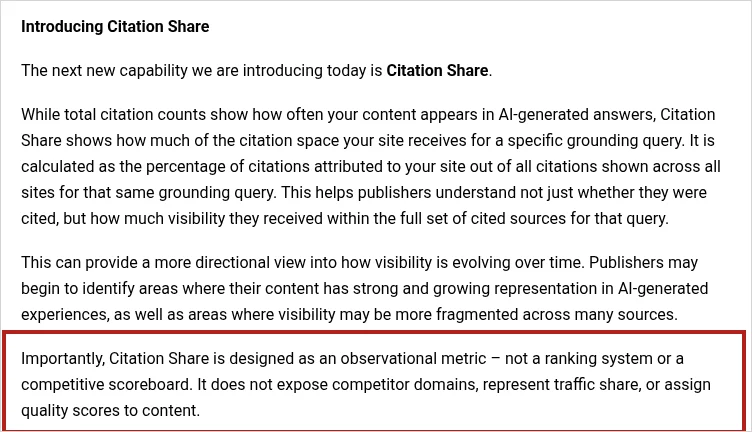
Bing defines Citation Share as "the percentage of citations attributed to your site out of all citations shown across all sites for that same grounding query." It is one percentage for one query.
The thread stretches it much further. "A site may get 100 citations for a topic, but if competitors are getting 5,000, the business may still be underrepresented," Groberman writes. He adds that "This starts to move AI search reporting closer to share-of-voice analysis."
Bing calls it "an observational metric" and lists what it leaves out: "It does not expose competitor domains, represent traffic share, or assign quality scores to content."
Citation Share never shows which other sites were cited, or how often.
The feature that does point at other sites is one the thread never mentions. In an October 13, 2026 post, Bing announced Topics Portfolio, a beta tab inside AI Performance. Bing says its Top Opportunity Queries table lists queries "where other sites appear and yours does not," with citation volumes "shown as ranges rather than exact numbers." Bing also warns that "smaller sites may see a shorter list or may not even see this feature." It is the most recent AI Performance feature on Bing's webmaster and search blogs.
The thread also sells something
Groberman runs SEO Stuff, and the thread links to its done-for-you package several times. He describes that package as "10 AI-search-optimized articles with three DR50+ authority placements." That doesn't make all of his reading wrong. "A citation from a commercial query may mean your business is being considered closer to the buying decision," he writes, and I think that is a sensible way to read Intents.
Disclosure: my agency, ViewEngine, sells AI visibility work and builds its own tracking tools. I built one of the first share-of-voice platforms for ChatGPT, Perplexity and Google AI, and share of voice means something specific.
It comes from running many prompts many times and counting which brands get named. Citation Share answers a narrower question: what percentage of the citations for one grounding query went to your site. That is useful the same way a crawl log is useful. It is a diagnostic, and it can't tell you who got recommended instead of you.
My guess is the thread will keep circulating, and clients will start asking for their AI share of voice out of Bing Webmaster Tools. The honest answer is that Bing doesn't report one.
Free newsletter
The Sherpa Brief
One email a week on what changed in AI search, what it means, and what to do about it. Written for marketers, SEOs, and publishers.
Free. Unsubscribe in one click.