
Fifteen YouTube videos got new descriptions and new timestamps on the same day. A few weeks later, an AI search analytics company reported that those videos were pulled 359 percent more often by AI search. Because both edits landed together, nobody can say which one did the work.
Peec AI says videos with revised descriptions rose 359 percent in daily AI retrievals, against 17 percent for unchanged videos and 25 percent for YouTube overall. That is the number now circulating as proof that description rewrites pay off.
I read it as a lead worth testing, not a result. Google has since given channel owners a way to run the test on their own videos, and that is the part of this story I would act on.
David Konitzny, a GEO researcher at Peec, published the findings, and Search Engine Land covered them on November 6.
Peec analyzed about 60 YouTube videos. On October 19 it updated the descriptions on 15 of them and added manual timestamps to the same 15. It then compared AI retrievals from October 6 to 21 with retrievals from October 22 to November 4. The videos themselves did not change.
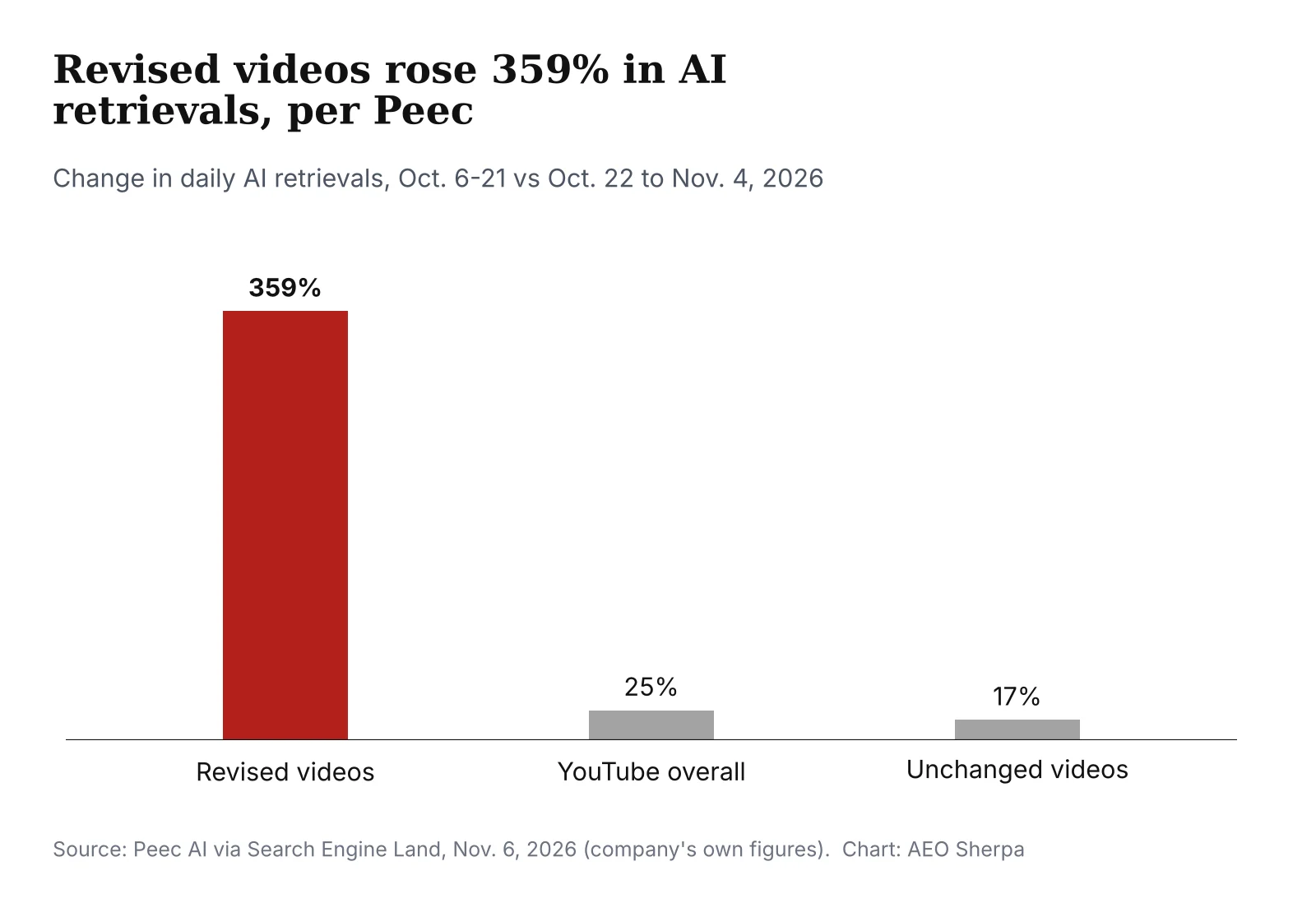
Search Engine Land also reports engine-level figures. In Google AI Overviews, retrievals for the revised videos rose 293 percent, against 27 percent overall. In Google AI Mode they rose 129 percent, against 11 percent overall. YouTube allows descriptions up to 5,000 characters, and the article notes that many videos use only a fraction of that space.
Neither source defines a retrieval or says which models and prompts produced the daily counts. I cannot tell you how the figure was measured. Peec also sells AI search analytics, as my agency, ViewEngine, does. Disclosure: ViewEngine sells AI visibility work and builds its own tracking tools.
Konitzny does not oversell it. He wrote that "Of course, this doesn't prove that longer descriptions alone caused the increase. Simply filling all 5,000 characters isn't the goal." Search Engine Land says the study measured changes in AI retrievals but could not isolate the effect of the description updates.
The dates add a second wrinkle. The two windows differ in length, and the October 19 edits fall inside the first one. Any of three things could have moved the number: the longer description, the timestamps, or the plain fact that someone touched the videos.
What Google now lets you measure
On November 7, Lily Ray, an SEO and AI search consultant, pointed to a tool that did not exist for channel owners a few months ago. She wrote that "If you connect your YouTube profile to GSC (using their new social profile connectors), you can get back some of the real search queries tied to how your videos rank and are cited in Google Search."
Google calls the feature platform properties. In a July 29 post, the Search Central team said it lets you track how posts on Instagram, TikTok, X and YouTube perform on Google Search, Discover and Google News, and that it was then available to everyone. The same post says you can use Search Console annotations to track whether an update such as rewriting a YouTube title affects search performance over time.
That is a different measurement from Peec's. Google's post describes performance in Google's search surfaces. AI Overviews, AI Mode and ChatGPT go unmentioned. So Search Console cannot confirm or refute Peec's AI retrieval counts. It can show whether the queries, clicks and impressions for a video moved after you edited it.
One more limit from BrandGlue, a social media agency that wrote up the feature: data starts when you connect, with no backfill. A channel owner who wants a clean before and after should connect first and edit second.
Ray adds a reason to bother. She wrote that "Many sites can also rank much higher with YouTube videos for many competitive queries than they can with their own sites these days." If she is right, YouTube is worth measuring in Google even before the AI question comes up.
What I make of it
Peec showed that videos it edited saw more AI retrievals over a short window. It did not show which edit mattered, and one run cannot show the lift would repeat. AI visibility moves around from run to run. I treat any single before and after like this as one noisy sample.
My guess is that the timestamps are doing as much work as the descriptions, because they hand an engine clean, labeled chunks of a video to retrieve. That is a guess, and a two-week window cannot settle it. A channel that edits descriptions on half its videos, leaves the timestamps alone, and watches Google queries and clicks in Search Console would learn something real about Google. It still would not tell you what ChatGPT does with the same videos, and until someone measures that, I would not repeat the 359 percent.
Free newsletter
The Sherpa Brief
One email a week on what changed in AI search, what it means, and what to do about it. Written for marketers, SEOs, and publishers.
Free. Unsubscribe in one click.