
Your geo-redirect rule probably skips anything with "bot," "crawl" or "spider" in the user agent. The two strings Google may use to read your page for an AI answer contain none of those words.
Technical SEO consultant Dave Smart reported on November 3, 2026 that Gemini fetched his test page as Google and AI Mode fetched it as Google-Lens. Our own check on November 4 found neither string treated worse than Chrome's on 28 big homepages.
That is reassuring at the edge. My guess is that the risk sits in redirect logic, which nobody has tested with a real AI Mode fetch.
Smart found the short Google string while reading log files. He first suspected spoofing. Then he checked IP addresses. Some requests, he wrote, "appeared on the user-triggered-fetchers-google.json range of IP addresses" that Google publishes, and reverse DNS pointed to google-proxy hosts on google.com. He adds that not all of them did.
Next came a controlled test. He asked Gemini to fetch a page on his own site with made-up query parameters to make the request easy to find. It appeared in his logs as Google. He repeated the test in AI Mode with different parameters, and that request appeared as Google-Lens.
He lists what he saw. Both fetches took only the main document, with no images, scripts or stylesheets.
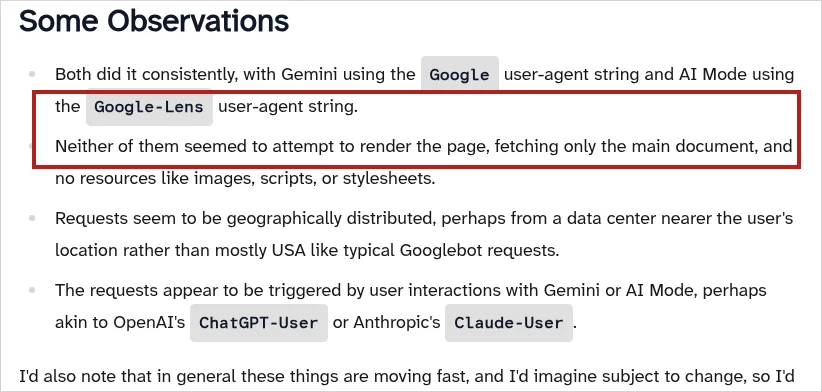
The requests "seem to be geographically distributed," in his words, perhaps from a data center nearer the user than typical Googlebot traffic. He also writes that they look triggered by a person, like OpenAI's ChatGPT-User or Anthropic's Claude-User.
His advice is to make sure you are not blocking them. He says one client's firewall "got spooked by the short nature of the Google user-agent string alone." He adds that these things are moving fast and may change.
What Google's page says
Google's page on user-triggered fetchers was last updated August 19, 2026. It describes nine fetchers, from the Chrome Web Store fetcher to Google Site Verifier, and Google and Google-Lens are not among them. The page says the list "is not exhaustive" and covers the requestors "more likely to show up in log files." It also says these fetchers "generally ignore robots.txt rules."
A robots.txt file does not settle what these fetchers read. I read it as a reason to look at server logs instead.
Where a redirect could catch them
Blocking is the obvious risk. Redirects are the quiet one. A poster on r/SEO, u/Ok-Motor-9812, described one site that sends pages to a local version by country. It skips any user agent containing bot, crawl or spider. Googlebot, bingbot, GPTBot and PerplexityBot all got a 200. Tested from Portugal, Perplexity-User, Google-InspectionTool and GoogleOther all got a 302 to another page.
That is one site and one post with a score of 2. It does show the mechanism. Google and Google-Lens carry none of the three words, and Smart says the requests may come from data centers near the user. If a fetch arrived from a country that gets redirected, the rule could send it elsewhere. That is my inference, not a result. Testing it takes a live AI Mode fetch from two countries against a site with a redirect.
Our own check sets the limits. On November 4, around 3 PM ET, we sent four user agent strings to the homepages of 30 large sites. They spanned news, retail, travel, health and software. Every request came from one data center IP, and we did not follow redirects. Twenty-eight sites were comparable.
Perplexity-User was refused on five where Chrome's string got a 200 or 302: CNN, BBC, The Guardian, Lowe's and Salesforce. Google and Google-Lens were never treated worse than Chrome's string. They got through on Zillow and Bloomberg, where Chrome's string was refused. We spoofed the strings from a non-Google IP. It tests user agent rules only, not how real Google addresses are treated.
Why the logs matter
Spoofing makes all of this harder to read. In an 18-day Cloudflare log posted on r/TechSEO by u/pournasserian, 113 requests named PerplexityBot and 75 named Googlebot without being verified. A string in a log is a claim. Smart checked IP ranges and reverse DNS before he believed his.
I would copy that habit. To audit how AI Mode sees a page, find out which fetcher asked, from where, and what status code came back. A visibility score on its own does not give you that.
The risk sits in redirect logic and custom firewall rules. The edge looked open. I would not rewrite anything on one blog post. I would add Google and Google-Lens to the strings I look for in a log, and I would check any rule that leans on the word bot.
Free newsletter
The Sherpa Brief
One email a week on what changed in AI search, what it means, and what to do about it. Written for marketers, SEOs, and publishers.
Free. Unsubscribe in one click.