If you sell online, a new Reddit test has a tidy rule for you. Give Google your collection pages and give ChatGPT your product pages.
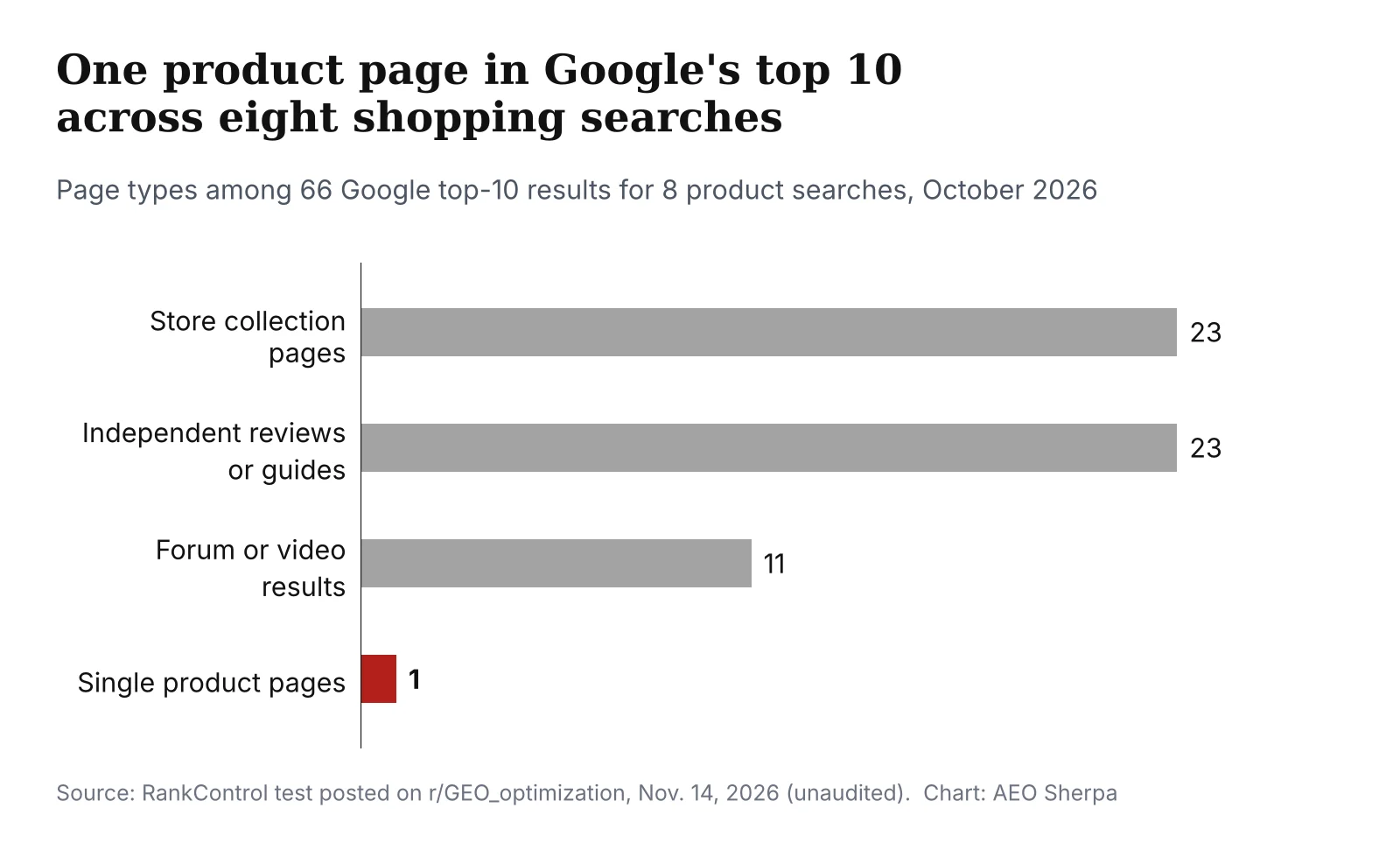
The test found one single product page among 66 Google top-10 results for eight product searches. ChatGPT cited 34 pages for its product questions, and 15 were product pages.
Wix's study of more than a million AI citations reports the reverse for shoppers still comparing options. I wouldn't rebuild a single collection page on 34 citations.
The account RankControl laid out the test on r/GEO_optimization on November 14, 2026.
It started in October with Google. RankControl pulled the top 10 results for eight common product searches and named a few as examples: stand mixer, hiking backpack 50l and dog food sensitive stomach. The 66 results broke down into 23 store collection pages, 23 independent reviews or guides, 11 forum or video results and one single product page.
Then it moved to ChatGPT. It asked 10 product questions in ChatGPT search, and eight of those runs went through OpenAI's API with web search turned on. The answers cited 34 pages. Of those, 24 were brand or store pages, 15 of them product pages, and only one was a collection page.
The search logs were the most interesting part. ChatGPT ran 43 searches across the eight runs, and 19 of them went straight to a single brand. In six of eight runs it added "2026" to its own searches without anyone asking for a year.
RankControl's conclusion was that a store needs to write for two audiences, with collection pages for Google and product pages with specs in plain text for ChatGPT. The post also warned readers to "take it as guidance not rate," since the questions differed and each one ran once.
The first reply offered a different reading. "I'd frame it as different page jobs rather than different audiences," wrote u/Lanesraforseo. "The collection page ranks for discovery in Google, the product page gets cited for confirmation in ChatGPT." That is an interpretation of the test, and nobody has measured it.
The bigger dataset says something else
Wix Studio's AI Search Lab published the largest public breakdown of cited page types in March 2026. Its researcher Tom Wells analyzed 75,000 AI answers and 1,056,727 citations from ChatGPT, Google AI Mode and Perplexity.
The prompts were nonbranded and sorted by intent across five industries, including ecommerce. Wix sells website and store builders, and the data was collected in Peec AI, an AI visibility platform where Wells works. Both have a commercial stake in this topic.
For commercial prompts, Wix reports that category pages took 12.42 percent of citations and product pages took 7.14 percent. Wix defines commercial as a shopper comparing options and reading reviews before deciding what to buy. Product pages beat category pages in every other intent Wix measured, and they lead outright once the shopper is ready to buy.
RankControl's examples sound like commercial questions, and that is where the conflict sits. The two studies are not matched. Wix pools three engines over a million citations, while RankControl tested one engine, mostly through the API, with 34 citations and a lot of brand-directed searches.
The same Wix table has a bigger winner than either page type. Listicles led commercial citations by a wide margin.
Wasim Kagzi, an SEO strategist writing for Search Engine Land, covered the Wix study on October 27, 2026. He noted that Wix "doesn't disclose its data collection window or explain how pages were classified into the different content types." He also cited DeltaV Digital, which tracked 21,075 AI responses and 25,337 citations and found category pages at 5.2 percent. Kagzi reports that DeltaV's brand panel left out ecommerce brands.
A backpack search came back different
The Google half of the test needs its own caveat. We checked Google US for "hiking backpack 50l" through SerpApi on November 14. It returned seven organic results. Walmart, Shein and Satsus showed single product pages, Amazon and Etsy showed listing pages, and YouTube and Facebook filled out the rest.
That is one query on one day, and it rebuts nothing. It does mean RankControl's one product page in 66 did not hold for this query when we looked.
Where I land
The ChatGPT half has a sampling gap. Most of the runs went through the API, and each question ran once. AI answers are probabilistic, and API answers often differ from what a shopper sees in the app. I would want each question run many times in the product people actually use before I called 15 of 34 a pattern.
In this sample, ChatGPT searched brands directly 19 times, and product pages made up most of the store pages it cited. My read is that it was confirming a shortlist, and a product page answers that kind of check. Both camps agree on the fix there. Keep price, specs and stock in plain text on the product page, where a crawler can read them.
What I would not do is strip collection pages to chase ChatGPT. Google ranks them for discovery, and Wix's data has them out-earning product pages on commercial prompts. All of this measures citations, though. A citation is a diagnostic. What pays a store is being the brand the answer recommends.
The listicle share is the part I'd think hardest about. For comparison shopping, the cited page is often somebody else's list. Getting onto those lists is the work.
My guess is that the question matters more than the engine, and Wix's own summary says intent predicted cited page types better than the model did. If that holds, a which-mixer-should-I-buy question pulls lists and a does-it-fit-my-shelf question pulls the product page. That is a test I'd like to see someone run properly.
Disclosure: my agency, ViewEngine, sells AI visibility work and builds its own tracking tools.
Free newsletter
The Sherpa Brief
One email a week on what changed in AI search, what it means, and what to do about it. Written for marketers, SEOs, and publishers.
Free. Unsubscribe in one click.