You've probably spent this month polishing your own Black Friday page. In AI answers, the furniture leader's gain this year came alongside somebody else's page.
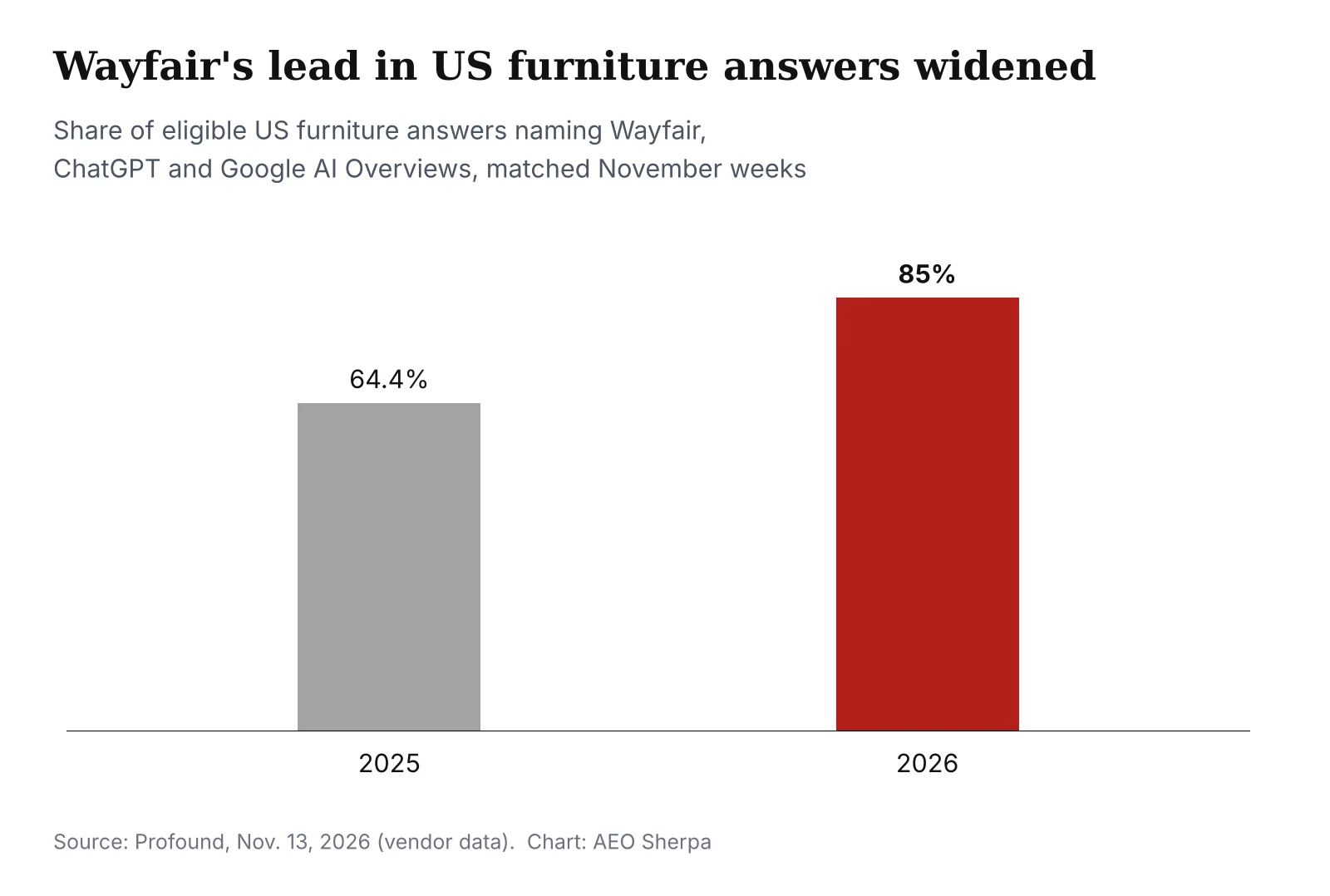
Wayfair appeared in 85.0 percent of eligible US furniture answers in Profound's 2026 comparison week, up from 64.4 percent a year earlier. That is from Profound's Black Friday in AI Search 2026 report, published November 13, 2026. The most-cited furniture page was a Forbes deals guide, and 90.9 percent of answers citing it also named Wayfair.
The citation went to Forbes. The mention went to Wayfair, and that is the number I track.
Profound, which sells AI visibility tracking, laid out the numbers in a report by researcher Davis McCain. Disclosure: my agency, ViewEngine, sells AI visibility work and builds its own tracking tools.
Profound says its main snapshot covers 279,741 AI responses across 25 retail categories in the US, UK, Germany and France. It ran from October 27 to November 9, 2026, on ChatGPT, Gemini, Google AI Mode and AI Overviews.
The year-over-year numbers are narrower. They use the same 1,250 US prompts on ChatGPT and AI Overviews only. The 2025 week ran November 4 to 10 with 18,043 responses, and the 2026 week ran November 3 to 9 with 17,500. Profound defines visibility as the share of eligible brand-naming answers that mention a brand.
The report shows two ways onto the AI shortlist. AT&T took the first one, through its own site. Its visibility in US phone answers grew 645 percent year over year, moving it from 14th to sixth, while Boost Mobile fell 82 percent and OnePlus fell 76 percent.
AT&T's Black Friday hub was cited in 11.7 percent of monitored answers, up from 0.7 percent last year. McCain points to a page that puts named offers, monthly prices, trade-in requirements and store availability in one place. "The takeaway: put the conditions beside the headline offer and answer the questions that determine whether someone can buy," he writes.
Ulta and Chewy show what that route looks like when it holds. Both kept first place in their US categories, Ulta moving from 84.1 percent to 85.4 percent and Chewy from 78.8 percent to 87.1 percent. Both kept their Black Friday hubs at the same URLs both years.
Wayfair took the other road
Wayfair already led US furniture a year ago. This year its lead widened while Macy's visibility fell 53 percent and Kohl's fell 77 percent.
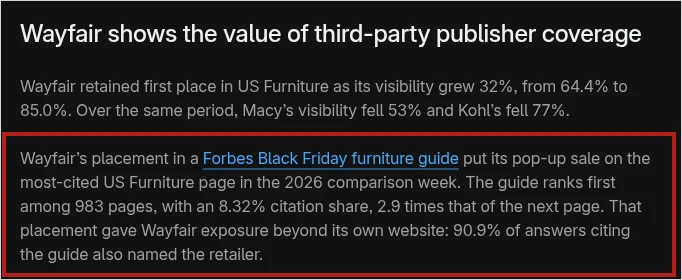
The page that carried Wayfair's name most was not on wayfair.com. A Forbes Black Friday furniture guide ranked first among 983 cited US furniture pages, with an 8.32 percent citation share, 2.9 times the next page. "Wayfair's placement in a Forbes Black Friday furniture guide put its pop-up sale on the most-cited US Furniture page in the 2026 comparison week," McCain writes.
His advice is to "pitch your Black Friday offers to well-known publishers AI is citing in your category."
The data shows the guide and the gain moving together. It does not show the guide caused the gain. My guess is it works both ways, because a brand that already leads a category is an easy pick for a deals editor.
Black Friday falls on November 27. Profound says a Times Union sale calendar was first cited on its publication date, October 28, 2026, and went on to become the second-ranked page across all four markets. Profound's earlier guide with VaynerX put the median gap between publication and first citation at 6.8 days. Late entry can happen. Nobody can promise it will happen for you.
A mention is still only the start of a purchase. Kevin Indig of Growth Memo posted on X that "As much as software buyers use AI to discover and evaluate products, over 70% still visit vendor websites." His post covers software buyers, not shoppers, and does not give the survey behind it.
Agents are a separate question. HUMAN Security's October agent report counts requests from AI agents across the sites HUMAN protects, not people. It says "Agents still browse far more than they buy." HUMAN puts 85.2 percent of agent requests on product and search pages and 1.9 percent on checkout and payment, though checkout volume grew 117 percent in a month.
Why I'd chase the mention
This report makes a clear retail case for tracking mentions over citations. If you only counted citations to wayfair.com, you would never see the Forbes page. Citation analysis is what found the Forbes page.
Your website is no longer the whole picture. AI answers draw on everything they can find about your brand across the web. AT&T's numbers suggest an owned page still pulls its weight when it answers the buyer's questions, though Profound's data can't isolate which part of the page did it.
With under two weeks to go, I'd check which publisher guides AI already cites in my category and whether my real prices and conditions are in them. If I can get an editor's attention in time, that's where I'd spend it. Forbes gets the citation. I'll take the mention.
Free newsletter
The Sherpa Brief
One email a week on what changed in AI search, what it means, and what to do about it. Written for marketers, SEOs, and publishers.
Free. Unsubscribe in one click.