
You have spent a year checking whether ChatGPT cites your pages. An agent with a specific question for your site is a harder test, and a vendor's first numbers show how often that test ends in nothing.
LightSite AI says 43% of the requests agents sent through its WebMCP tools ended with no recorded result or link. The other 57% returned business information, matching results or a relevant page. That is data from LightSite's own client sites and no portrait of the web.
Cloudflare CEO Matthew Prince has just called helping sites win agent traffic "sort of the new version of SEO." My read: that new SEO needs a metric of its own, and a citation count is not it.
LightSite AI posted the numbers on r/TechSEO on November 8. About three to four weeks earlier, it said, it had rolled out WebMCP tools across its client base and begun logging what agents ask websites and whether the sites can answer.
The questions are narrow. Agents asked "Do you have an office in Spokane?" and "How far in advance can I book?" They also hunted for a specific car part or a clothing item that met certain requirements. LightSite's post describes each as an agent looking for one answer on behalf of a user.
LightSite added caveats. It wrote that a missing result "doesn't necessarily mean the information wasn't somewhere on the site." In some cases, it added, the agent was simply blocked from the site by a technical block. A request with no recorded result could also mean the logging missed something, though the post does not say. The data covers only sites on LightSite's infrastructure, and the post gives no request count.
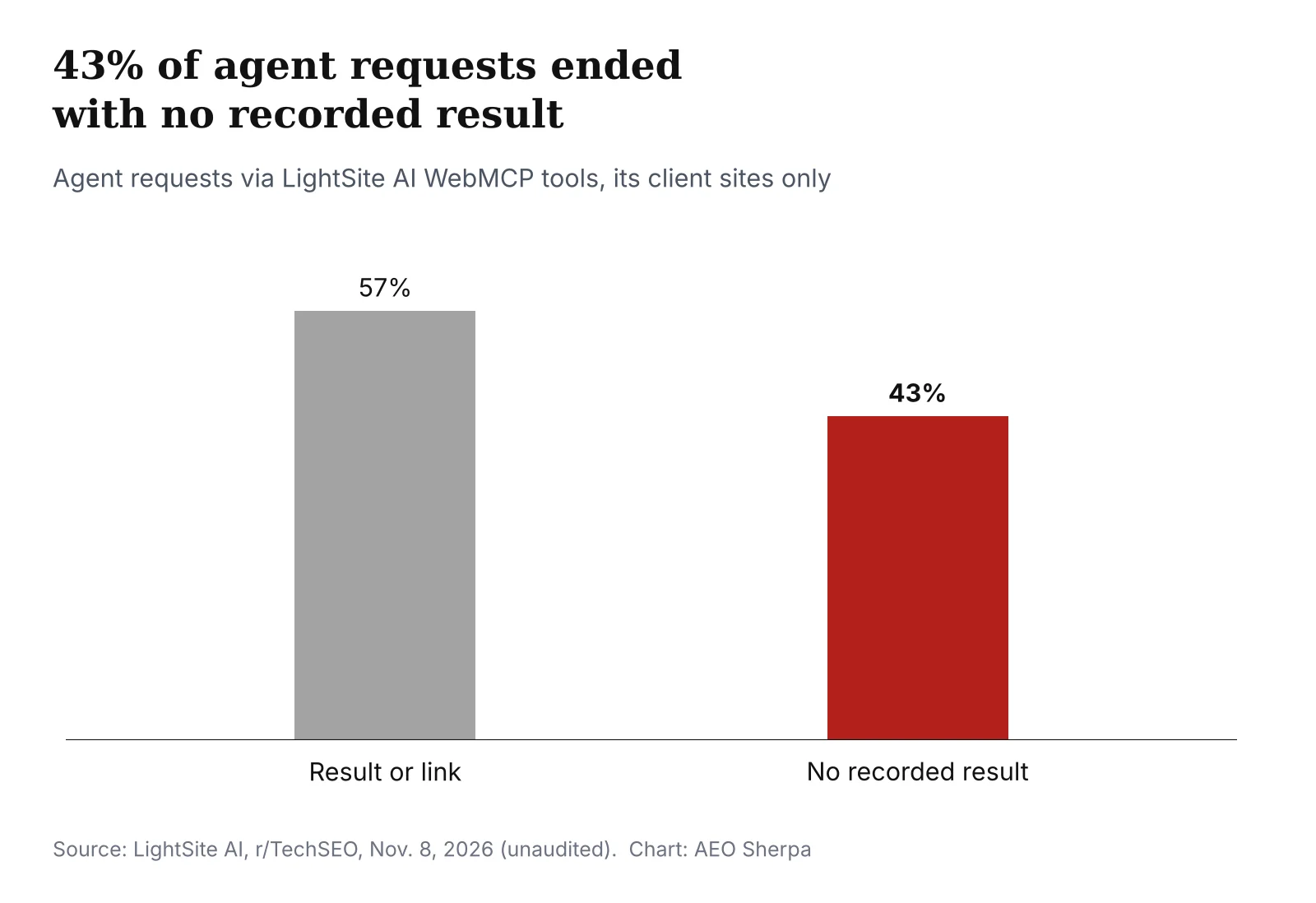
One commenter pushed on the same point. The user ArfadiaOfficial replied that the 43% seems to pool three different failures. The agent was blocked, or the agent reached the site and got nothing usable back, or the information was never on the site. Each calls for a different fix, the commenter wrote, and one blended rate cannot say which to work on.
The same weekend, Search Engine Journal reported on Cloudflare's third-quarter call. Prince, the company's co-founder and CEO, said Cloudflare is helping customers who want more agent traffic with what he called "sort of the new version of SEO." Cloudflare reported revenue of $782.5 million that quarter, up 39% from a year earlier.
Prince also split his customers in two. Some want as many agents as possible, he said, and "others see them as a bane to their business and want to keep them away." The Journal's Matt Southern noted that Prince did not name a Cloudflare service for optimizing a site for agents.
Not everyone thinks this is new. Rob Miles replied in a thread on X on November 8 that "The funny thing is, if you'd designed your website properly to work well on older devices and for disabled people using screen readers, it would have already been "AI agent ready" from the start." It is a reply to a post I did not read. I treat it as a view. It does fit the walls problem, though.
Walls are a real part of this story, and a second dataset shows how big. On November 7, Guillermo Flor posted on X that Scope had run 1,035 agent sessions against 18 hosted databases. The job was to sign up, create a database, write a record and hand back credentials. Only 16.6% finished. CAPTCHAs killed 373 sessions and bot blocks killed 105 more.
This is a different task on different sites, and I would not stack it against LightSite's 43%. I also have Scope's numbers only through Flor's post. His read of them is plain enough: "If an agent already knows it wants your product and still can't become a user, that is not a model problem. That is a signup problem."
For an agent to help a customer, the information has to exist, the agent has to reach it, retrieve it and get a usable answer back. A citation tracker sees none of the last three steps. A site can hold the right facts and still lose the customer at any of them.
So I would want the 43% split before anyone tries to improve it. Blocked requests, requests that reached the site and returned nothing, and pages that never held the answer are three possible causes. The data here does not tell me how big each one is, and LightSite has not supplied that breakdown.
Disclosure: AEO Sherpa runs on Cloudflare's EmDash CMS. My agency, ViewEngine, sells AI visibility work and builds its own tracking tools.
My guess is that the most useful agent metric will be two numbers read together. One is the share of requests that never got in, which is an access problem. The other is the share of requests that got in and still returned no usable answer, which is a content problem. Reporting only the second would let a site with aggressive bot protection look healthy, and a blended rate would hide where the customer was lost.
Free newsletter
The Sherpa Brief
One email a week on what changed in AI search, what it means, and what to do about it. Written for marketers, SEOs, and publishers.
Free. Unsubscribe in one click.