
You have been counting how often ChatGPT cites your brand. Start counting what sits under the answer too.
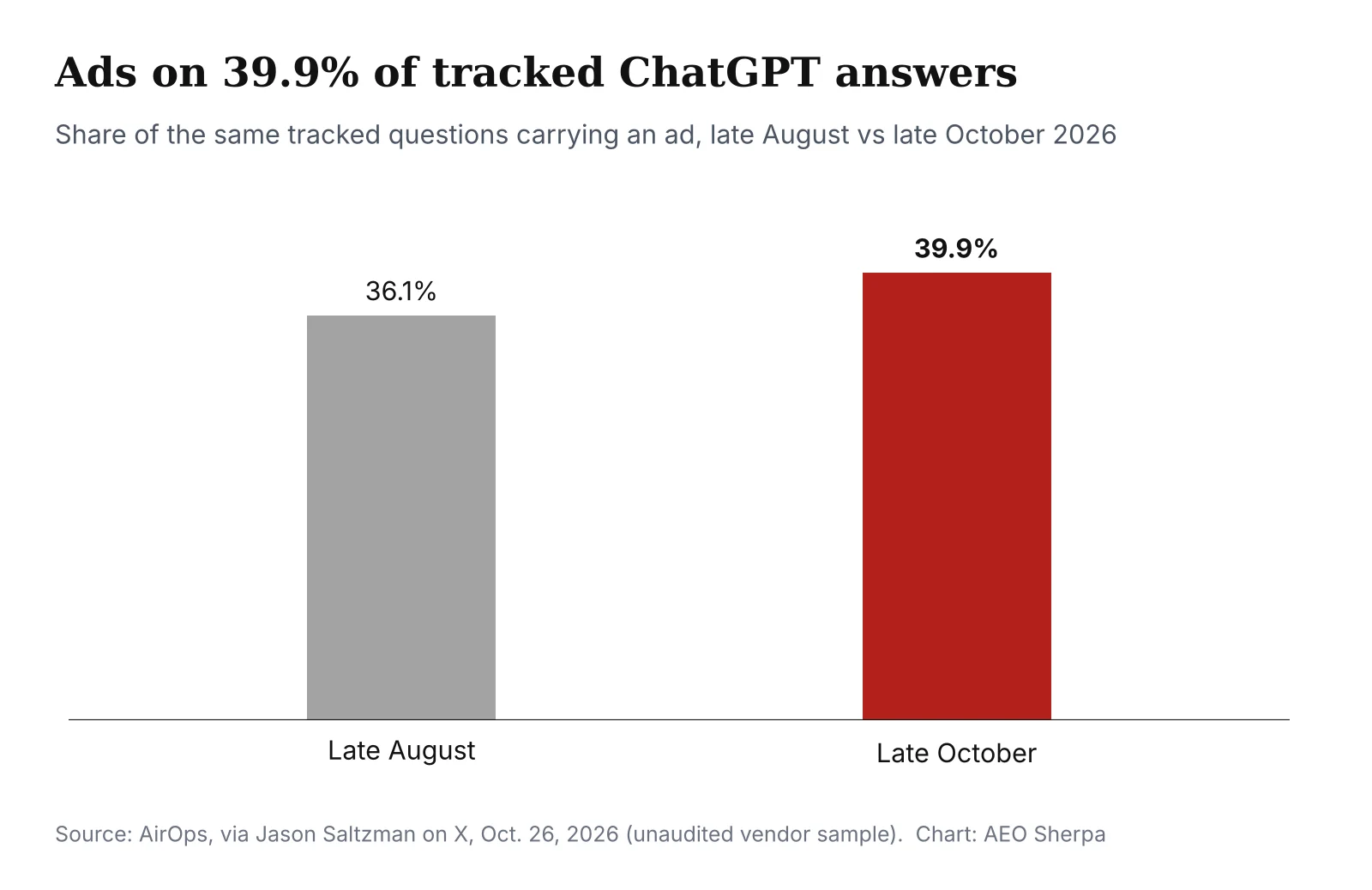
AirOps, a vendor whose platform covers ChatGPT ads, says the share of its tracked ChatGPT questions that carry an ad rose from 36.1 percent in late August to 39.9 percent in late October. Distinct advertisers per question rose from 1.82 to 2.14, and about half of ad-carrying answers now show two or more advertisers.
On the prompts where ads appear, a citation now shares the screen with a rival's paid card. That is my read. The sample is AirOps's, and it is a vendor sample.
Jason Saltzman of AirOps posted the figures on X on October 26, 2026, the same day AirOps launched a free ChatGPT Ads Library. His post says the numbers cover the same questions tracked in both periods. It does not give a prompt count.
The backdrop is OpenAI's rollout. On October 21, 2026, OpenAI said it was bringing ChatGPT Ads to 26 more countries, for 89 in total. It also said more than 100,000 advertisers have run campaigns since ads launched just over eight months ago. Ads appear only on the Free and Go plans. Plus, Pro and Enterprise stay ad-free.
OpenAI describes the ads as clearly labeled and separate from answers, and says "advertising does not influence the answers ChatGPT provides." OpenAI's figures cover where ads can run. AirOps is trying to measure how often they do.
Saltzman's other findings point the same way. He says B2C sectors see more ads and more advertisers than B2B, and that the gap between commercial and informational prompts roughly doubled over three months. He summed it up this way: "Ads are an increasing part of who shows up in and around AI answers."
The library makes it inspectable
The library lets you search a brand or domain and see the ads AirOps has observed. Its page lists 6,284 brands as of October 28, ranked by seven-day activity, and Expedia ranks first. On its Expedia page, AirOps reports 549 ads seen and 503 running now. The ads listed there mostly end on the same line, "Find & Compare Deals and You Can Save Big." That is one advertiser, and I would not generalize it to how big brands write for ChatGPT.
AirOps lists its own limits. The ads "come from an AirOps research workspace that tracks sample prompts across industries," all prompts run in the US, and the data is a sample, not the full picture. The page also sits above a pitch for the AirOps platform.
Whether the ads pay is a separate question, and the evidence is thin. Jony Volk, an X user posting on October 27 about traffic from ChatGPT ads, wrote: "Why is your ad platform sending almost entirely bot traffic? 65% of visitors left in 0 seconds. 17% stayed longer than 2 seconds." That is one advertiser's account. AirOps's page says OpenAI publishes no performance benchmarks.
What I make of it
I think of citations as diagnostics. They show where you can change what the AI says, and recommendations, branded search and leads are the outcomes. An ad beside the answer is a different surface, and it competes for the same buyer in the same moment.
I would stop treating paid and organic AI visibility as separate reports. On the commercial prompts where ads show up, check who sits next to your citation, and use the library for the US prompts it covers. Nothing in the AirOps data shows what that neighbor costs you in clicks or sales, and a citation count does not either.
I built one of the first share-of-voice tracking platforms for ChatGPT, Perplexity and Google AI. I know how much the choice of prompts can move a headline number, and that is why I read 39.9 percent as a direction, not a rate. The direction is clear enough to act on: measure what ranks and what is paid, and keep them apart.
Disclosure: my agency, ViewEngine, sells AI visibility work and builds its own tracking tools.
Free newsletter
The Sherpa Brief
One email a week on what changed in AI search, what it means, and what to do about it. Written for marketers, SEOs, and publishers.
Free. Unsubscribe in one click.