
You've probably treated the phrases in a Bing report as searches people ran. Bing says they aren't. The Grounding Queries tab shows "a short phrase" grouped from what its AI retrieved and cited, and the phrases "are not full user questions or prompts."
Two site owners exported that tab in late October 2026, and the rows look odd. One export put 75 of 484 citations on the phrase "searchable ai mode tracking separate surface". The other found that six of nine phrases drew four or fewer Google impressions on that site in six months, yet carried 31 percent of its citations.
My read is that these phrases are clues about the question an engine was answering, and clues are all they are.
Mert Erkal got there first. On October 22, 2026, the founder of the SEO and GEO consultancy Stradiji posted on X that six of the nine grounding queries Bing showed for his site had four or fewer Google impressions in six months. His newsletter says he matched the Bing phrases against six months of his own Search Console query data for the site. Nobody types phrases like "citation optimization meaning techniques" into Google, he wrote, but an AI may search for them while it builds an answer. That second part is his interpretation, not something the report measures.
A site owner who posts as Sanbi_Ai followed on r/TechSEO on October 23 with an export dated October 18. It held 20 grounding queries behind 484 citations. The median phrase ran five words, and eight of the 20 did not start with how, what, best, free, top or Google. Grouped by the idea behind them, best-of lists took 35 percent of citations and the AI Mode question took 34 percent. Of the top phrase, Sanbi_Ai wrote "Nobody types that."
The scope is wider than the word Copilot suggests. Per Bing, the report covers Microsoft Copilot, AI summaries in Bing and "select partner AI integrations," and "the data shown represents a sample of overall citation activity."
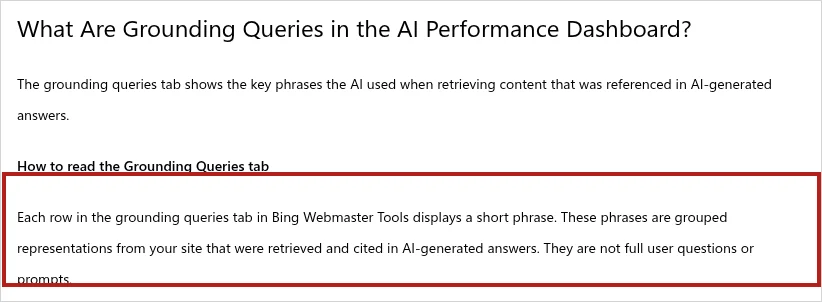
Neither export says which of those surfaces produced its citations. Sanbi_Ai notes the export records neither the date window nor the cited page, and Erkal's nine queries come from a single site. Read both as illustrations of what the rows look like.
The disagreement starts with what to do next. Sanbi_Ai says repeating these phrases gets you nowhere, and what seems to work is "giving each implied sub-question its own heading, with the answer in the first sentence." The commenter u/marintkael agrees on the repetition but doubts the payoff. One of the phrases was French, the comment says, and it still matched an English page, which marintkael reads as matching that "runs on meaning, not words." Guessing at grounding phrases, the comment concludes, "buys less than this report suggests." Sarang Shahane, founding director of BuzzIQ Labs, wrote on October 21 that these phrases are retrieval phrases and not search demand, and that sites should not chase them as keywords.
Disclosure: my agency, ViewEngine, sells AI visibility work and builds its own tracking tools.
Citations are a diagnostic, and a grounding phrase is a diagnostic about a diagnostic. It shows which question an engine was working on when it reached your page, which is useful for the same reason a crawl log is useful. It says nothing yet about whether answering that question differently would win more citations, let alone more recommendations or sales. My guess is that the cited pages already answer the underlying question, whatever string Bing shows, and that rewriting headings to echo a phrase would add nothing. I would still read the list, because a phrase you cannot connect to any page you wrote is a question worth asking about your own site.
Free newsletter
The Sherpa Brief
One email a week on what changed in AI search, what it means, and what to do about it. Written for marketers, SEOs, and publishers.
Free. Unsubscribe in one click.