
If you track rankings, you have probably wondered what a searcher sees once they switch AI answers off. Bing says adding -ai to a query removes its AI answers. In our check, the organic links barely moved. One Bing query returned the same 10 URLs in the same order, and a second kept 9 of 10.
On Google, the same trick removed the AI Overview on the query we tested and swapped the links too. None of the top 6 organic URLs from the normal search showed up in the -ai version.
My read: on Bing, -ai acted like a display setting. On Google it acted like a different query, which makes it a poor stand-in for what ranks without AI.
Microsoft laid out both options in a Bing blog post on November 11, 2026, and SEOs spent the evening arguing about what the operator really does.
The feature itself is older. Search Engine Roundtable covered it on June 8 after Jordi Ribas, who leads search at Microsoft, posted that "We just shipped a preview extension in Bing that lets you toggle AI chat-like features on or off with just one click." That extension runs in Chrome and Edge. The other route needs no install at all. You add -ai to any Bing query.
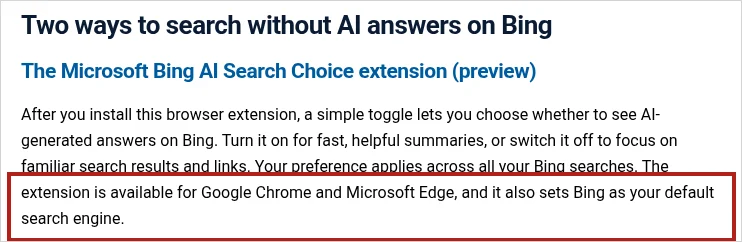
The November post repeats the offer with one line worth reading twice: "The extension is available for Google Chrome and Microsoft Edge, and it also sets Bing as your default search engine." PPC Land led its story with that catch. Microsoft cites its own research, saying "our research shows users want to have the option to choose whether or not AI is involved in every session." The post gives no numbers for that research or for how many people use the extension.
The reaction turned on one question
Glenn Gabe, an SEO consultant at GSQi, flagged the post on X. "Bing is letting users turn off AI answers via a Chrome extension or by using the -ai operator. They are listening. :)" he wrote. Ribas followed with a post of his own: "We enabled these features because we believe everyone deserves a search experience that works for them, including the choice to decide how and when they use AI."
Lily Ray, also an SEO consultant, read it as a jab at Google. "It's funny how everything that has to be so dramatic with Google is so simple with other companies," she posted. Barry Schwartz of Search Engine Roundtable was less impressed. "yea, not sure why they announced this again, this is kinda old," he replied.
Schwartz also asked the question that matters to anyone who ranks pages. He wrote that it was "hard to tell if -ai is a feature or messing with the query," and tagged Google's Rajan Patel to ask whether Google supports the operator. Gabe answered that "several tests in Google yielded the removal of AI."
What the operator did to the links
We ran paired searches with and without -ai through SerpApi, US desktop, on the morning of Nov. 12: two queries on Bing and a different one on Google. On Bing, why is the sky blue returned the same 10 organic URLs in the same order both ways. The query best crm for small business kept 9 of its 10.
Google behaved differently on the one query we ran there, how to remove rust from cast iron. The AI Overview showed without -ai and disappeared with it. The links changed as well. None of the top 6 organic URLs from the normal search appeared in the -ai results, and Google's reported result count fell from 192 to 78.
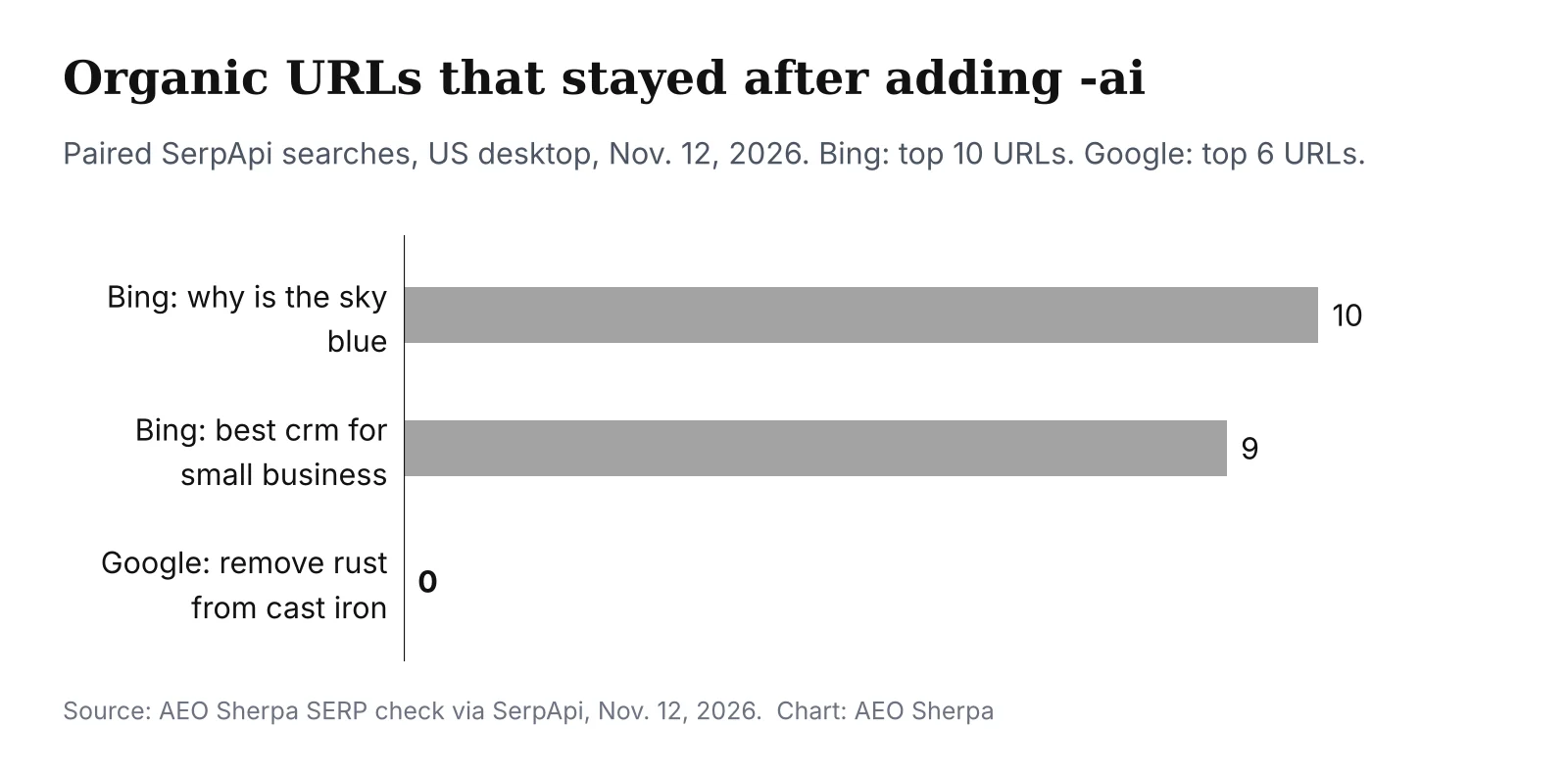
That is two Bing queries and one Google query. It does not settle how Google treats -ai everywhere. For that one search, adding -ai hid the AI Overview and changed which pages came back.
Two switches that only look alike
On Bing, a searcher who used -ai in our sample saw the ranking the page had already earned. That is good news for publishers, though it only matters if people use it, and Bing's post gives no adoption numbers. I read the default-search requirement as Microsoft using the switch to win Chrome users as much as to serve them.
On Google, my guess is that -ai works the way a minus sign has always worked in search. It excludes a term, and the engine runs a narrower query that happens to skip the AI Overview. Gabe's tests and ours agree the Overview goes away. In ours, the top links went with it. Until Google explains how the operator works, the mechanism stays my guess.
A Google -ai results page is a different search. Hold it up against your normal rank tracking and you are comparing two queries. From it you learn little about what you would rank for without AI. Disclosure: my agency, ViewEngine, sells AI visibility work and builds its own tracking tools.
I would like Google to say plainly what -ai does. Until it does, I will treat a Google -ai page as its own search and keep it out of any rankings comparison.
Free newsletter
The Sherpa Brief
One email a week on what changed in AI search, what it means, and what to do about it. Written for marketers, SEOs, and publishers.
Free. Unsubscribe in one click.