
You are about to spend two weeks explaining moving rankings and shifting AI answers to your boss or your clients. Google gave you two suspects within hours.
On November 10, 2026, Google put its new Gemini 4 Carbon model into AI Mode, but only for paying Google AI Ultra subscribers. That afternoon it logged the November 2026 core update, which applies globally and to all languages and may take up to two weeks to roll out.
My read: if your tracker searches logged out, Carbon is not why its numbers move. The core update, the ads and plain noise are the suspects worth checking.
The mix-up started on X before lunch, and it is worth following in order.
Robby Stein, Google's VP of product for Search, announced the model at 11:26 AM ET: "Shipping Gemini 4 Carbon in Search today for Google AI Ultra subs." Google's own launch post draws the same line for everyday users: "Try Carbon starting today in the Gemini app and AI Mode in Search if you're a Google AI Ultra subscriber."
Marie Haynes, of Marie Haynes Consulting, expected a ranking shake-up. Two minutes after Stein, Haynes posted that it "is better at understanding user intent" and would "likely feel like an algo update."
SEO consultant Gagan Ghotra pointed out in a reply that the launch was limited to Ultra. Haynes changed her call at 12:39 PM ET. Carbon "is only for ultra users in AI Mode," she wrote, and "won't feel so much like an algo update just yet."
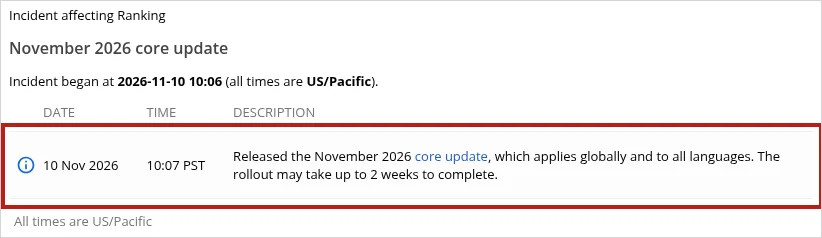
Then the real update landed. Google's Search Status Dashboard logged it at 10:07 AM PST, 1:07 PM ET, with one line: "Released the November 2026 core update, which applies globally and to all languages. The rollout may take up to 2 weeks to complete."
The reactions came fast. Glenn Gabe of G-Squared Interactive predicted that "all signs point to a powerful one." Malte Landwehr went straight to the AI side, saying he would "keep my eyes open for a potential impact on AI Overviews." Nobody had posted AI Overview data yet.
Why a logged-out tracker can't see Carbon
Carbon sits behind Google's most expensive consumer plan. PPC Land reports that Ultra starts at $99.99 a month. It also reports that the previous model, Gemini 4 Argon, reached AI Mode for both Pro and Ultra subscribers on October 13. Carbon got the narrower door.
A logged-out search cannot reach an Ultra-only model. Unless your rank tracker, SERP API or AI visibility tool signs in with an Ultra account, it will not record a single Carbon answer during this rollout.
That leaves other suspects when your logged-out sources shift. The first is the core update itself.
The second is ads. Search Engine Journal reports that Google announced the change on November 9. Ads in AI Mode are expanding to more than 10 countries in English. Separately, multiturn ads, which can appear on follow-up questions, are launching in the U.S. only.
The third is noise. In October, the rank-tracking vendor DemandSphere said Google returned spurious results on about 11% of its daily rank checks, PPC Land reported. Nozzle, another tracking vendor, counted 8.0% of results pages as poisoned. PPC Land notes that neither disclosed its full method.
Two caveats from the day's replies are fair. A reply to Haynes argued that a model which reads intent better may change which sources get pulled on the second and third turn, and trackers that only record the opening query would miss that. And if someone on your team pays for Ultra and sees AI Mode answer differently, Carbon is a possible cause. A logged-out tracker cannot confirm or rule it out, because it measures a different audience.
The calendar makes this harder
PPC Land counts this as Google's third core update of 2026, after March and May, which ran 12 days, 4 hours and 11 days, 21 hours. If November uses its full two weeks, it ends November 24.
Google's core update documentation, as PPC Land summarizes it, tells site owners to wait at least a full week after a rollout finishes before comparing Search Console data. PPC Land worked out what that means here: a clean week of post-update data would not exist until December 1, the day after Cyber Monday.
So any shift you report in the run-up to Black Friday could come from the update, the ads, tracker noise or ordinary churn. I would treat each as a candidate to rule out. Annotate both November 10 events in Search Console and GA4. Then baseline a fixed set of queries, logged out, with repeated runs, and call it what it is: a mid-rollout snapshot, not a clean before picture.
This is the same rule I apply to every AI visibility swing. Diagnose before you prescribe, and try to prove your favorite explanation wrong first. A single AI answer is noise anyway. You need many runs of many prompts before a shift means anything.
Disclosure: my agency, ViewEngine, sells AI visibility work and builds its own tracking tools.
My guess is the first "Carbon changed AI Mode" screenshots will show up before the rollout ends. Before you believe one, ask whether the person who took it pays for Ultra.
Free newsletter
The Sherpa Brief
One email a week on what changed in AI search, what it means, and what to do about it. Written for marketers, SEOs, and publishers.
Free. Unsubscribe in one click.