You have probably been told to stop publishing listicles by now. Your CMO just heard the same from Google.
The November 19, 2026 post lists three moves: stop chasing keywords, stop the Top 10 listicle, stop trusting proxy scores. The post points to an October guide credited to Brendon Kraham, VP Search and Commerce Global Ads Solutions: shoppers using AI search visit 12 touchpoints, nearly three times as many as non-AI journeys. Google's post adds that queries run 3x longer.
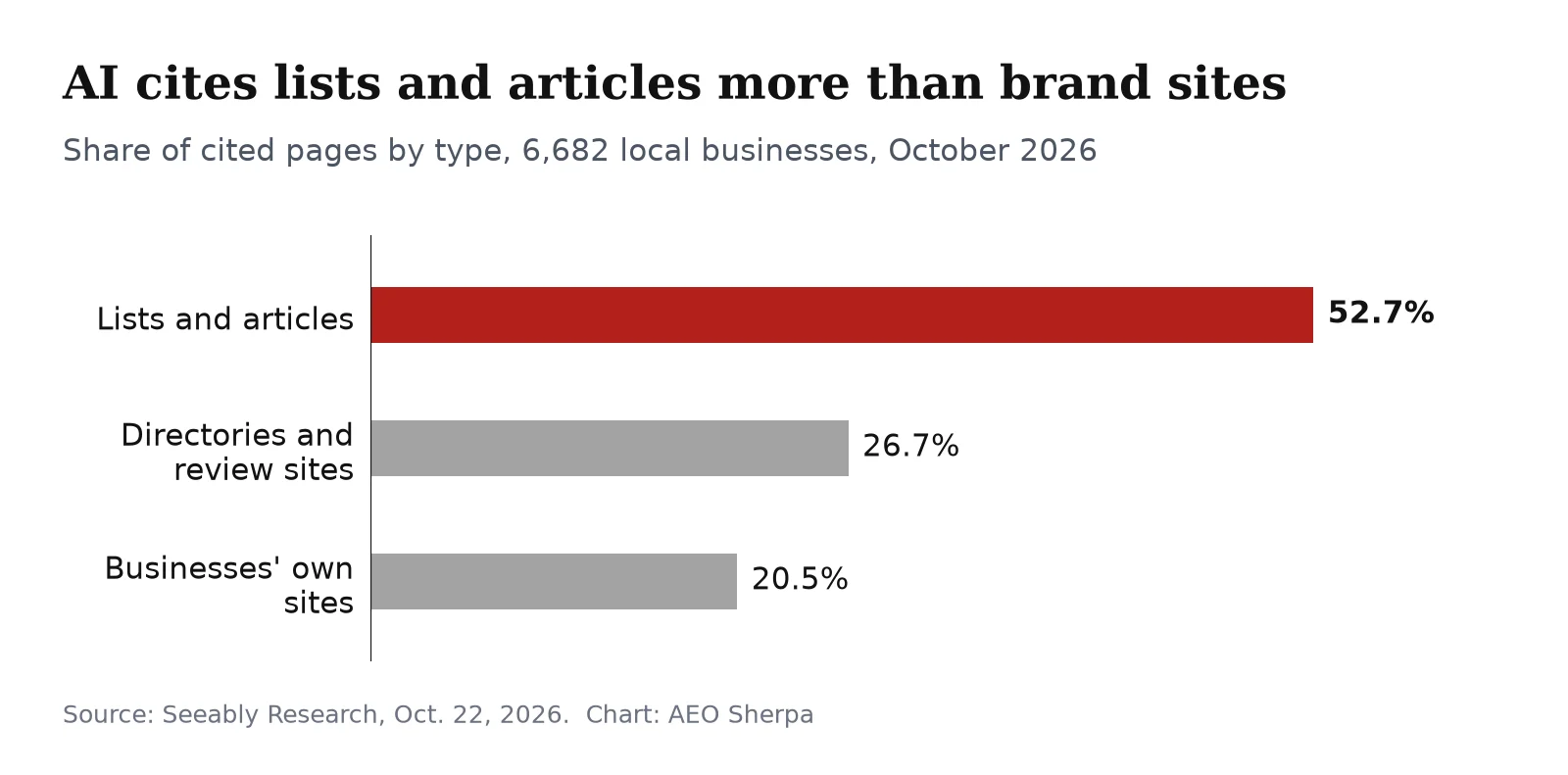
But lists and articles together draw 52.7 percent of AI citations in Seeably's October 2026 study of local businesses. My read: Google is right about generic listicles and wrong about lists.
Kraham laid out the case in October. Think with Google reposted it November 19 with a sharper frame.
The guide is an October piece making the brand-authority case to CMOs. Kraham writes: "People using AI search visit 12 touchpoints across their buying process, nearly 3X more than in non-AI journeys." His running-store example carries the substance of the advice: swap a generic Top 10 Things to Consider for a deep-dive video on why one customer's running shoes collapsed. The target is a thin roundup anyone could have written.
Think with Google recirculated it on November 19 with a sharper frame. "AI didn’t make your brand invisible in Search." The post lists the three moves for CMOs: answer conversations instead of chasing keywords, lead with first-hand expertise instead of the Top 10 listicle, measure real outcomes instead of trusting proxy scores.
Lily Ray picked it up the next morning. "Wow did Google really just tell CMOs to stop with the top 10 listicles? H/t @gfiorelli1" wrote Ray, an SEO expert, on X. Her post and Google's show 104 and 109 likes respectively as of November 20, 2026, with 25 and 24 replies.
The replies brought receipts
Publishers answered with their own evidence. Recipe publisher Inspired Taste said: "Google is lying with full Frankenstein recipes AIOs by using our brand name on mangled versions of our recipes." The example was a branded search for its own brand. It says NYT Cooking gets the same treatment.
SEOs went after the third move. Joe Youngblood, an SEO replying on X, leveled the thread's sharpest complaint: Google hands out only per-page impression data, with no prompt data and no click data. The guide points to newer Search Console reports for visual queries, social and video performance, and generative AI traffic. Those show visibility, not outcomes. An outcome is a recommendation or a lead.
A minority agreed with Google but asked it to tell its other departments, since search behavior rewards what the guide condemns. Orit Mutznik said the points make sense but the Gemini images distract. Sam Shev asked Google to repost the advice as a Top 10 listicle.
Then there is what AI actually cites. Seeably's October 2026 study covered 6,682 local businesses across 25 markets, each one industry in one city. Lists and articles together drew 52.7 percent of citations, directories and review sites 26.7 percent, and the businesses' own sites 20.5 percent. Seeably asked ChatGPT, Gemini, Claude and Perplexity the questions customers typically ask in each market, and it sells the same scans to agencies. Yelp was the single most cited site, named in one answer in five. It is an October snapshot of five industries in five cities. Read it as a slice, not the whole web.
I think Google has the right villain and the wrong charge. A generic Top 10 carries no facts about what makes anything different. Of course it fails. But the study counts citations, not recommendations, and a citation is not a recommendation. My argument: kill the generic roundup, but not the list. The page worth citing beats the page worth skipping, whatever shape it takes.
My guess is the CMOs who follow this advice literally will stop publishing the pages AI would have read, while competitors take their slots on everyone else's lists. Write the listicle that deserves the citation, or get on somebody else's.
Free newsletter
The Sherpa Brief
One email a week on what changed in AI search, what it means, and what to do about it. Written for marketers, SEOs, and publishers.
Free. Unsubscribe in one click.