
You've been told that OpenAI's bots fetch HTML and never run JavaScript, which would leave any site built in the browser invisible to ChatGPT.
Genezio, which sells an AI visibility platform, says its logs show otherwise. Its CTO reports that OpenAI's search crawler, OAI-SearchBot, loaded one of its pages and ran the JavaScript, then called back to a hidden endpoint from an IP inside OpenAI's published crawler ranges.
A second test published the same day looked at a different job. It asked ChatGPT and other tools to read a page they were handed, and most saw only the HTML. My read is that the two tests measured different OpenAI bots, and how often the search crawler renders is still unknown.
Genezio's Bogdan Vlad laid out the evidence in a research post on October 22, 2026.
It started with a puzzle. Several Genezio clients run sites rendered entirely in the browser, where the server sends an almost empty HTML shell. Genezio says ChatGPT was still citing those pages and quoting details that exist only after the JavaScript runs.
Genezio went to its own CDN logs. Alongside the page requests from OpenAI's crawler, it found valid Next.js prefetch requests, which Genezio reads as a sign the page's JavaScript was running. It then built a stronger test.
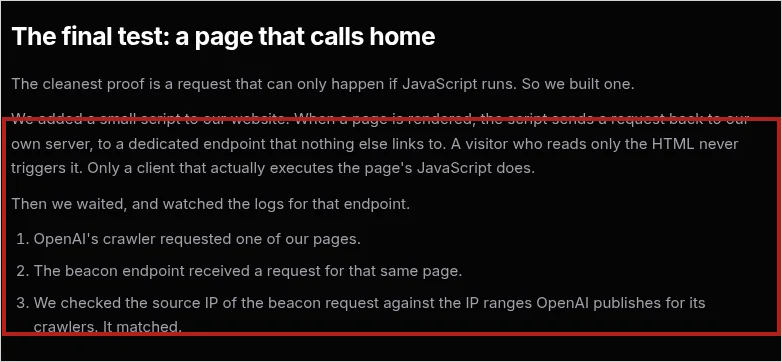
Vlad added a script that sends a request to a dedicated endpoint nothing else links to. A visitor who reads only the HTML never triggers it. OpenAI's crawler requested a page, the beacon endpoint then received a request for that same page, and the source IP matched the ranges OpenAI publishes for its crawlers. "That request could not have come from reading HTML," Vlad wrote.
The post states its own limit: "We can't say what share of JS-rendered pages actually get rendered and cited," Genezio wrote. Vlad also said on X that ClaudeBot downloaded the script but never ran it, and that PerplexityBot fetched only HTML. The post does not say whether the beacon request itself carried the OAI-SearchBot user agent. Genezio ties it to OpenAI by IP range.
The same day, TranX, another AI search vendor, published a test that points the other way. It invented a company with five product pages. Each page carried three made-up facts, a town, a mascot name and a price, delivered five different ways, from plain HTML to a JavaScript file to a Next.js page.
On October 21 and 22, TranX gave each page's address to the ChatGPT, Claude and Gemini apps. It also tried OpenAI's gpt-4.1-mini with web search and Anthropic's claude-sonnet-5 with web fetch. It asked each tool to list every fact the page states. TranX ran one try per page per app, and results can shift with the model.
On the pages where the facts lived only in JavaScript, TranX says four of the five tools saw nothing. In TranX's server logs, ChatGPT-User, Claude-User and Google's fetcher each requested the page and never asked for the JavaScript. The ChatGPT app, running GPT-6.1 Sol, was the exception. TranX's logs show it fetched an empty shell, then came back twelve seconds later from an address block registered to OpenAI and downloaded the JavaScript file.
Blake Wu of TranX wrote that this is not something to lean on. "That's clever, and you shouldn't build on it. It happened in one app, after we explicitly asked it to read the page. ChatGPT's ordinary page fetcher, the one its search uses, did not do it," Wu wrote.
Glenn Gabe, an SEO consultant at G-Squared Interactive, had landed in a similar place days earlier. After his retest he wrote on X on October 19, 2026 that "ChatGPT, Claude, and Perplexity all choked on JavaScript-based content while Gemini and Copilot did well."
A commenter on r/TechSEO, u/marintkael, pointed to the distinction behind the split. TranX tested the live fetch, where someone hands the model a URL. That is a different job from crawling pages into the index an assistant searches later. OpenAI uses different user agents for the two, ChatGPT-User and OAI-SearchBot.
That explanation fits the test designs, but it is not proof. Genezio's beacon is tied to OpenAI by IP range, and TranX describes the fetcher its search uses as one that did not run JavaScript. Whether those are the same pipeline is not something either post settles.
Disclosure: my agency, ViewEngine, sells AI visibility work and builds its own tracking tools, and both Genezio and TranX sell in the same market.
My read is that the advice has not moved. Put the facts you want quoted in the HTML your server sends. What has changed is the reason. A JavaScript-only site is no longer a certain miss in ChatGPT search, but nobody has shown how often it gets read. I would measure that in your own logs before betting a page on it.
Free newsletter
The Sherpa Brief
One email a week on what changed in AI search, what it means, and what to do about it. Written for marketers, SEOs, and publishers.
Free. Unsubscribe in one click.