
You may assume that when Google's AI stops citing a site, the other engines follow. For Grokipedia, the AI-written encyclopedia, they did not.
According to Ahrefs data, Google AI Overviews cited Grokipedia 5,525 times on September 1 and 12 times on November 5, a drop of 99.8%. Over the same nine weeks, Copilot citations rose 31%, from 365,546 to 479,386. Copilot now accounts for 98.2% of the Grokipedia citations Ahrefs counts.
My read is that Google's view of a site is not the AI web's view. Ahrefs sells SEO and AI visibility tooling, and these are its tracked-citation counts, not a census of what each engine said. Google has made no statement about Grokipedia.
The drop first reached the SEO crowd as a rumor. On November 5, an X user, @real_mahalingam, said Grokipedia had been "completely censored" from Google. The next day, u/WebLinkr posted a Semrush traffic chart to r/SEO and asked whether scaled content abuse was behind it.
I could not confirm the removal claim. Grokipedia's robots.txt disallows only /api/, and the site is not telling Google to stay away. What the rankings data shows is a steep fall in how much Google surfaces it, not a clean deletion.
Our DataForSEO data for the US counts the keywords where Grokipedia ranks in the top 10. It had 148,202 in August and 13,234 in October, down 91.1%.
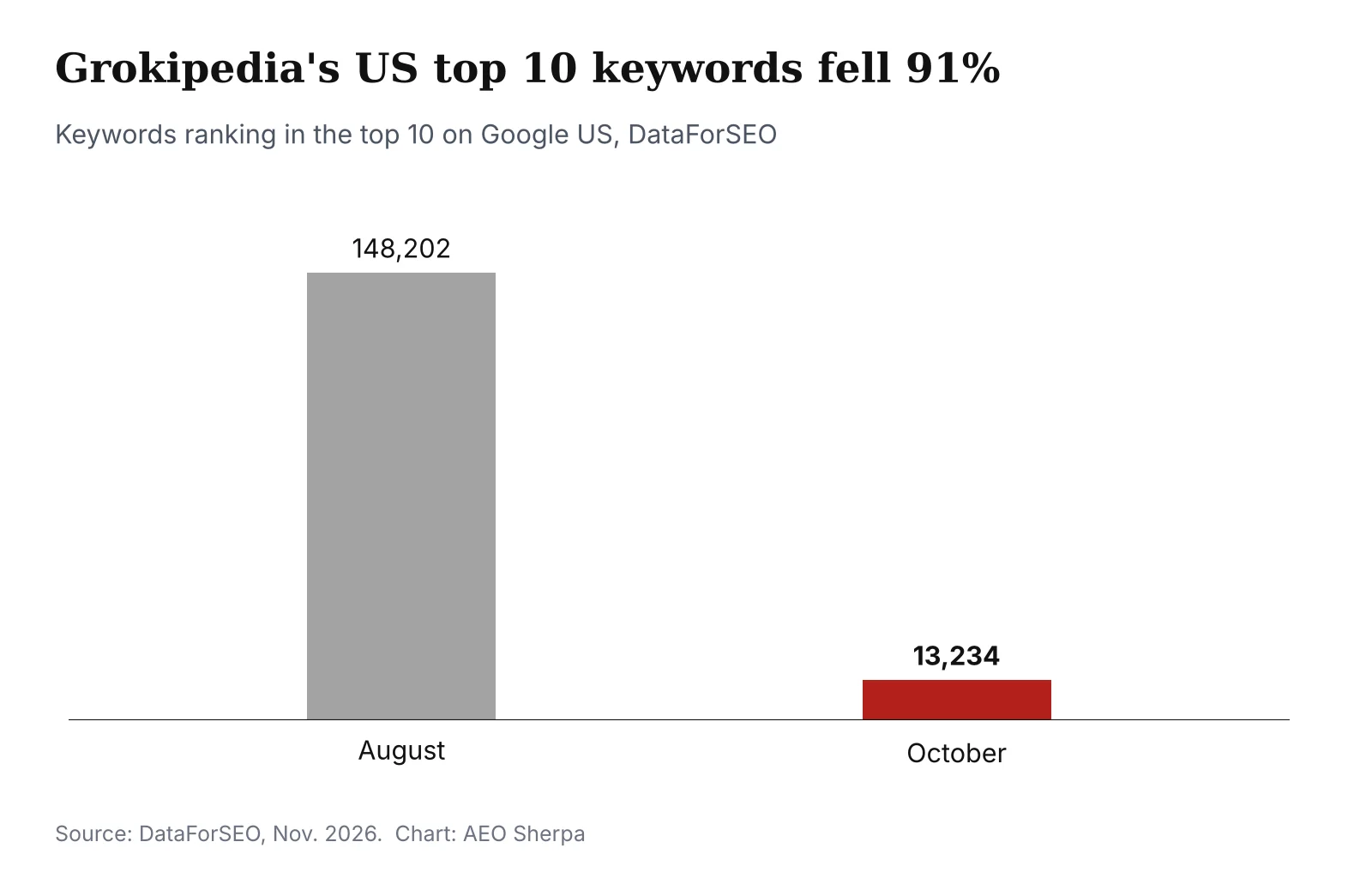
Its total ranking keywords fell from 2,551,197 to 954,739. Ahrefs estimates the site's organic traffic at 800,888 on August 3 and 57,236 on November 2, down 92.9%.
The engines split
Ahrefs counts split the drop by engine, and that is where it gets odd. AI Mode went from 4,181 citations on September 1 to 28 on November 5. Gemini went from 6,490 to 135. Perplexity fell more gently, from 7,620 to 3,584.
Copilot went the other way. Its count rose from 365,546 on September 1 to 479,386 on November 5. Ahrefs shows 104,596 Copilot citations for Britannica on November 5. That makes Copilot's Grokipedia count about 4.6 times the established encyclopedia's. Britannica works as a rough control. Its Google counts fell far less, about a quarter in AI Overviews, a third in Gemini and half in AI Mode, which argues against a tracker-wide sampling change. It is a control for tracking noise only, and it says nothing about why Google moved.
This is not the first fall. In February, Search Engine Roundtable reported a decline across Google, AI Mode and AI Overviews. Barry Schwartz said on X in August that his updated story showed the fall continuing.
The camps disagree on why. WebLinkr points to Google's recent focus on scaled content abuse. Another commenter in the thread, u/mnudu, said sites built on near-duplicate templated pages often just stop earning traction once Google decides they add little at scale. Neither claim has support from Google, which has made no statement on Grokipedia. The u/mnudu comment describes a general pattern, not anything specific to this site, and the r/SEO thread is the only discussion of the drop I found.
What the split tells you
The pattern fits my view on content at scale. Authority has to come before volume, and Grokipedia launched with roughly 885,000 entries before it had earned the trust to carry them. Google appears to have noticed.
What I did not expect is that Microsoft's answers kept leaning on it. My guess is that Copilot's retrieval rewards pages that answer the question cleanly, and Grokipedia's pages do that whatever Google thinks of the site. The data cannot show that, and I hold it loosely.
The practical point is simple. A site can be nearly invisible in Google's AI answers and still be a top source in another engine. Check each engine on its own numbers. Disclosure: my agency, ViewEngine, sells AI visibility work and builds its own tracking tools.
I will keep watching whether Copilot follows Google down. If it does, the gap was only a lag. If it does not, the engines are making separate quality calls, and your visibility in one tells you little about the others.
Free newsletter
The Sherpa Brief
One email a week on what changed in AI search, what it means, and what to do about it. Written for marketers, SEOs, and publishers.
Free. Unsubscribe in one click.