If AI Mode cites your pages, Google has now put ads on the follow-up questions too. The evidence it gave for scaling them is two weeks of U.S. data, and it covers product lists only.
On October 28, 2026, Google announced AI Mode ads in ten more countries and multiturn ads in the U.S. Shashi Thakur, Google's VP and GM of Search Ads, wrote that click-through rates are "already similar between sponsored and organic product list items within AI Mode." The footnote dates the data: Google internal data, U.S., August 20, 2026 to September 3, 2026.
That comparison never touches an organic citation. I think it says little about the answers where you earn one.
The numbers came out the same evening, on Alphabet's third-quarter earnings call and in the ads blog post.
On the call, Chief Business Officer Philipp Schindler was asked why Search revenue growth slowed. Search and other revenue grew 12 percent to $63.35 billion, after 19 percent in Q1 and 17 percent in Q2, according to Search Engine Journal's report on the quarter. Schindler named currency first. Then he said that "the strong growth in AI Mode queries had an impact because of the lower monetization we were seeing in AI Mode," per the call transcript. Matt G. Southern of Search Engine Journal notes that Schindler did not say what AI Mode monetizes lower than, or how much money it cost.
In his prepared remarks, Schindler described the traffic Google wants to monetize. On AI Mode, he said, "many of these queries are upper funnel queries," and "the majority of AI Mode queries are incremental." Then came the same click-through sentence Thakur wrote in the blog post.
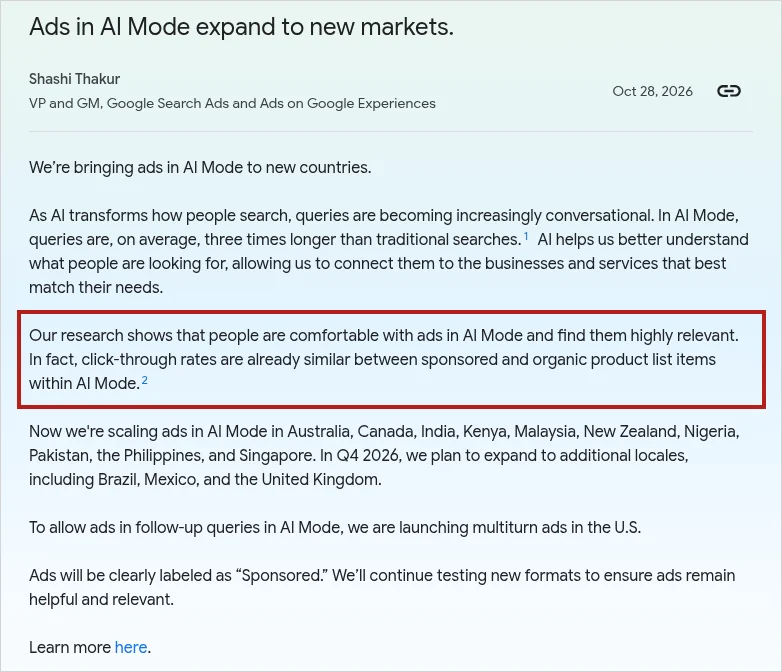
The post itself adds the rollout. Ads in AI Mode are scaling in ten countries, among them Australia, Canada, India and Singapore, with Brazil, Mexico and the United Kingdom planned for Q4 2026. The line that matters for U.S. publishers is shorter: "To allow ads in follow-up queries in AI Mode, we are launching multiturn ads in the U.S."
The help page shows how ads get matched
Barry Schwartz of Search Engine Roundtable asked the obvious question about the stat in his post on October 28. He wrote: "I would hope so, but I am not sure - I mean, the product results are super graphical - but what about the text links?" Neither the blog post nor the call transcript gives a click-through rate for text ads or for organic citations.
Google's help page on ads in AI Overviews and AI Mode explains where else ads can land. It says they can appear across follow-up questions in AI Mode when a conversation has commercial relevance. For longer, exploratory questions, Google matches ads to both the query and the AI response.
Its example is a person asking why their pool is green. The AI response covers water testing and brushing, and ads for pool vacuum cleaners or algae treatment kits can follow. That is an informational question with ads attached. The page also says advertisers cannot opt out of AI Mode separately, and that paid ads do not influence the organic answer or whether a site is cited.
Three readings of one call
Reactions split three ways. Some finance accounts on X and Reddit read the lower monetization line as proof that AI is eating Search. Equity analyst Brad Freeman wrote that the "AI Mode monetization gap" is still closing, and Eric Seufert of Mobile Dev Memo replied that it comes down to "mix shift, and AI Overviews / AI Mode monetization is still being optimized."
SEO consultant Glenn Gabe, in a post that drew few readers, took the multiturn ads as a sign that "the road to AI Mode as the default continues." Lily Ray's list of call takeaways on X, posted on October 28, said "CTR is similar between sponsored and organic results in AI Mode," which drops Google's product list qualifier.
Ray's version is the one that travels. A line trimmed from "product list items" to "results" reads as a finding about everything in AI Mode, and the footnote does not support that. Whether you think AI Mode becomes the default or ad revenue catches up, neither argument answers how a citation performs once an ad shares the answer.
What I watch is whether the brand still gets recommended, and searched by name afterward. A click-rate comparison on product lists cannot tell me that. Until Google shows it, I read the parity line as a statement about product lists, and I would not carry it any further.
Free newsletter
The Sherpa Brief
One email a week on what changed in AI search, what it means, and what to do about it. Written for marketers, SEOs, and publishers.
Free. Unsubscribe in one click.