
You track AI visibility by asking the same question many times and counting how often a brand shows up. That works when the answers you sample look like the answers users see.
On November 23, 2026, Google said AI Mode users can opt in to connect Wallet, starting in the U.S., with Drive files and Gemini chats following in the coming weeks. The new connections join Gmail, Calendar and Photos.
My read: personal context is about to make generic samples less representative, and trackers that ignore it will drift from what users see.
Robby Stein, Google's VP of Product for Search, laid it out Monday on the Keyword blog.
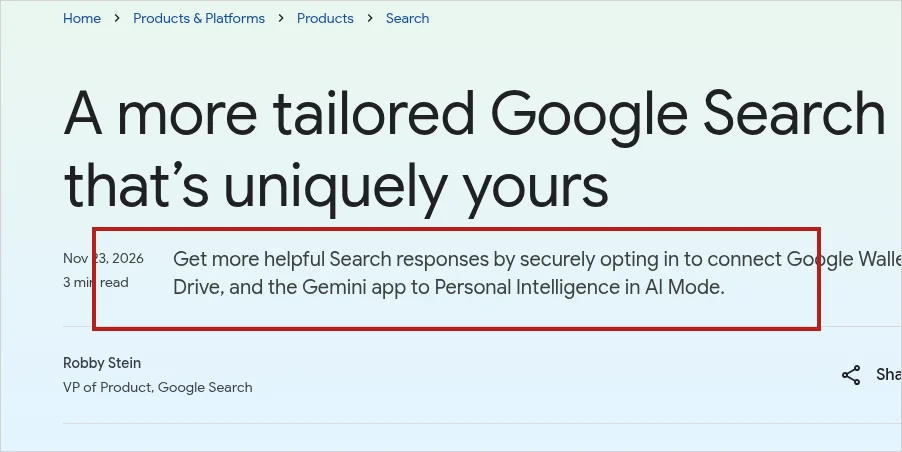
Google says Wallet comes first, starting in the U.S., with Drive and Gemini chats following in the coming weeks. The company describes the connection as read-only: AI Mode can read account information but cannot move, manage or invest money. Each connection stays opt-in, Google says, with an off switch in Search settings.
The post routes setup through Search Personalization, where users pick Connected Apps and choose what to link. Google says a Personalization icon will soon show the context behind any tailored answer.
The post also says AI Overviews and AI Mode will tailor responses to recent search context, adjustable in Search Settings. That tailoring needs no app connection. It reaches users who never opt in to anything. Google's example is trip research picked up in a new thread without starting over.
Rajan Patel of Google named the U.S. start on X: "Starting today in the U.S., securely connect Google Wallet to Personal Intelligence in Search."
SEO consultant Glenn Gabe asked the adoption question on X: "But will many people connect these to Personal Intelligence?" The replies split between refusal and shrugs. On r/Bard, an announcement thread showed the same split: u/NinthEnd wrote, "Please no. This crap causes so many errors," while u/twoforward1back welcomed the memory: "About time. I get lost where my conversations were."
Privacy is the adoption risk. PPC Land reports that AI Mode already carries ads in 11 countries and that Google's October 16 policy lets Search-accessible data personalize ads. It recounts that Google said Personal Intelligence users would see no ads in March before confirming tests in October. Tech Times adds that Google's ad pages do not mention Wallet, while Gemini's terms allow training on transaction summaries, which does not settle how Search treats the same data.
Mordy Oberstein read the news as Google spelling out the difference between search engines and LLMs. "LLMs need context and feed off it. What does that mean for GEO? AEO? LMAO? Feed the machine," he wrote on X.
The measurement problem is narrower: pooled scores will miss connected users. I track AI visibility every week for clients across AI Overviews, AI Mode, ChatGPT, Perplexity and Gemini. Clean-session scores never saw any one user's screen, and repeated runs still map the distribution of generic answers.
What changes is the gap: personal context is one more source of variation, and a pooled score represents the users who never connect anything better than the ones who do. PPC Land illustrated the gap this way: "two people typing the same words may see different overviews citing different sources, and a tracking tool working from a clean, unpersonalized session sees neither of them."
Recommendations remain the outcome that matters. Citations are diagnostics that show where you have room to change what the AI says. Disclosure: my agency, ViewEngine, sells AI visibility work and builds its own tracking tools.
Oberstein's advice is the right response to that gap. What a brand can publish is complete, current, structured facts about itself, and that public record is what the model reads when it needs context. Private spending, documents and chats stay outside anything a brand controls, which is exactly why the public facts have to do the work.
For brands, the work splits in two. Watch whether people connect anything at all, and pay attention to the recent-search tailoring that reaches everyone either way. My guess is that adoption stays slow while default tailoring quietly widens the gap between tracked scores and real answers.
Free newsletter
The Sherpa Brief
One email a week on what changed in AI search, what it means, and what to do about it. Written for marketers, SEOs, and publishers.
Free. Unsubscribe in one click.