
You probably keep a brand regex for your Search Console reports, and maybe a monthly export of your AI Overviews impressions. Google has moved the first job into its API. The second still means clicking a download button.
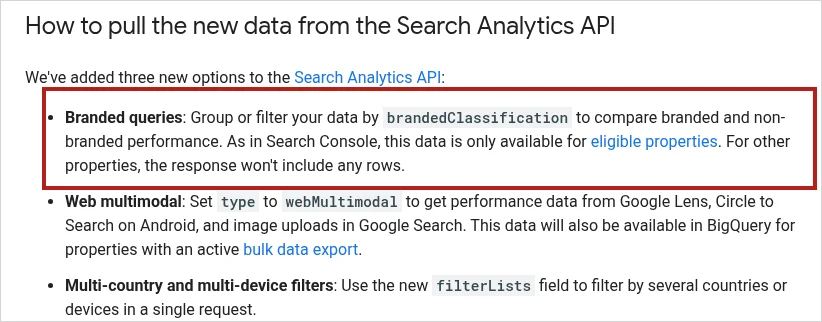
On November 16, 2026, Google added three options to the Search Analytics API. The headline one is brandedClassification, which splits branded from non-branded queries. The API's type field now takes seven values, and none of them is AI Overviews or AI Mode.
My read: the brand split is the more useful AI-era number of the two. Check Google's label against your own list before you chart it.
The Search Console team laid out the details and limits in its Search Central post.
All three features already existed in the Search Console interface. Besides the brand split, a new webMultimodal type returns performance from Google Lens, Circle to Search on Android and image uploads in Google Search. That data will also reach BigQuery for properties with an active bulk data export. A filterLists field lets one request cover several countries or devices.
In the post, the Google Search Console team pitches the move at agencies and tool builders: "Instead of stitching together separate requests or maintaining complex keyword regex lists, you can now query a group of countries (such as EMEA, LATAM, or DACH) and device combinations in a single API call, and automatically segment branded from non-branded traffic in your dashboards."
The brand filter comes with Google's rules
Google introduced the branded queries filter in the Performance report on November 20, 2025. The API documentation sets three limits on its API version. Filtering or grouping by brandedClassification cannot be combined with a query filter in the same request. Branded data starts on February 21, 2026. It covers only top-level properties with enough query and impression volume.
A property that misses that bar gets nothing back. Google's post says branded data "is only available for eligible properties. For other properties, the response won't include any rows." A dashboard that turns missing rows into zeros will report a month with no brand demand instead. Keep the unavailable state as its own value.
Google uses an internal AI-assisted system to decide which queries are branded, as Search Engine Land reported when the filter reached all eligible sites. It counts brand names in any language, typos, and queries about a product unique to the site. Google's own launch post warned that "some queries may occasionally be misidentified."
David Davies, who posts on X as @OnlineInference, put the practical worry plainly: "Useful dashboard upgrade, though be sure to check how effective Google is at understanding your brand terms."
The AI report stayed behind
The report AI search people wanted did not move. Search Console's Generative AI performance report shows impressions for AI Overviews and AI Mode. Google says it rolled out to all websites worldwide as of August 31, 2026. The report has an export button for its chart and table. The API's type list has webMultimodal and six older values, and nothing that maps to it.
Marie Haynes, an SEO consultant, raised it on X on Nov. 16. "However, they did not mention adding the Generative AI impressions information which is something I really would like," she wrote. Barry Schwartz wrote up the release for Search Engine Roundtable that morning and listed the three features.
A script can now pull branded and non-branded traffic for every country and device you sell in. AI Overviews and AI Mode impressions still come out of a manual export.
Why I care more about the brand line
I think the missing AI report hurts less than it looks. Impressions in an AI answer tell you that you showed up. They don't tell you whether anyone wanted you afterward.
I think branded search does. My guess is that a good share of people who see a brand recommended in an AI answer search for it by name later instead of clicking the citation. That is my interpretation, not something this API can prove. Branded demand also rises with ads, press and word of mouth. I track AI visibility every week for clients in local services, healthcare, e-commerce and B2B software, and the brand line is still the one I want next to the citation counts.
If Google's system counts a product name as branded that your regex would not, your non-branded growth shrinks on paper.
A first check is cheap. Pull total clicks for BRANDED for a set of dates, then pull the same dates, property and search type grouped by query and classify those rows with your own list. A gap between the two totals is a reason to look closer. It won't show which queries Google labelled differently, and the docs warn the API returns "top ones" rather than every row. The query pull may never add up exactly.
The start date limits one comparison. With Google's label beginning February 21, 2026, a year-over-year view built on brandedClassification has to wait until late February 2027. Your own regex on older query data has no such limit.
Disclosure: my agency, ViewEngine, sells AI visibility work and builds its own tracking tools.
I'd still like the Generative AI impressions in the API, the same as Haynes. Until Google adds them, I'll treat the brand split as the demand side of the picture, and I'll check Google's label before I trust it.
Free newsletter
The Sherpa Brief
One email a week on what changed in AI search, what it means, and what to do about it. Written for marketers, SEOs, and publishers.
Free. Unsubscribe in one click.