
You moved the domain, filed Change of Address, watched traffic recover, and called it done. One site owner did exactly that in early 2026, and in late July Google began indexing the old domain again.
The new domain went from about 5,000 impressions a day to 20 a week, according to the owner's post on r/SEO, and more than 5,000 of its pages dropped to Crawled, currently not indexed. Search Engine Roundtable and Search Engine Journal covered the case on October 13, 2026. Neither mentioned that Google's help page says Change of Address actions run for 180 days.
My read: look at the timing before anyone blames a quality reset. Three explanations are on the table, and each leaves different evidence in Search Console.
The owner described the whole sequence on r/SEO on October 11, 2026.
The site changed its name and domain at the start of 2026. The owner set up redirects and Change of Address, and traffic recovered around the start of April. At the end of July, the old domain suddenly had pages in the index again, and the owner says more of them arrive every few weeks.
The 180-day limit nobody covered
A commenter, u/DrKJING, offered the first explanation, and it comes from Google's own documentation. The help page says the Change of Address actions continue for 180 days after you start the migration in Search Console. Those actions include telling Google to prefer the new site when it picks canonical pages.
After the 180-day period, the page says, Google no longer recognizes any relationship between the old and new sites.
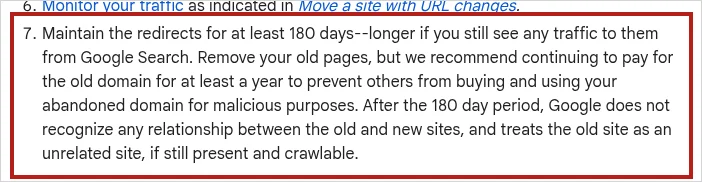
It treats the old site as unrelated if it is still present and crawlable.
The owner did not give a filing date. If it went in on January 1, day 180 landed on June 30, about a month before the old domain came back. That is close, not exact. The commenter's hypothesis is that the redirects were carrying the move alone from then on. If so, URL Inspection should show the old URL as Google's selected canonical for pages on the new domain. An old-domain canonical would also fit a migration with conflicting signals. It would support the hypothesis without proving it.
Google's page also says to keep redirects longer than 180 days if you still see traffic through them. The owner does, since clicks on old-domain results still land on the new site.
Mueller says it can take a long time
John Mueller, Google's Search Advocate, answered in the thread. His first line was that "Sometimes things just take a particularly long time to be fully processed." He added that Change of Address should be set up in Search Console for both the www and non-www versions so the whole domain can migrate. That is the tip Search Engine Roundtable and Search Engine Journal ran with.
Google's page backs the www point. Google says to file it for every subdomain variant of the old domain, including ones the site no longer uses. A move filed for one variant could stall. It is a harder fit for a site that had recovered by April and held for months.
Haynes proposes a quality reset
Marie Haynes, an SEO consultant, offered a different explanation on X on October 13, 2026: "I have a theory. I think a site migration triggers a new quality assessment. And I think Google is getting more strict about what it indexes now."
She says sites with botched migrations often show their pages as crawled, currently not indexed in Search Console. Google has seen the pages and chosen not to index them. That matches the owner's 5,000 pages. Glenn Gabe, another consultant, said the same day that he has had an uptick in site owners writing to him about botched domain changes. His advice is to avoid a domain change unless you absolutely have to.
The owner's newest posts are where the theories pull apart. The owner says that not a single page made after the migration has been indexed, and that there must be more than 100 of them. Another commenter said those pages worry them more, since they never existed on the old domain. A canonical story can explain old pages returning. It has a harder time explaining new pages that never get in.
That is where I would look first. Inspect one new URL and compare the canonical the owner declared with the one Google selected. If Google picks the new URL and still declines to index it, the Haynes explanation gets stronger. If Google picks the old domain, the 180-day explanation does.
I think the 180-day window is the least discussed and the cheapest to test, and I would rule it in or out before accepting a theory nobody can measure. I would not call any of the three settled on one site's account. The filing date and Google's selected canonical would tell us more than the commentary so far.
Free newsletter
The Sherpa Brief
One email a week on what changed in AI search, what it means, and what to do about it. Written for marketers, SEOs, and publishers.
Free. Unsubscribe in one click.