
You've spent two years getting your products talked about so AI engines would recommend them. In mid-November 2026, two of the biggest players in AI shopping asked you for something plainer: your product data, kept current.
On November 13, 2026, OpenAI announced ChatGPT Wallet and told businesses to upload a product feed "with current pricing and availability." The same morning, Reuters reported an internal Amazon plan to collect data on virtually every product for sale, partly by crawling brand sites.
My read: the feed and the live product page are now where AI shopping answers get won or lost. A blog post can't fix a wrong price.
Both stories broke within hours of each other, and both companies wrote down the same problem.
Amazon came first. Reuters reporter Greg Bensinger reviewed an internal document for a project called World Product Graph. It is a PR/FAQ, the six-page memo Amazon writes before it builds something, with an aspirational release date of October 1, 2027. The plan "depends on discovering how brands organize their products on their own websites," the document says. Some brands would send data to Amazon directly. Coca-Cola and Bayer have already signed up, according to the document, and Procter & Gamble held a trial summit.
"Amazon cannot be the go-destination for every shopping mission if customers must leave to research product relationships on Google, brand websites, and review sites," the Amazon document says. Reuters cites a 2025 Morgan Stanley report: 16 percent of online shoppers start product research on Amazon, against 57 percent on Google.
Amazon's memo says of its own shopping assistant: "Many Rufus answers are factually wrong or incomplete, but customers lack expertise to detect these errors." Amazon told Reuters the document's figures are outdated and that its data shows Alexa for Shopping is roughly 97 percent accurate globally.
OpenAI asked for the same thing
A few hours later OpenAI announced ChatGPT Wallet. According to OpenAI, the wallet lets agents pay with a stand-in card number after the user approves each purchase with a check such as Face ID. OpenAI says it starts in dots for ChatGPT Pro subscribers in the US who are 18 or older and hold eligible US-issued cards. OpenAI also says 1.2B people use ChatGPT each week.
The part for marketers is the Commerce Partner Playbook that shipped with it. It tells businesses to claim their profile in ChatGPT's Business Hub, upload a product feed with current pricing and availability, and set their CDN or firewall to recognize signed requests using Web Bot Auth.
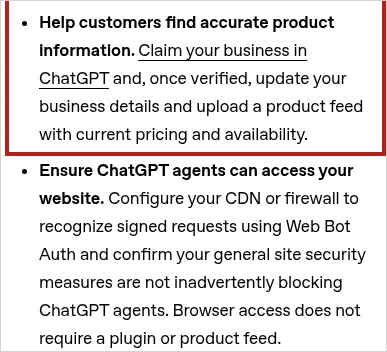
OpenAI's announcement puts it this way: "To accept payment from ChatGPT Wallet, websites need to ensure agents are not inadvertently blocked, and payment and risk systems need to recognize legitimate purchases made by agents." OpenAI named Forter, Riskified, Sardine and Signifyd as fraud partners, and Adyen, Checkout.com and Stripe as payment providers.
OpenAI's feed documentation adds the sentence I'd read twice. "ChatGPT can use product feeds and other available retail and public web sources for product discovery," OpenAI writes there. Then: "The feed does not update a cart or confirm a purchase. Your live website or plugin still checks the current offer when a customer acts." Uploading a feed also requires identity verification in Business Hub.
The feed is one input ChatGPT can use to find products. Your page is what gets checked when a customer acts. If the two disagree, the shopper sees a price the page drops.
The prices are already drifting
A small study published a day earlier shows how far AI answers already drift on price. Hasmord Research asked ChatGPT, Perplexity and Google's AI Overviews about 20 products on November 12. Each question asked for the price, one key spec and the warranty.
One person then checked every answer by hand against each brand's own store that day. Hasmord sells an AEO platform, and this is its own vendor study: 20 products, one ask per engine, one day, US results only.
The engines got 144 of 157 facts right, or 92 percent. All 52 warranty answers matched the brand's site. Prices were the weak spot at 45 of 55, with four more answers giving a range instead of the store's price. All six wrong prices were lower than what the store charged, and every one of those answers cited the brand's own store.
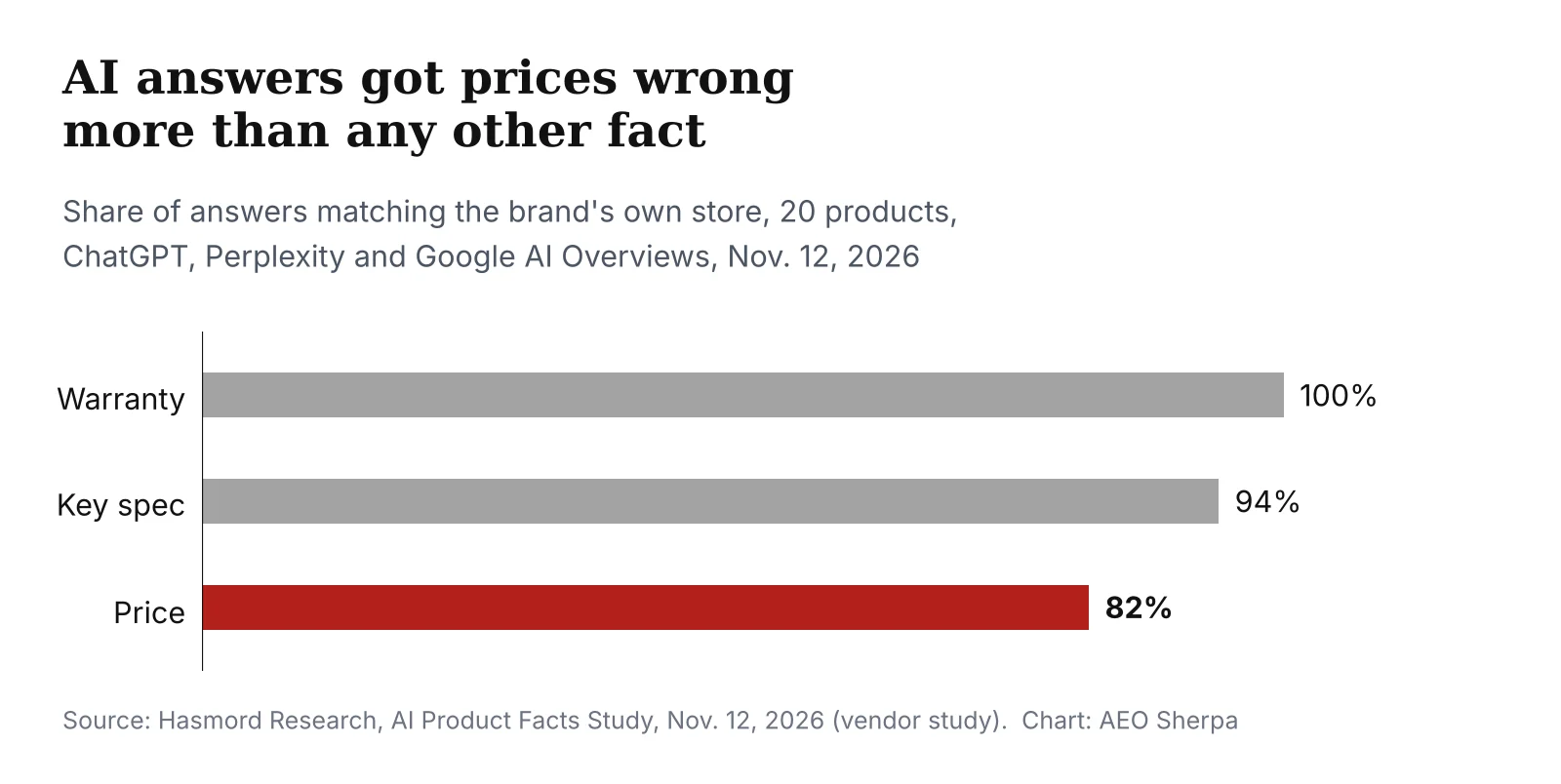
"A link to your page does not mean the answer has today's number from it," Hasmord wrote. The study does not say why the prices were off. Hasmord's own guess is an older price or a sale that had ended.
I read these three documents as one story. Amazon concedes its assistant gets facts wrong. OpenAI separates the feed that helps ChatGPT find a product from the page that confirms the offer. Hasmord shows answers citing the right store with the wrong number. That connection is my inference, and none of the three companies drew it. Disclosure: my agency, ViewEngine, sells AI visibility work and builds its own tracking tools.
I've argued for a while that AI visibility is about everything the engines can find about your brand across the web. I still think so for recommendations. For price, stock and specs, brands need one current number, stated plainly, in a feed and on the page. OpenAI says Wallet starts with Pro subscribers and a check on every purchase. Given that rollout, my guess is that few agent checkouts reach stores this holiday season. Not everyone expects the terms to stay this friendly. "OpenAI isn't taking a cut of purchases yet. I'd give that a year, tops," Hedgie, a markets account on X, posted on November 13.
That is speculation, and so is mine. What the evidence supports is narrower. Handing these systems clean data gives them a better number to quote, and it does not remove the need to check what they say. If your prices changed this month, I would ask ChatGPT, Perplexity and AI Overviews what your product costs, more than once, before an agent does.
Free newsletter
The Sherpa Brief
One email a week on what changed in AI search, what it means, and what to do about it. Written for marketers, SEOs, and publishers.
Free. Unsubscribe in one click.