
If you market a hotel or a travel brand, OpenAI has handed you a new number to watch. Business Hub, launched in beta on November 10, 2026, shows how often ChatGPT mentions your business and how many recorded clicks your website links get.
That same afternoon, OpenAI bought Odessia, an AI travel agent that planned and booked flights, hotels and itineraries inside a single conversation. The trip never needed a click to a hotel's site.
My read: for travel, the click line measures a referral model OpenAI may be moving past. I would report mentions first, next to where you land in the recommendation.
Odessia's founder, Francis Davidson, announced the sale on X at 18:00 UTC, and the story starts with what he built.
Davidson founded Sonder, the lodging company, before this. According to TechCrunch, Odessia raised a $6 million pre-seed round led by Sequoia and launched its agent about five months ago. Skift reports it opened to the public on October 14, 2026, as a free concierge that people reached by text.
Davidson built it to book, too. His agent "plans and books flights, hotels and itineraries through a single conversation," Skift wrote. Its IATA accreditation as a travel agent "gave it access to private hotel rates and perks." That is a travel agency living inside a chat window.
Then Davidson sold it. "Over $60M/year of travel was planned by Odessia over the past summer by tens of thousands of early adopters," he wrote in his announcement. The verb is planned, not booked. He says he will join OpenAI "to focus on the future of travel."
TechCrunch reported that the tool has already been shut down and that the deal looks like an acqui-hire. An OpenAI spokesperson told the outlet: "We're thrilled to welcome Francis to OpenAI. Francis is a proven founder who has built multiple businesses to help people travel, and we're excited he's chosen to build with us." TechCrunch notes OpenAI has not announced any travel product.
The same afternoon, a click counter
OpenAI's launch post introduced Businesses in ChatGPT. Through Business Hub, a company can claim its listing and see "the number of mentions and website clicks a business receives," plus discovery topics. Insights cover the past 28 days, according to OpenAI's help page.
"For a local business, a mention counts when ChatGPT shows a result for that location, even if the customer doesn't open the listing or visit the website," the help page says.
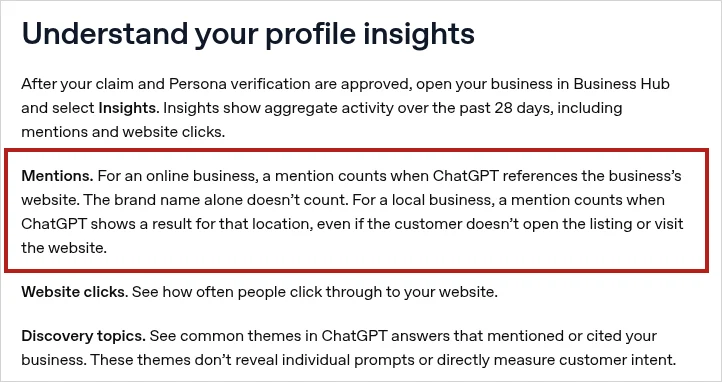
Clicks are narrower. The tooltip Barry Schwartz captured at Search Engine Roundtable reads: "Number of recorded clicks on links to your website in ChatGPT. Clicks don't confirm website visits or conversions."
For now, the business tools still end at your site. Asked whether a business agent can complete purchases or make bookings, the help page answers no. The agent can "explain products and policies and link to your website, where customers complete those actions."
SEOs liked the launch. Kevin Indig of Growth Memo called it "one of the most impactful developments for AI Search: we're finally getting 1st party data from ChatGPT!" Wil Reynolds of Seer Interactive saw the sales angle: "when you go in to see how you're showing up, it gives them a surface to remind you that you could be advertising to these people."
Where the travel moves point
Skift's reporting on the deal goes further. "OpenAI has been building travel advertising and booking into ChatGPT so users can buy without going to a merchant's site," it wrote. Booking.com and Expedia were among the first apps inside ChatGPT when OpenAI opened its app platform in October 2025, Skift notes. What Odessia adds, in Skift's telling, is a team that built a booking agent end to end.
Some people read the deal as a move on the booking itself, among them the investor @amarmic, who posted on X. "ChatGPT is moving from recommending trips to selling them, and OTAs should be paying attention."
The other side has a fair case. Skift's own take opens with "OpenAI didn't acquire Odessia for its revenue," and TechCrunch saw an acqui-hire of a product that is already offline. On that reading, OpenAI bought a team, hotel content and an IATA accreditation. Whether travelers will hand a chatbot the final booking is still an open question.
Why I would watch mentions first
Disclosure: my agency, ViewEngine, sells AI visibility work and builds its own tracking tools.
Both camps can be right, and the measurement problem holds either way. If booking moves into ChatGPT, a hotel's click line can fall while its visibility in ChatGPT rises. A guest who picks your property in the chat and books there never shows up as a click. That guest still chose you. The click counter simply has nowhere to record it.
So I would treat clicks as a diagnostic. I care whether ChatGPT picks you. A local mention only tells you the location appeared in an answer, engaged with or not. Treat it as the floor. Next to it, I would track where the property lands across many runs of a representative set of travel prompts, because a single answer is noise.
Claiming the profile costs nothing, and I would do it. I would also save what ChatGPT says about your market. That record becomes the baseline if booking ever moves into the chat. My guess is that for travel brands, clicks on their own will be the first Business Hub number that stops telling the whole story.
Free newsletter
The Sherpa Brief
One email a week on what changed in AI search, what it means, and what to do about it. Written for marketers, SEOs, and publishers.
Free. Unsubscribe in one click.