If you sell products online, you have probably asked what decides which ones ChatGPT shows its shoppers. Until this month, OpenAI's own help doc gave a clean assurance.
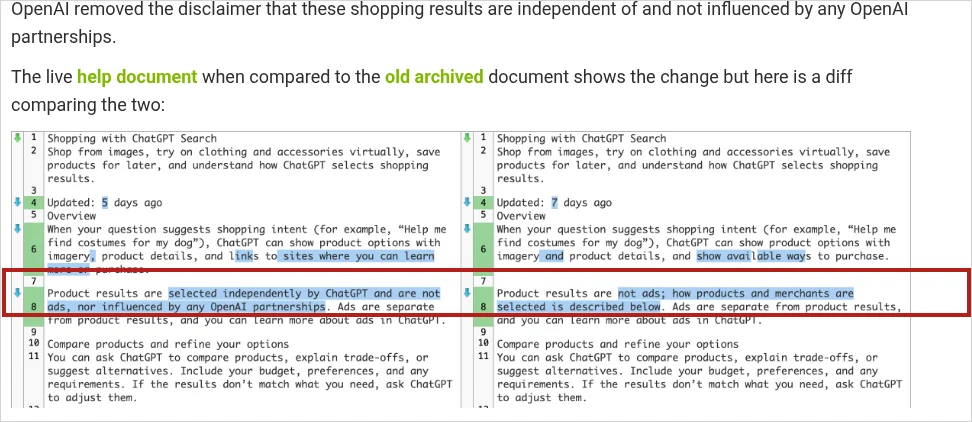
That assurance is gone. OpenAI has cut the sentence saying ChatGPT product results are picked independently and not shaped by its partnerships, though the page still says results are not ads. Search Engine Roundtable reported the edit on November 23, 2026.
My read: the shelf is now worth auditing rather than trusting, the ads need judging on their own economics, and Google stays the baseline. Early ad reports split on whether the channel delivers.
Schwartz credited Kaziukenas, who had spotted the change on the AI Visibility Journal.
The before proof is a November 4, 2026 archived copy of the Shopping with ChatGPT Search page. It read: "Product results are selected independently by ChatGPT and are not ads, nor influenced by any OpenAI partnerships."
The Journal says it checked the live page on November 15, 2026 and found both phrases gone. A November 19, 2026 recheck matched. The edit falls between the November 4 capture and that first check.
Kaziukenas put it on X on November 21, 2026: "ChatGPT shopping help page no longer says product results are NOT influenced by any OpenAI partnerships."
The live page now says product results are "not ads" and describes selection below.
The section below it describes the inputs as the shopper's query and context, structured metadata from first-party and third-party providers, the model's own earlier responses, and OpenAI's safety standards.
A separate argument is running among ad buyers, about a different surface: the ads ChatGPT shows below answers, not the product picks themselves. In a Reddit PPC thread, a law-firm marketer posting as justwatchthefire wrote that "In ChatGPT, users explain their entire situation and timeline in detail before they ever see an ad. By the time our ad shows up below the response, they're already educated and have way higher intent."
The same poster says ads only reach logged-out, Free, and Go users, never Plus, Pro, or Enterprise accounts. On budgets: "daily budgets ($25/day min) act way more like a loose pacing target than a cap because conversational traffic spikes unpredictably." The poster adds that charges land on rolling thresholds rather than neat monthly invoices.
That audience limit applies to the ads. Shopping itself is rolling out across Free, Go, Plus, and Pro, per OpenAI's March 2026 product discovery announcement, which says it runs on the Agentic Commerce Protocol with richer visual comparisons.
Other testers in the same thread describe conflicting individual results. The thread is a handful of reports with different setups, not a controlled comparison. RecentLack writes: "I've run 3 different campaigns for PI and have not seen a single lead on thousands in test spend." And abc_123_anyname, two weeks into testing the same feed sent to Google and Meta, reports: "Although CPC is acceptable at $0.30 ish we've received only ONE conversion."
One reply makes the hypothetical concrete: the same chatbot doing the educating "probably just told them they can file the paperwork themselves," wrote Repulsive-Soil7671 in the thread. And markinpassing, replying to Kaziukenas on X, made the disclosure argument plainly: "A partnership that nudges ranking wouldn't be, which is why the dropped sentence is the one I'd want OpenAI to explain."
OpenAI withdrew an assurance, and a withdrawn assurance is not proof that partnerships now shape the picks. It is a reason to stop trusting the shelf and start auditing it: run the same product prompts three to five times across paid and free accounts, compare what comes back with Google, and treat run-to-run differences as variability you can see, not proof of a cause you cannot.
For the ads, which are a separate question from the picks, I buy ryanmcraver's rule: "First, judge it on signed cases, not form fills." ryanmcraver adds that ChatGPT volume is still small. You can misread a good month when samples run this small. Keep Google as the base until months of case data say otherwise.
That is the honest shape of this story: one documented deletion, a divided handful of early ad reports, and an opaque channel you can measure but not see into. Audit it like one.
Free newsletter
The Sherpa Brief
One email a week on what changed in AI search, what it means, and what to do about it. Written for marketers, SEOs, and publishers.
Free. Unsubscribe in one click.