
If you track your brand in ChatGPT, you probably test the prompts that name your category. A viral audit of Supabase suggests you're testing the easy half.
Supabase says agents or AI-driven tools now create 70 percent of its new databases. Yet on four prompts that describe a job Supabase does, without naming the category, the audit says ChatGPT cited Supabase zero times.
My read: the split is worth borrowing for your own tracking, and the zero is weaker than it looks. One snapshot can't tell you what an AI recommends.
The audit came from mal (@mal_shaik), a founder who offers AI visibility audits, in an X post on October 4. His post claims Supabase is the database AI agents recommend most, and sets out to explain why. His answer is a content machine: more than 15 launch weeks, which he says produced 75 or more indexed pages, plus comparison pages for each competitor, GitHub activity, answers to "how do I" questions and a presence in developer directories.
Then he flipped the prompts. Instead of naming the category, he described four jobs Supabase does: making sure each user can only read their own rows in Postgres, pushing realtime updates to the browser, adding Google login and magic links to a Next.js app, and asking for the best vector database for a RAG app. He says ChatGPT cited Supabase on none of them. On the last one, it cited Qdrant and AWS.
"the pattern: supabase wins every query where someone names the category. but when someone describes the job they need done (the exact problems supabase solves) the AI has no page to link to," he wrote. He counted Firebase too: mentioned 15 times across his queries, cited twice.
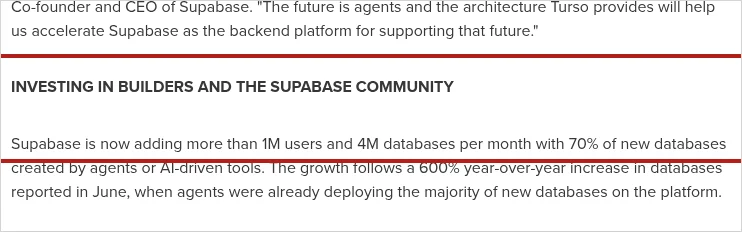
The stakes are in Supabase's own numbers. Two days earlier, its October 2 release said it is adding more than 1 million users and 4 million databases a month. Seventy percent of those new databases are created by agents or AI-driven tools. It also announced it is acquiring Turso, and Y Combinator repeated the figures when it congratulated the company on its $150 million round.
If that number is anywhere close, the answer an agent gives when someone asks for a backend is a distribution channel. That's why the job prompts matter.
The replies went after the mechanism. John Rood argued in an X reply that job prompts never go looking for a page: "pages win the queries that name a category. the ones that describe a job get solved, not retrieved: the model answers from code it has already read. that half isn't won with another page, it's won by being in the code people ship, and supabase already is."
That matches how I think about AI search. Retrieval and citation are separate events. A model can answer without fetching anything, and then a citation count undercounts its influence. The missing-page theory has a hole of its own, too: Supabase already publishes a full row level security guide in its docs.
He hasn't said how many times he ran each prompt, or which ChatGPT mode, country or dates he used. That matters more than it sounds. AI answers change from run to run. A single pass is one roll of the dice.
I wouldn't build a content plan on this audit. I would borrow its split. Sort your prompts into the ones that name what you sell and the ones that only describe the problem, run both many times, and watch recommendations before citations. If the job prompts come up empty, find out why before you write a new page. My guess is that sometimes a page is the fix, and sometimes the answer comes from somewhere a page can't reach.
Disclosure: my agency, ViewEngine, sells AI visibility work and builds its own tracking tools.
Free newsletter
The Sherpa Brief
One email a week on what changed in AI search, what it means, and what to do about it. Written for marketers, SEOs, and publishers.
Free. Unsubscribe in one click.