
You've heard the theory. AI answers plant a brand in someone's head, and the visit shows up weeks later as Direct traffic. Then you open your analytics, see Direct climbing, and feel good about it.
Wil Reynolds of Seer Interactive says that line can't be trusted. After he connected GA4 data to Cloudflare logs, he found Direct "polluted." Kevin Indig, who looked for hidden AI traffic in the GA4 properties of 12 sites, found the same kind of problem with numbers attached. Across his filtered January to September 2026 sample, total Direct rose 140.9 percent while engaged Direct changed by minus 1.0 percent.
My read: a rising Direct line proves nothing about AI search until someone has counted the humans in it.
Reynolds posted on October 25, 2026 that Direct going up is "not going to be a good way to determine impact of AI search." He wrote that connecting GA4 data to Cloudflare logs, even the free program, sent him down rabbit holes in Direct and left him "realizing it's polluted AF." He gave no figures for how much of Direct he flagged, and he said more is coming.
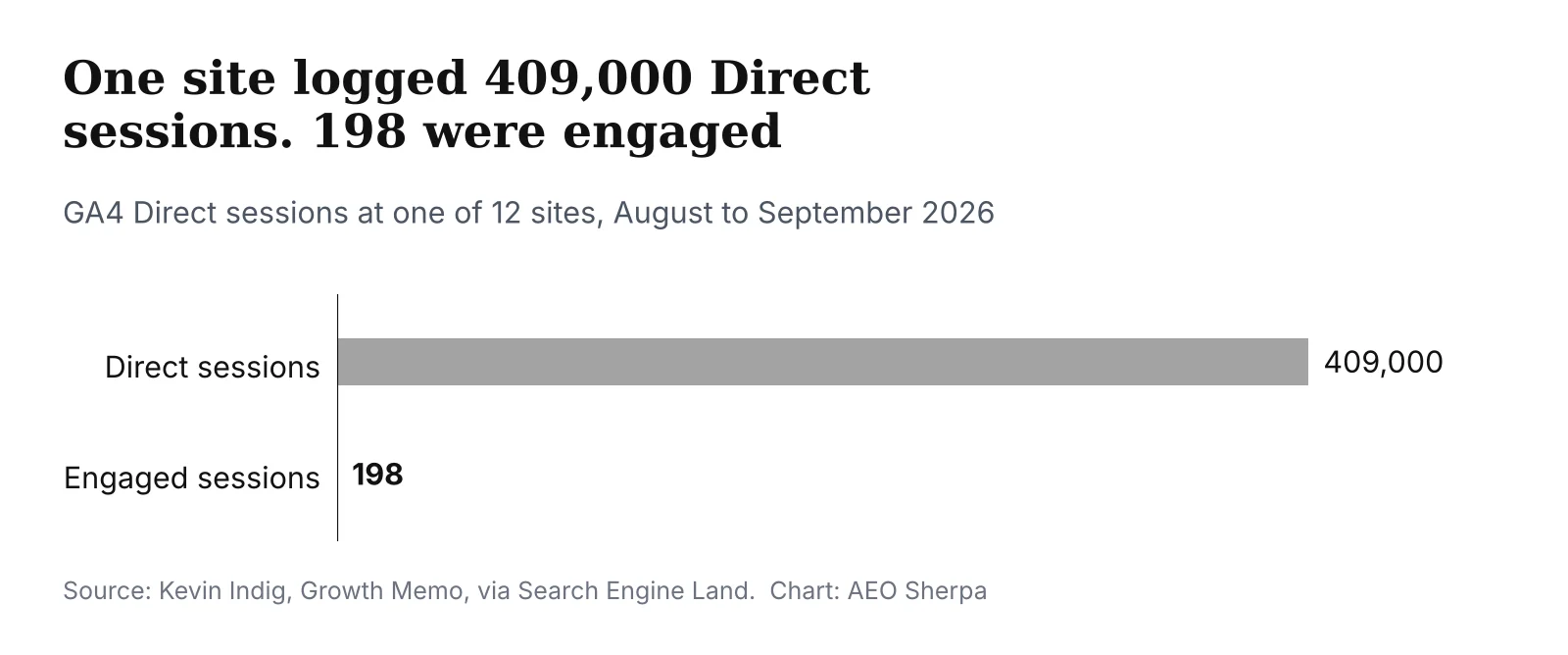
Indig supplies figures from a different analysis. He pulled the GA4 properties for 12 sites and compared August with September 2026. He says the sample leans toward B2B and that all but two of the sites target the US. Eight of the 12 showed Direct growth, some of it over 100 percent. When he dug in, much of it was automated traffic. At one site, GA4 recorded 409,000 Direct sessions and only 198 of them were engaged.
On October 23, Indig also posted the result of a separate test on four brands. He asked whether a rise in AI visibility showed up in Direct or branded search a few weeks later. Across 632 tests, he wrote, he "couldn't establish a reliable relationship." One site reached a correlation of 0.72 between AI visibility and Direct. Then he shifted the AI data against the traffic data, pairing the wrong weeks on purpose. Three of the 19 mismatched versions matched or beat the real result, and he had only 17 usable weeks at the delay he picked. An effect could exist, he says. He could not isolate it.
Reynolds' thread filled with people who had seen the same mess. Gaetano DiNardi, a marketing consultant, wrote "Direct is full of noise" and described a client who claimed Direct was offsetting lost organic search. When he dug in, he said, "the findings were obvious bot automation / spam from countries they don't even target."
Not everyone reads it as only bots. A reply from dodgejd says social traffic stripped of its referrer also lands in Direct. Dries de Gelder wrote on X that he still thinks the lag is real, but called it "a hypothesis, not a defense."
Four ways to measure instead, and where each one breaks
Joe Manna's was the simplest. He wrote that he recommends "the engaged sessions construct instead of just sessions for exactly this reason." Indig's sample shows what it can do. Engaged Direct stayed flat while total Direct more than doubled. Engagement screens out much of the session growth. It does not tell you what brought the visitor, and a bot can be built to look engaged.
A second reply, from passiveseo, suggested branded search in Search Console as a cleaner signal. Reynolds answered that he would add it to his data sets. Branded queries can also rise for reasons that have nothing to do with AI, and the report can't say where the searcher heard the name.
That gap is why the method from djforge interests me most. It connects a person's own account of how they found you to a specific session, instead of inferring influence from an aggregate trend. djforge says the team is "matching 'how did you hear about us' answers to their corresponding 'direct' sessions" and finds AI search is one source in a spread of many. Nobody has validated this at scale, and it only counts people who answer the form. Indig points the same direction, recommending self-reported attribution along with a set of leading indicators.
The fourth is counting fetches in server logs. msniezynski says counting ChatGPT-User, Perplexity-User and Claude-User requests per URL gets close to AI pageviews. A fetch is a machine reading your page. It tells you where AI is reading, not whether a person showed up afterward.
One more limit applies to the AI numbers you can already see. Google's GA4 default channel group now has an AI Assistant channel for recognized assistant referrers. Non-ad clicks from AI Overviews and AI Mode stay in Organic Search. That detail comes from a post on r/analytics by someone who says they work with the vendor SEOVisitor. The result is that the channel misses a share of AI-driven visits by design.
Where I land
Disclosure: my agency, ViewEngine, sells AI visibility work and builds its own tracking tools. I have a stake in how this gets measured.
I think the Direct-as-proof pitch should be retired. Indig's test could not tell the apparent relationship apart from mismatched weeks, and Reynolds says the bucket looks polluted when he inspects it. Neither of them shows that AI sends no one to Direct. They show you can't claim it from the line alone.
There are two jobs here and people keep merging them. Cleaning out bots and spam is one job. Deciding that a human visit was caused by an AI answer is another, and a clean Direct report still can't do it, because social traffic and plain habit land there too. I still believe the click moves to a branded search a few seconds after the answer. That is a guess, and nothing in this story proves it. I think the branded line and the customer's own words will tell you more than Direct ever did.
Free newsletter
The Sherpa Brief
One email a week on what changed in AI search, what it means, and what to do about it. Written for marketers, SEOs, and publishers.
Free. Unsubscribe in one click.