
You checked whether ChatGPT recommends you. The answer was yes. You moved on.
Ask again the next day and you may get a different answer. Supercite asked 210 buying questions on ChatGPT, Gemini, AI Overviews and AI Mode on November 17 and 18, and 84 percent of the 839 answers named a different set of brands the next day.
Two days cannot split daily drift from the engine rerolling the same question. One commenter asked the same prompt three times in a row and only two of the six brands survived all three runs, and the founder says he will add same-day reruns.
My read: this is a measurement story. Ask once and you get a sample, ask often and you get a trend.
Joshua, who runs the AI visibility tracker Supercite, published the numbers on November 18 and posted them to r/aeo the same day.
The setup is simple. Supercite asks 210 buying questions every day across the four engines and logs which brands get named and which pages get cited. Comparing November 17 with November 18 gave 839 answers it could match across both days, with 5,072 brand mentions in total.
Supercite sells AI visibility tracking. This is vendor research, but the method section is unusually open: two days, one answer per question per engine each day. Supercite's team asked as a US user in English. Disclosure: my agency, ViewEngine, sells AI visibility work and builds its own tracking tools.
Comparing the two days, 701 of 839 answers named a different brand set, which is the 84 percent.
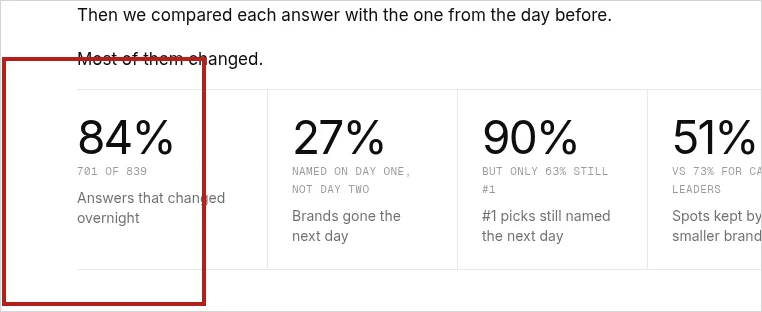
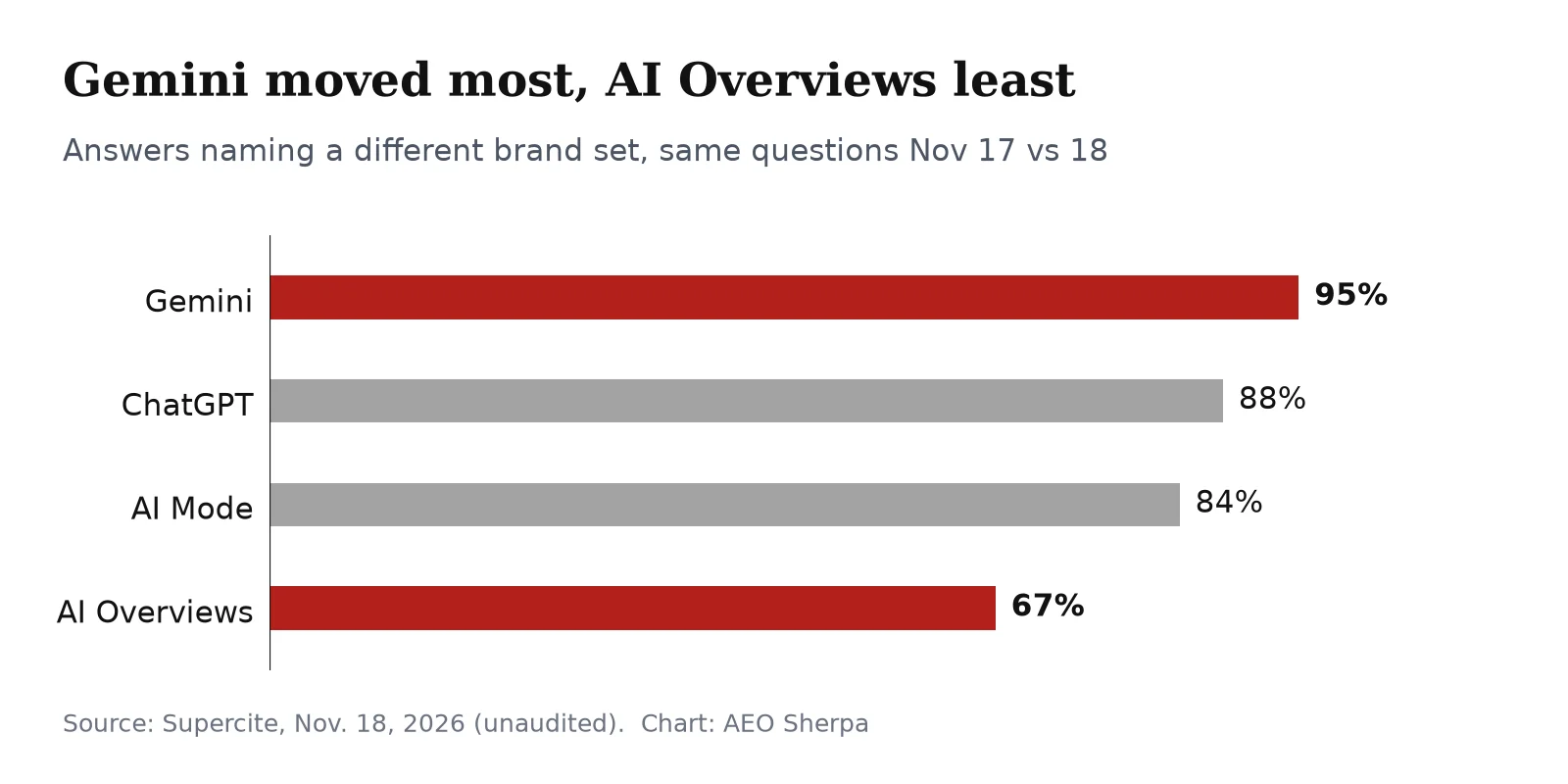
Gemini moved most at 95 percent of answers changed, AI Overviews least at 67 percent, and 27 percent of the brands named on day one were gone on day two.
Leaders kept 73 percent of their spots while smaller brands kept 51 percent. Cited pages overlapped 42 percent across the two days.
The churn is not even. Accounting software barely moved while running-shoe top picks flipped two of three, and AI search visibility tools were the least stable category of all. ChatGPT kept the same number-one brand 71 percent of the time, which emergent.sh's Swapnil Palash, in his rewrite of the study, attributes to the model possibly starting from a memory shortlist before reading pages.
Supercite illustrates it with one example. It asked AI Mode for the easiest CRM for a team that has never used one. On November 17 the answer led with Less Annoying CRM, citing its "zero-frills simplicity" and a single page, a Zapier roundup. On November 18 Less Annoying CRM was gone, HubSpot led, and the answer cited two different pages, a Slack guide and HubSpot's own product page.
In the r/aeo thread, Supercite's founder Joshua, posting as joshhred, offered his explanation of the pattern: the engine reads 3 to 10 pages for each answer and picks different ones each time. Big brands are on most of those pages and stay. Small brands are on a few and come and go.
The fight is about the reroll
Lanesraforseo, in the r/aeo thread, wrote that "a same-day rerun of the 210 questions would show how much of the 84% is just a reroll of the same question versus an actual day-over-day change."
Jaded-Passenger-8072, in the same thread, reported three reruns of the same prompt without naming the engine: "Asking the same prompt three times in a row, only 2 of the 6 brands it named showed up in all three answers." It illustrates the objection without settling it.
The limit is stated up front. Its method section calls these early numbers and says day-to-day change mixes real change with normal randomness in how the engines answer. Joshua said he will add same-day reruns and update the post with the full week.
A second argument runs underneath. VillageHomeF, in the r/aeo thread, dismissed AI visibility tracking as worthless by design. RankControl, a vendor posting in an r/GEO_optimization thread, added a different experiment: "when we used OpenAI's model for 12 buyer questions (with search turned off) it named 59 brands with zero citations. With search on, it named 54 and cited the brand's own site for 47 of them." That compares search on against search off. It bears on named-versus-cited measurement, not on how much of the 84 percent is reroll noise.
DutyOnly4308, in that same thread, suggested splitting reports into three lines: "cited, named, recommended. A help page cited in a category answer is a real signal (your content is in the pool it reads), but it says nothing about whether you'll be picked."
One more caution comes from inevidimka, in the r/aeo thread: a list where one of ten brands changes and a three-brand list that completely flips both count as changed. Overlap per answer would make the practical instability easier to interpret.
My read is narrower than either camp. Two days cannot say how much is drift and how much is reroll, and a same-day baseline would estimate the run-to-run wobble. The direction is already clear: a single answer is a sample, and share of mentions across many runs is the number. By share I mean a brand's hit rate per question across repeated runs, first place or tenth. I built one of the first share-of-voice trackers for ChatGPT, Perplexity and Google AI. I track visibility weekly for clients across the big surfaces, and my position has always been the same: measure often, or do not measure at all.
Cited pages overlapped 42 percent across the two days, against steadier brand retention. My hypothesis is that cited-page recurrence warns earlier than mention counts: a page that keeps getting cited while a brand drops is the fixable state to watch. For smaller brands the implication is conditional. If the engine's page picks drive the churn, getting named on more of the pages it reads should steady the mentions.
Repeated brand-mention measurement is the outcome to track, and cited-page recurrence is the diagnostic to watch. Whether recurrence warns before mentions drop is still untested, and the same-day baseline is the test that would tell us.
Free newsletter
The Sherpa Brief
One email a week on what changed in AI search, what it means, and what to do about it. Written for marketers, SEOs, and publishers.
Free. Unsubscribe in one click.