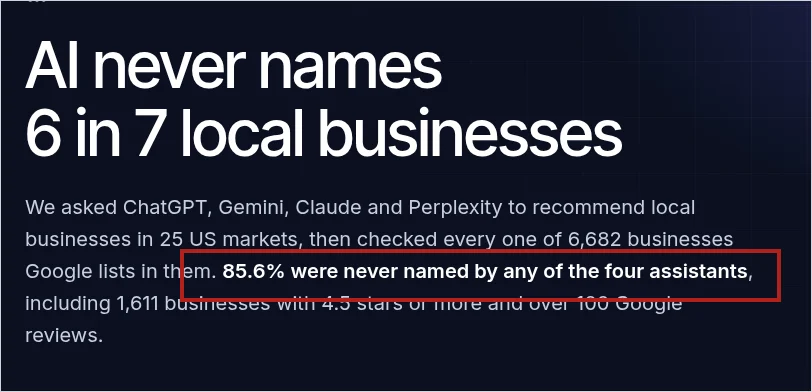
You have watched the reviews pile up and assumed the AI answers would follow. A new study checked 6,682 local businesses across 25 US markets and found 85.6 percent were never named by ChatGPT, Gemini, Claude or Perplexity.
The study broke out on November 19, 2026, when Alex Groberman walked through it in an X thread. Two more independent tests surfaced that evening, measuring different slices of the same question.
My read: the outcome that matters is getting picked again and again, and reviews alone do not buy it.
Groberman laid out the Seeably numbers on X on November 19.
Seeably says it scanned five trades, dentists, personal injury lawyers, plumbers, roofers and med spas, across five cities: New York, Los Angeles, Chicago, Houston and Phoenix. That is 25 markets and 6,682 businesses from Google's local listings. In each market it asked the four assistants typical customer questions, counting a business as named on a single mention. Its method note gives no question count and no repeat rule.
Seeably's read favors review volume. Stars matter little. The guarantee fails either way: 1,611 businesses rated 4.5 stars or higher with more than 100 reviews were never named, and 47 percent of the group with more than 1,000 never came up.
Groberman put it bluntly: "You can have 4.5+ stars, 100+ Google reviews, and still be completely invisible in ChatGPT, Claude, etc."
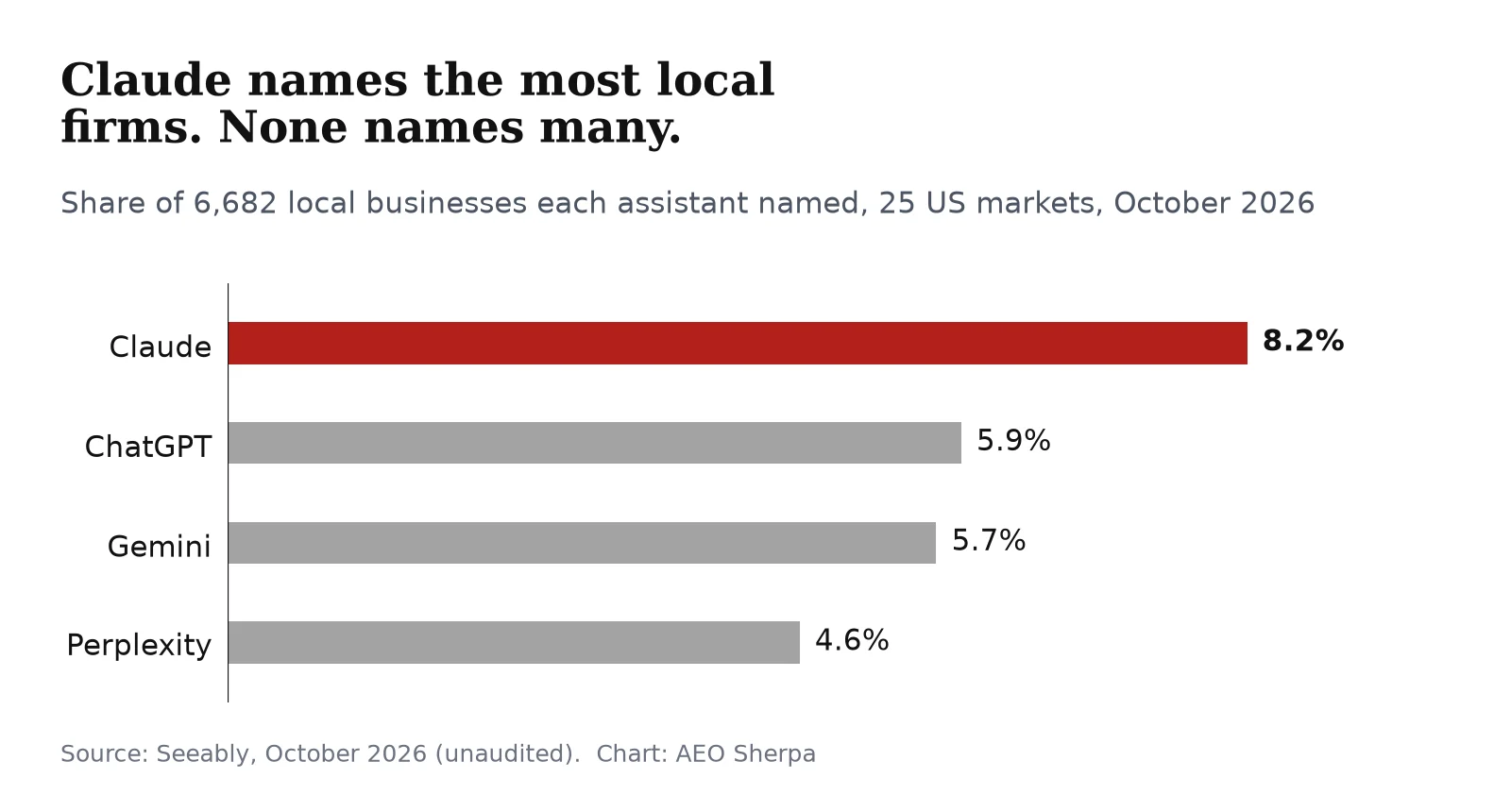
The assistants also disagreed: Claude named 8.2 percent of the 6,682, ChatGPT 5.9, Gemini 5.7 and Perplexity 4.6.
Of the businesses any assistant named, 70.7 percent were picked by only one of the four.
Third-party pages dominated the citations. Seeably found 52.7 percent of cited pages were lists and articles, 26.7 percent directories and review sites, and 20.5 percent the businesses' own sites. Yelp was the most cited site, in 20.5 percent of answers, with Reddit at 12.1 percent.
Seeably says it scanned on October 21, 2026, one market on October 13, and published the study on October 22, using clean sessions with no history, account or location data. Seeably adds that signed-in users sharing a location may see different answers. Seeably sells software that shows agencies which businesses AI recommends in a market. Disclosure: my agency, ViewEngine, sells AI visibility work and builds its own tracking tools.
Two more tests land the same night
Hours later, Luca Giraldi, a digital marketing consultant, posted his Veneto test to r/aeo. The test ran 100 local queries, Giraldi reports, collecting 577 answers across ChatGPT, Perplexity and Google's AI Overview, with the overview appearing for 94 of the 100 searches. ChatGPT searched the web in all 177 responses, three searches on average, he reports.
Perplexity leaned on Italian directories: ProntoPro 239 citations, PagineGialle 183, Treatwell 182 and TripAdvisor 159, Giraldi reports.
Giraldi collected the answers on October 25, 2026, and published the dataset on Zenodo on October 26, noting the limits himself: 100 queries of his own choosing, answered through developer interfaces that can differ from apps and browsers. The Zenodo record lists the deposit as open under a CC BY license.
Minutes after the Italy post, a Houston test landed on Reddit. A user posting as zinki2000 asked 40 homeowner questions 6 times each across ChatGPT, Gemini, Perplexity, Google AI Mode and Google AI Overviews in late October 2026, collecting 1,092 answers. The account names no employer or product. Forty questions times 6 runs times 5 assistants should produce more than the 1,092 answers the post reports. It does not say what happened to the rest.
One roofing company was named in 34 percent of all answers, more than double the 15 percent for the runner-up. One company appeared in 34 percent of Gemini answers but 2.5 percent of ChatGPT answers. Being cited was not the same as being recommended: one roofer's site sourced 15 percent of answers, 33 percent on ChatGPT, yet the firm was not among the 15 most recommended roofers.
BBB, Thumbtack, Angi and Yelp were cited by all five AIs, and Reddit threads drew 281 citations.
Each conclusion rests on specific datasets. Few firms get named, per Seeably's 85.6 percent and Houston's runaway leader.
Assistants disagree, per Seeably's single-assistant picks, Houston's engine splits and Italy's 40 to 51 percent repeat overlap at the citation level, Giraldi reports. Citations concentrate on third-party pages in all three. None of the three establishes a stable recommendation rate, and that gap is what the debate seized on.
Then the method hawks showed up
The debate ran into November 20. Sav Banerjee pushed on the counting: "Being named once isn't the same as being recommended. When we run checks like this we ask each question 4 times and only count a business that shows up in 3 of 4. Did the study count single mentions?" Banerjee wrote in an X reply.
Connor Houghton asked the repeat-run question: "Was each business checked once per assistant, or across repeat runs? When BrightLocal repeated the same local prompts, the lists barely held together," he wrote in an X reply, "so never named over one run and over five could be very different numbers."
A stricter rule would only shrink the named share. The exact 85.6 percent is the method-dependent part.
On the r/aeo thread, one commenter reported that API citations matched the browser only 29 percent of the time, against 81 to 82 percent for a second browser group. That is a single practitioner's test, and Giraldi's own limits note concedes the API gap.
Seeably's setup has the same kind of hole: clean sessions with no location data. iSearchFrom put the question plainly in an X reply: "Small detail in the method: every question was asked with no location data. Curious how different the list gets for someone actually in Phoenix."
The critiques land in different places. Repeats hit Seeably, which states no repeat rule. The API gap is Giraldi's stated limit. Houston repeated everything 6 times. Its splits are the sturdiest.
This lands days after Chris Shirlow's Semrush study of the Map Pack, Google's map with business listings atop local results. Shirlow reports AI Overviews went from 38 percent of his high-intent local searches in his first round to 99 percent in his last, after 480 searches by hand across 12 US markets. In his last round, he writes, the overview replaced the pack on 79 of 80 searches, and one in five named no pack business at all. Semrush sells SEO software. Semrush concedes the study shows the ranking gap but not the shared factors behind AI recommendations.
I track AI visibility every week across AI Overviews, AI Mode, ChatGPT, Perplexity and Gemini. Checking one assistant and calling it visibility misses most of the picture.
Recommendations are the outcome. Citations are the diagnostics. That distinction is the whole game: win citations on the pages assistants use, then check whether mentions follow, across assistants and repeat runs. My guess is the agencies still reporting a single ChatGPT rank will have an awkward year.
Free newsletter
The Sherpa Brief
One email a week on what changed in AI search, what it means, and what to do about it. Written for marketers, SEOs, and publishers.
Free. Unsubscribe in one click.