You're about to see a lot of core update winners and losers charts. Many of them will rest on rank tracker data that, by the trackers' own measurements, Google has been quietly corrupting since September.
Google started its November 2026 core update on November 10, 2026. A day later, consultant Glenn Gabe said he had run numbers for about 1,000 sites and was seeing "crazy differences between the tools." Nozzle, a rank tracker, had reported its worst poisoning day yet on November 2.
My read: for the next two weeks, a drop in one tool is a hypothesis. I'll believe it when Search Console shows it too.
Gabe laid it out in his "Core Update Notes" post on X on the morning of November 11.
"With Google poisoning the SERPs for AI scrapers and now SEO tools, it might be hard to gauge visibility drops/surges accurately," wrote Gabe, an SEO consultant at G-Squared Interactive. He said he had run the numbers for "~1000 sites across a few verticals so far." Then he posted visibility screenshots for two sites and asked readers to "notice any differences there between ahrefs and semrush? lol." He blamed the gaps on the poisoning.
Gabe did not throw the tools out. "GSC data will always be the source of truth (for now), but it doesn't always give the full visibility picture based on ranking drops across all queries that a site ranks for," Gabe wrote in the same post.
The update applies globally and the rollout may take up to two weeks, Google said on its Search Status Dashboard, as Search Engine Land reported. Barry Schwartz, who founded Search Engine Roundtable, asked on X the next morning: "It is probably way too early but anyone seeing movement in the past 24 hours?"
The trackers have been fed bad pages since September
The best public measure of the problem comes from Nozzle, which sells rank tracking. Its study draws on a sample of the SERPs it tracks for its customers. The sample runs from August 20 to November 3, 2026, across 58 countries.
Nozzle calls a page poisoned when fewer than half of a keyword's usual sites show up. By that test, page 1 alone was poisoned on 15.0 percent of SERPs since September 13, against 0.17 percent before. Page 1 peaked at 34.8 percent on October 27.
It got worse going into the update. Nozzle published a November 3 update that looks at both pages of each SERP.
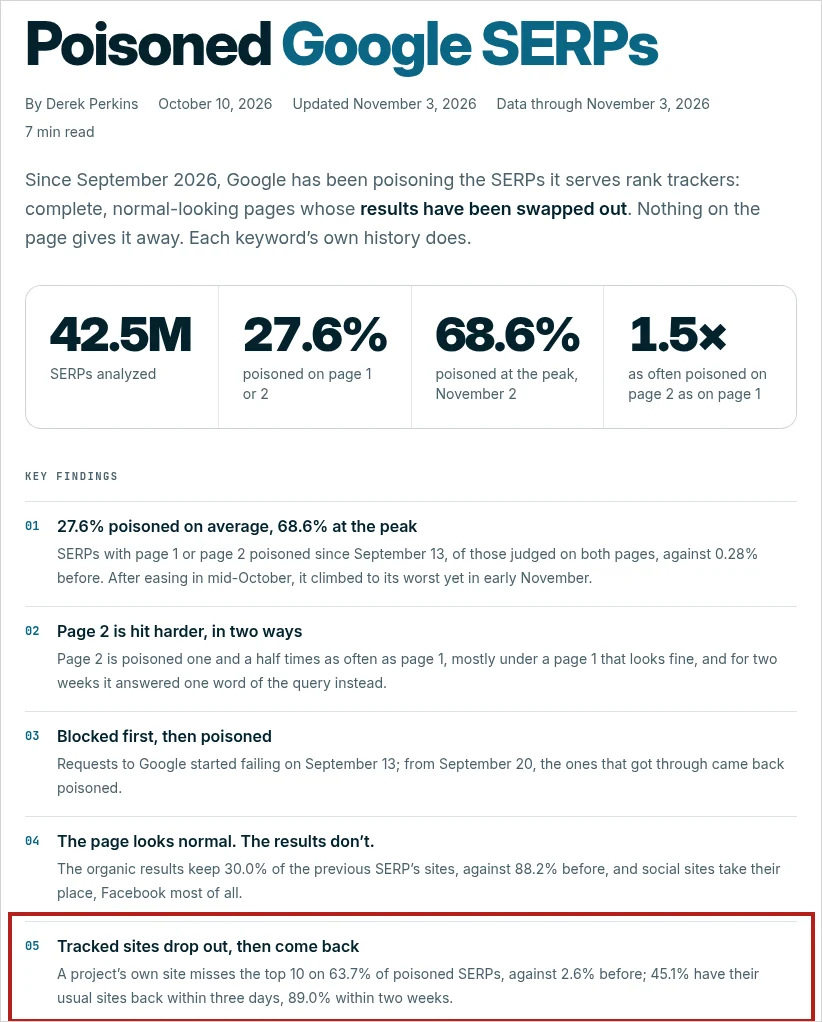
On November 2, page 1 or page 2 was poisoned on 68.6 percent of the SERPs it judged that way. The September peak on the same measure had been 43.5 percent.
The top comment in the r/SEO update thread says the update began rolling out around October 19. Maybe it did. My guess is that some of what looked like early update movement in tracker charts was poisoning, since it peaked on page 1 on October 27. Nobody can split the two cleanly from tracker data alone, and that makes any before and after comparison built on those weeks shaky.
Poisoned drops can look like update losses
Where a tracked site is one of a keyword's usual results, Nozzle found it out of the top 10 on 63.7 percent of poisoned SERPs, against 2.6 percent in the baseline.
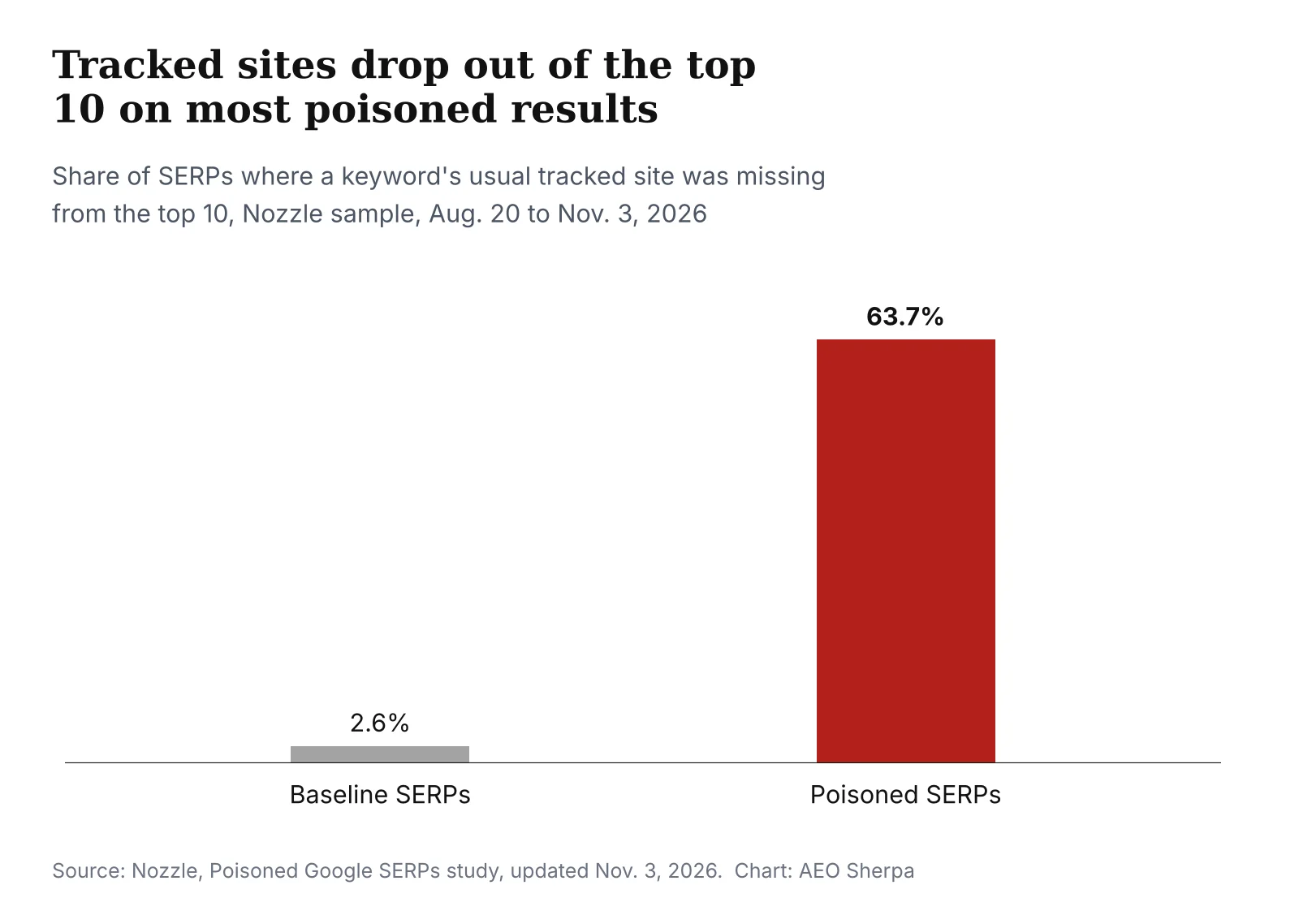
Most of those drops undo themselves. Nozzle found 45.1 percent of poisoned SERPs had their usual sites back within three days, and 89.0 percent within two weeks. Google says this rollout may take up to two weeks. A poisoned keyword can fall out of a rank report and recover inside the same window everyone is watching for real losses.
Digital Hitmen, an agency that summarized Nozzle's first write-up, reports that Semrush, Ahrefs, Nozzle and several other vendors have acknowledged the poisoning. It also reports that Ahrefs puts the affected share at 5 to 20 percent depending on the data provider. If exposure varies by provider, two tools can draw different lines for the same site. That fits what Gabe described, though nobody has shown it is the whole explanation for his sites.
We also ran a small check of our own. On the morning of November 11, AEO Sherpa ran a SerpApi Google query for site:reddit.com/r/TechSEO, limited to the past 24 hours. Of 8 organic results, 1 came back as a masked google.com/goto link instead of the Reddit URL. That is one query and one altered link, not a measure of poisoning. It does show a scraped result coming back different from the page it points to during the rollout.
The court win does not fix the data
The same week brought SerpApi a legal win. A federal judge granted its motion to dismiss Google's amended complaint, Search Engine Roundtable reported on November 10. The judge "did not rule that SerpApi's scraping practices are lawful," and Google may amend again by November 30, 2026, or the case is dismissed with prejudice.
Gabe summed up the gap in a second post: "Serpapi wins again, but Google can still poison the SERPs." The ruling is about whether Google's complaint holds up. Nothing in it requires Google to serve scrapers the results a person sees.
Disclosure: my agency, ViewEngine, sells AI visibility work and builds its own tracking tools.
I think the honest way to read this rollout is to find the cause before calling anything a loss. If a tracker line falls off a cliff in the next two weeks, the first question is whether Search Console and analytics show a matching drop. Nozzle's own rule of thumb points the same way: "If a site 'disappears' and Search Console still shows impressions and clicks, nothing happened to the site." That covers a site vanishing outright. A partial drop needs the same check, and I'd only call it real when two tools and Search Console move together.
Gabe is right that Search Console doesn't show everything. For this rollout, it and your analytics are the data that do not depend on a scraper getting an honest page.
Free newsletter
The Sherpa Brief
One email a week on what changed in AI search, what it means, and what to do about it. Written for marketers, SEOs, and publishers.
Free. Unsubscribe in one click.