
You have probably heard that AI visibility either shows up later in branded search or amounts to a marketing boondoggle. Both camps are grading a number that varies from run to run.
Kevin Indig shifted his AI data against mismatched weeks as a control, and three of 19 fake pairings matched or beat his best real correlation of 0.72. Tracker vendors now report that the set of brands an engine names changes between daily runs in roughly 41 to 49 percent of cases.
My read is that this raises a measurement question for both sides. If the visibility series swings for reasons unrelated to the brand, a flat result says less than the headlines claim.
The story starts with Indig's Growth Memo and runs through the fight it fed.
Indig published the memo on October 19, 2026. It covers two analyses. In the first he looked at the Google Analytics 4 properties of 12 sites and found that much of their Direct traffic growth was bots. In the second, a separate analysis of four brands, he ran 632 tests comparing weekly AI visibility with branded search and Direct traffic, the analytics channel for visits with no recorded referrer. One site showed a 0.72 correlation between AI share of voice and Direct traffic, peaking at a three-week delay.
He then checked whether that was unusual. He shifted the AI series against the traffic series, pairing the wrong weeks on purpose. His first comparison gave the real data an edge, since he had tried seven delays and kept the best one. He repeated it with every mismatched version getting the same seven chances. In the memo he wrote that several wrong alignments produced equally strong or stronger correlations. Indig does not say he differenced the series.
The fight came next. On October 22, Rand Fishkin of SparkToro bundled the memo with two other studies and asked whether AI visibility is a boondoggle. One was Marie Haynes' "GEO is a Distraction." In Fishkin's video, she is reported to have found ChatGPT sent 0.62 percent as much traffic as Google organic across 100 sites. The other was a benchmark from The SEO Works, which says organic search delivered 39 times as much traffic as AI assistants across 95 websites over 12 months. Rand Fishkin, SparkToro's co-founder, wrote on the SparkToro blog on October 22, "Traffic from AI assistants (ChatGPT, Claude, CoPilot, Deepseek, Perplexity, etc.) is nearly non-existent."
Mike King, founder of iPullRank, answered the same day in a post on his blog. He accepted the numbers and disputed the yardstick. King wrote, "The problem is the conclusion, because every one of these studies grades a brand channel with a traffic ruler." He also pointed to the 0.72 site in Indig's data as evidence that a brand effect exists for some brands, and he recommended putting AI share of voice in the mix model. King wrote, "And get AI share of voice into your mix model as an input, because once it’s there the conversation with finance changes from “does this work” to “how much should we spend.”"
On October 23, 2026, Indig posted the control result on X. He wrote that three of the 19 mismatched versions matched or beat the real correlation and that he had only 17 usable weeks at the selected delay. Indig wrote in that post, "An effect could exist, but I couldn’t isolate it in this sample." In the memo he said the short windows limited his ability to tell a modest effect from ordinary weekly variation.
The input moves too
Nobody in that exchange argued about the visibility series itself. A set of reports from the same days suggests it is less stable than it looks. All of them come from companies that sell trackers, reporting on their own panels.
An employee of Pineprompt described a 14-day run on Reddit. It covered 200 US prompts across seven engines and about 18,800 answers. The set of brands named changed from one day to the next in roughly 41 to 49 percent of cases, and close to 69 percent on Perplexity. In the same thread, the maker of Rendix looked at one outdoor apparel brand across 96 question and engine pairs. The brand was named every time in 17 pairs and never in 45. It moved in the other 34.
Promvia put the same 40 buyer questions to six engines every Monday for eight weeks, 1,883 answers in all. Only 46.8 percent of the domains an engine cited for a question were cited again the next week. That figure comes from the company's own post, and I did not check its downloadable rows. Hasmord asked 60 shopping questions three times in one day, an hour apart. Only 15 percent of the sites ChatGPT cited showed up in all three runs, against 55 percent for Google AI Overviews and 96 percent for Perplexity.
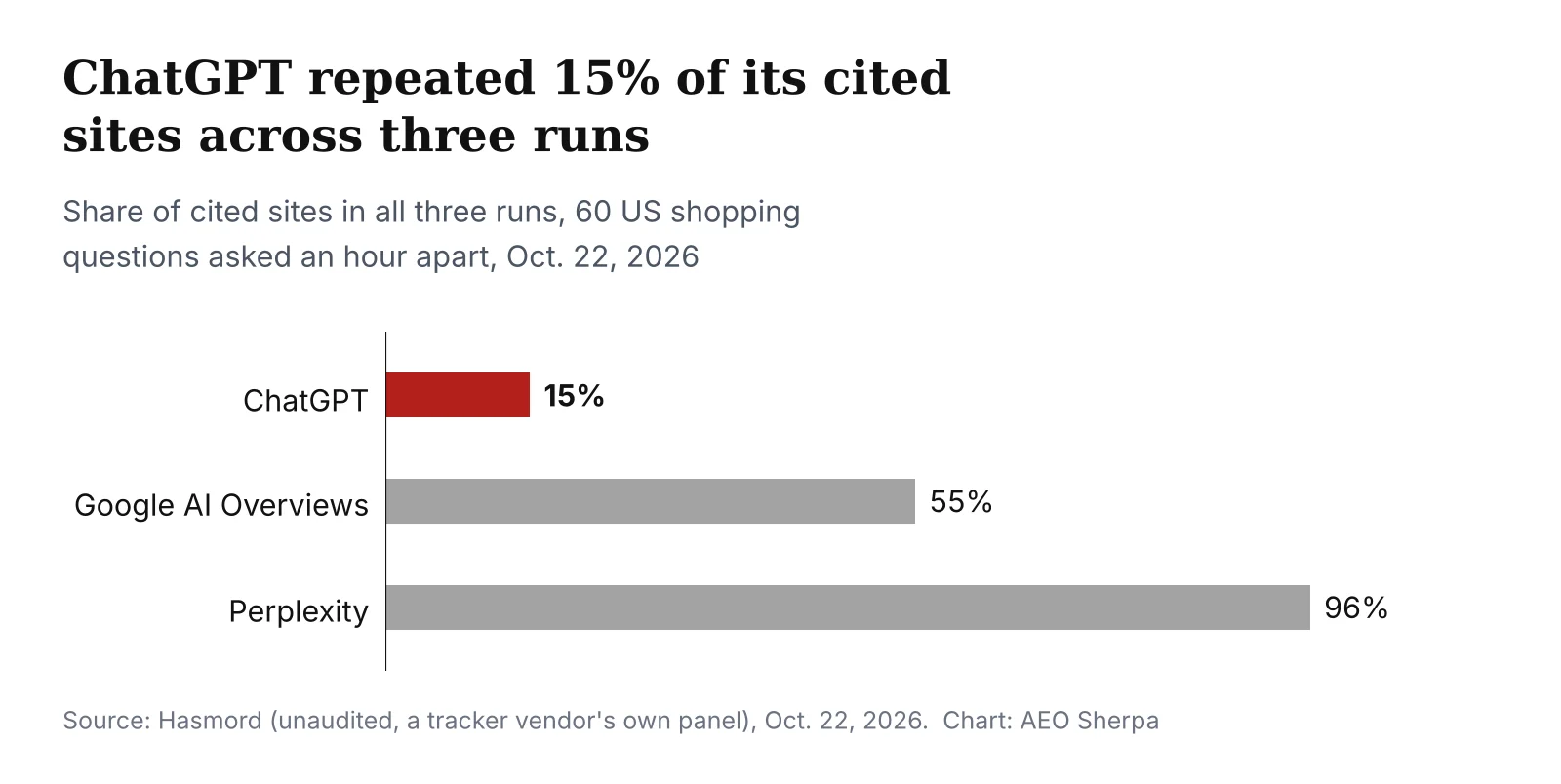
None of this is peer reviewed, and the measures differ. Brand-set turnover, citation overlap and aggregate share are separate quantities. Hasmord's study also found a limit on the argument. ChatGPT cited a brand's own site in 49 to 64 percent of answers across its three runs. The aggregate share held steadier than the list of sites behind it.
Disclosure: my agency, ViewEngine, sells AI visibility work and builds its own tracking tools.
I do not know how Indig's visibility series was built, or how many runs sit behind each weekly point. I can say what would follow if it swings the way the vendors describe. Measurement error in one series generally weakens its correlation with another, and 17 weeks is a short window to find a modest effect through that. The shifted-week result is a separate problem. It shows a strong correlation can show up at the wrong timing when you search many delays, and noise does not explain that.
I have long argued that AI visibility is probabilistic and a single answer is noise. Until someone publishes a visibility series with the number of runs behind each point and the spread around it, and then runs Indig's shifted-week control against it, I would treat a 0.72 and a zero as open questions.
Free newsletter
The Sherpa Brief
One email a week on what changed in AI search, what it means, and what to do about it. Written for marketers, SEOs, and publishers.
Free. Unsubscribe in one click.