
You send a client an AI visibility score every month. The number moves and everyone nods, and nobody asks what would have to be true for it to mean anything.
Over two days starting November 21, 2026, a dozen practitioners argued that out across three Reddit threads, and the same proposals kept surfacing: fixed panels, repeated runs, timeouts as their own status. A ten-point critique then listed the ways the scores mislead, and its target conceded most of it.
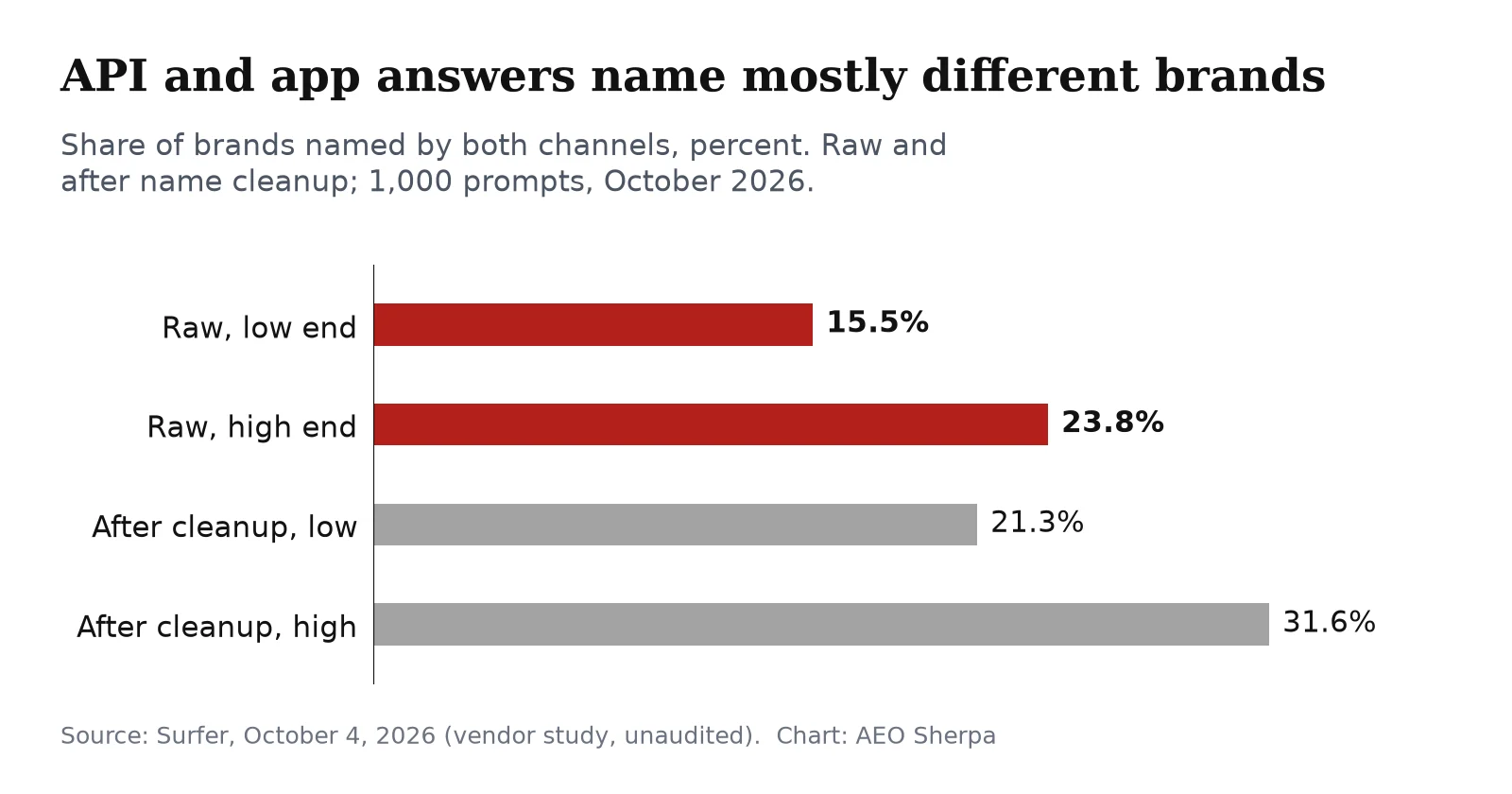
The hard numbers support one concern in particular: the channel mismatch. Surfer's study of 1,000 prompts and 13,779 answers found API and interface answers naming brand lists that overlap 15.5 percent to 23.8 percent raw. My read is that the score is the least trustworthy number in the report.
A tracker builder asked how to compare two weekly scans when some answers come back missing. His thread on r/GEO_optimization is one of three where a dozen practitioners argued the question over two days. The others sit on r/aeo and r/SEO_for_AI.
The fixed-panel idea predates the weekend. On November 20, meesbie told a newcomer on r/SEO to run a small experiment: "pick 10-15 questions a real buyer would ask ... keep that list fixed. ... Answers move around, so one screenshot is not a trend."
One answer set the tone. iGEO_ai wrote that missing needs splitting before anything gets compared: "i'd split missing into at least three buckets before comparing anything: the engine errored or timed out, the engine answered but refused or hedged, and the engine answered normally without the brand. only the last one is a real signal." Each bucket means something different. A missing answer is a gap in the data, a refusal says nothing about the brand, and only a completed answer without the brand means the brand was absent. None of the three is a zero.
Sharp_Emergency_7898 pushed further. "A single run is already noisy even when nothing times out, so I'd treat the answer you did get as a sample rather than a measurement. ... I'd rerun anything missing within a day, and only send the partial comparison if most matched pairs came back, maybe 80%." One run measures that run and nothing else. A trend needs repeats.
The same thread added two more rules: compare citations by domain as well as URL, since engines swap one page of a site for another, and version the panel so only runs on the same version get compared. Coverage means the share of planned question-and-engine pairs that actually came back comparable between scans.
On r/aeo, DutyOnly4308 proposed the full routine as his own: a fixed panel written before seeing any results, about three runs per question per engine, timeouts and refusals logged as their own status. In the same thread, tundro, a forked-tracker user, sees different answers between channels and treats desktop as closer to what buyers see: "The desktop results are likely the more accurate ones ... but we still feel the API results give a good general indication of coverage and citation frequency."
We checked the r/SEO_for_AI thread on November 22: moderators had removed the original post, while the critique and the author reply stand in the comments. Ken_Numbers opened with the uncertainty objection: the number comes with no variance estimates. "Fixing the wording doesn't make the measurement repeatable. ... Without those, a week-to-week move from 42 to 47 can't be told apart from noise." He went on: "A transparent score isn't a valid score. ... a 0-100 scale implies precision the data doesn't have. ... There's no link to outcomes. ... You can raise the number without any business effect, and the method can't show you that." His ten points come down to four tests: a validated panel, a specified engine and mode, justified weights, and competitors measured on the same panel.
DutyOnly4308, the method author, conceded the core of it in his reply: "Fair hits, most of them. ... Where you're simply right: there's no inter-rater check on the coding, no holdout questions, and nothing ties the score to traffic or revenue." That exchange settles one method, not the category. He conceded the gaps in his own scoring, which leaves the wider question open: how many trackers pass the four tests above.
The two channels disagree
Surfer's October 4, 2026 study tests the channel question with its own data. The company compared two collection channels across five AI products: the scraped consumer interface and the API. The comparison spans 14 model-and-method combinations and 13,779 answers from 1,000 prompts.
Brand lists overlapped 15.5 percent to 23.8 percent raw, rising to 21.3 percent to 31.6 percent after name cleanup.
At the page level, API and app sources overlapped 4.8 percent to 6.2 percent on ChatGPT and 19.7 percent on Perplexity.
ChatGPT's API names 13.8 brands per answer against 7.9 in the app, and its answers run 2.05 times longer. Surfer also states the limit plainly: the same prompt asked twice does not return the same answer, and the study ran one sample per prompt.
Surfer sells an AI visibility tracker built on scraped data. It has a stake in this answer. That does not make the numbers wrong, and the method is laid out in the open. It means reading the study as a vendor study, with the sample and method beside every claim it makes.
Disclosure: my agency, ViewEngine, sells AI visibility work and builds its own tracking tools. I track AI visibility every week for clients across AI Overviews, AI Mode, ChatGPT, Perplexity and Gemini. Recommendations and brand mentions are the outcome that matters, citations are the diagnostic, and neither is revenue until it is tied to traffic or leads. I do not trust a score that hides its channel, run count, and coverage.
AI visibility is probabilistic: share of voice across many runs of many prompts, never one answer. My guess is that most scores on dashboards measure the tracker method more than the brand visibility. Before the next report, ask for the raw answers behind it, the coverage rate, and a consistent share-of-voice denominator across competitors. Without those three, I would not act on a five-point move.
Free newsletter
The Sherpa Brief
One email a week on what changed in AI search, what it means, and what to do about it. Written for marketers, SEOs, and publishers.
Free. Unsubscribe in one click.