
You shipped a change, your AI visibility score rose over the next month, and the before and after chart looks like proof. A pre-registered test ran that comparison on a real event.
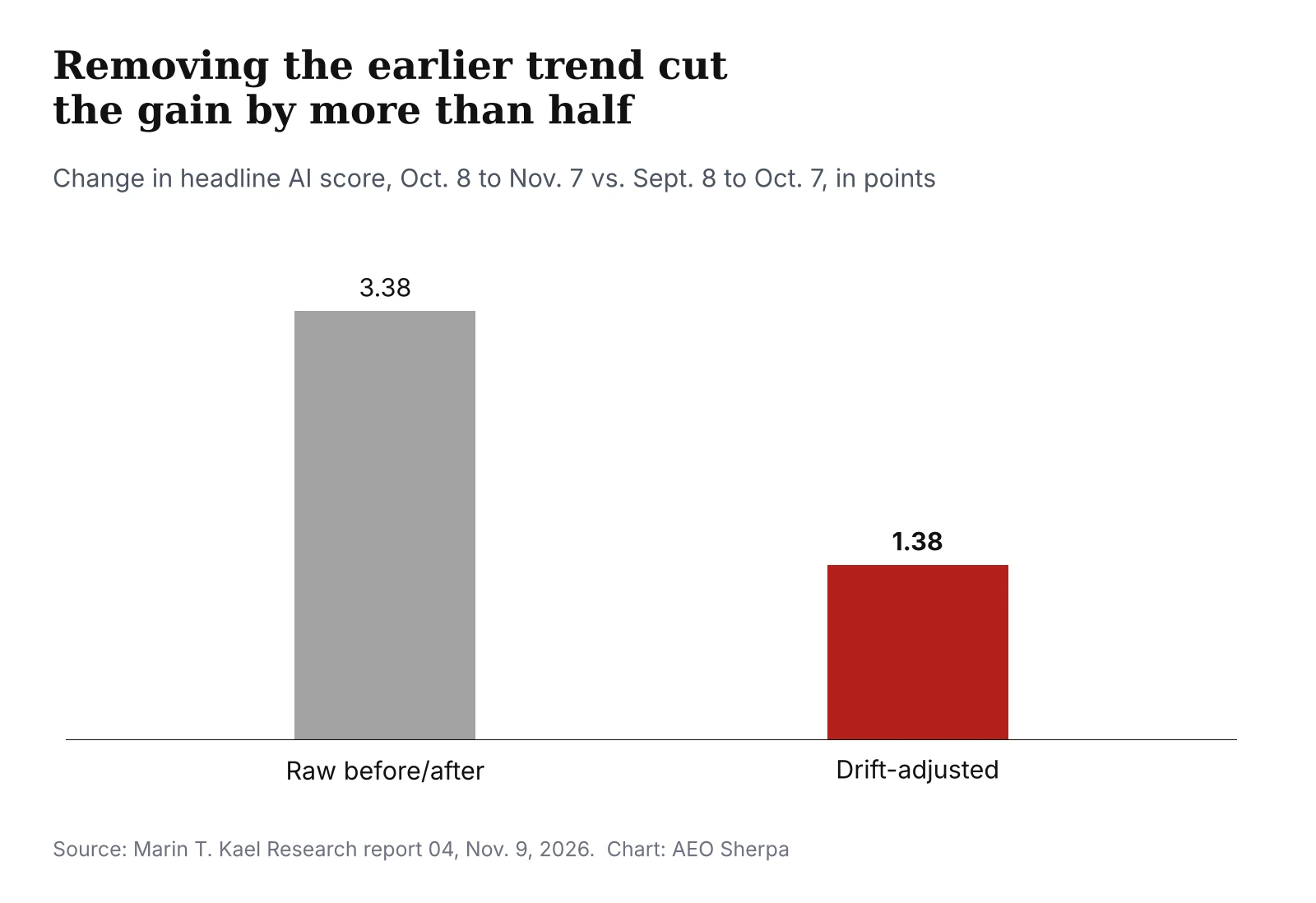
u/marintkael posted the result in r/GEO_optimization on November 9, 2026, and linked a report on a first book's release. The raw before and after gain was 3.38 points. After removing the upward trend that already existed before the launch, it fell to 1.38 points, with a 95 percent interval of -3.59 to 6.68.
That interval includes zero. My read: your dashboard would have reported the first number. The second guards against crediting a trend that was already running.
The poster linked the full report, and both sources describe the same design.
The question was simple. When a first book comes out, retailers, library catalogues and ISBN registers publish machine-readable records about its author for the first time. Do AI answers with web search change within 30 days? The hypothesis was registered before the October 8 release. It also predicted that direct questions naming the author would move before recommendation questions that name neither the author nor the book.
The instrument was 16 fixed questions about one new author, put to OpenAI Search and Gemini through their APIs with web search on. Each answer was scored from -3 to +3 every third day. The report states the results as a percent of the maximum score. The outcome is the score of those answers, not a direct test of whether the engines retrieved or cited the catalogue records.
The comparison was an effect window of October 8 to November 7 against a baseline of September 8 to October 7. Disclosure: my agency, ViewEngine, sells AI visibility work and builds its own tracking tools.
The trend was already moving
The headline average moved from 22.45 percent in the baseline to 25.83 percent in the effect window. That is the raw 3.38 points. It looks like a win, and the poster says the lower bound of the raw interval sat at 0.05.
The catch was drift. The report fits a line through the days before the launch, and that line was already climbing. For Gemini it rose about 0.2 points a day. Subtract it and the gain shrinks to 1.38.
The poster also checked the raw comparison across 200 bootstrap seeds, a check that was not pre-registered. The raw lower bound stayed above zero on 157 of the 200, and the adjusted interval included zero on every seed. In the poster's words, the apparent win depends on the random seed.
The channel results looked alike. Direct questions came out at -0.19 points, with an interval of -15.51 to 15.53. Recommendation questions came out at +2.27, with an interval of -3.02 to 8.11. Every interval includes zero. The order hypothesis got no support either.
What the test could detect
This is one author with no control group, and the report says so. Gemini covers only 5 of the 10 effect days, and the post says the reason was that it ran out of credit. OpenAI covers all 10. With the days actually measured, the minimum detectable headline shift was 7.32 points. A smaller real effect could sit inside that range without showing up.
Claude on claude.ai was tracked as a descriptive series only, and the post says no Claude recommendation named the author on any day. The poster reads the result narrowly. Thirty days showed no detectable effect at the size this setup can see, and measurement continues until January 6, 2027, to look for a delayed one.
One commenter, JianKopling, wants to know whether the catalogue listings eventually show up as cited sources even if the score does not move. Another, ChefOk4636, suggested logging whether retailer, library or ISBN pages appear in the retrieved sources at all. That would split the result into a retrieval question and an influence question.
The design also differs from the opt-out study by Cyrus Shepard of Zyppy, who described a 28-day interrupted time-series design around a deliberate change in Google AI visibility. That kind of change can be switched back. A book launch happens once, and the only defense against trend is modeling the slope before it.
This does not prove that third-party records do nothing. It does make me distrust my own charts. Most AI visibility case studies have no off switch and no pre-change trend line, and a score that was already rising will hand you an effect that is mostly the slope. Before I credit any change, I want at least 30 days of earlier readings and the line subtracted. I would rather report a smaller number I can defend.
Free newsletter
The Sherpa Brief
One email a week on what changed in AI search, what it means, and what to do about it. Written for marketers, SEOs, and publishers.
Free. Unsubscribe in one click.