
If you track how often Claude cites your brand, the tool doing the tracking may be reading Brave Search to do it. Brave Search is about to make scraping its results pages harder.
In a blog post on November 11, 2026, Brave wrote: "In the upcoming days, Brave Search result links will no longer lead directly to their destination." Brave says each link will need its own key, and that a scraper asking for every key on a page is something "which we can count per page."
My read: if your Claude numbers rest on scraped Brave pages, their cost and reliability now depend on how your vendor responds. Tools that already use Brave's API should see little change.
Brave laid out the change in a post from the Brave Search Team and a thread on its X account.
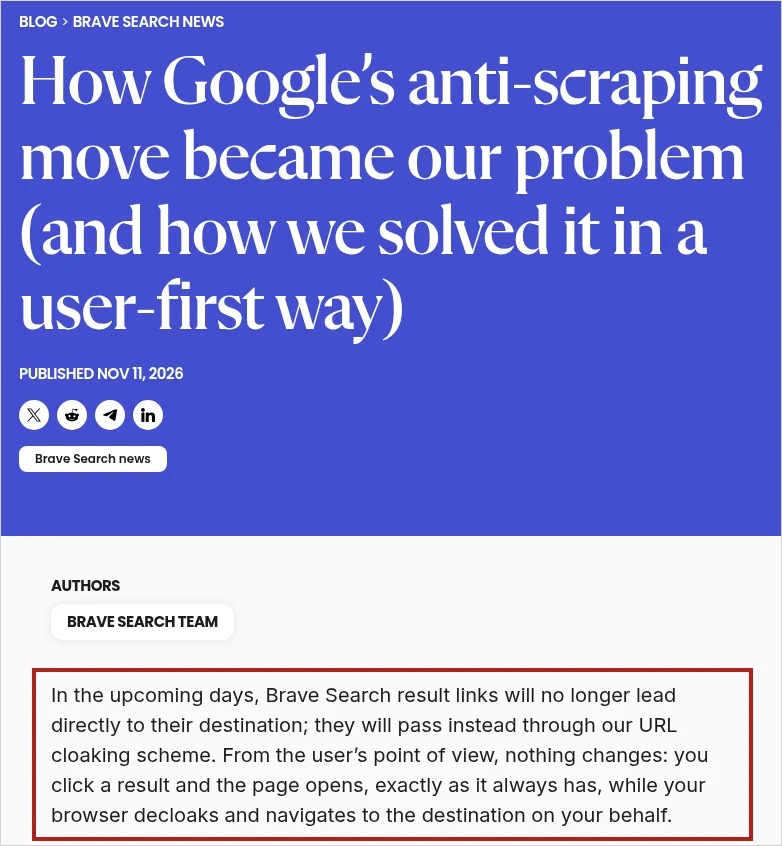
The story starts at Google. Google began routing result clicks through google.com/goto, and Brave says that "did not so much abolish the scraping trade as relocate it." On X, Brave put it plainly: "When Google inserted goto links to disrupt scrapers, many of them moved to Brave Search."
The new traffic hurt. Brave says it saw "traffic spikes of several thousand requests per second," and that the extra bot protection meant slower results and more CAPTCHAs for real users.
Brave also offered a theory about why Google acted now. Cheap scraped Google results used to hurt Google's search rivals. Once chatbots started querying all day, Brave argues, scrapers became "instrumental to Google's competitors in the AI space."
One key per link
Brave describes the fix as a cloaking scheme with a privacy twist. In its account, your browser asks Brave for the key to the link you clicked and disguises the request first. Brave says it then sees which results page the click came from and when, but not which link. "One answer opens one link," the post says.
Brave draws the line between clicking and bulk collection. "Users click a link or two from a results page, but scrapers want every link on every page," Brave wrote on X. "Scrapers will have to ask for decryption for each link, making the process more expensive and detectable."
People will notice some side effects. A copied link is the redirect, and Brave warns that "Redirect URLs might expire, so they should not be trusted as bookmarks." Users with JavaScript turned off get "a conventional redirect where the server (in this case Brave) can see the URL clicked."
For bulk users, Brave points to its Search API, which it says is "free for personal and hobby use and paid for commercial use." The Brave Search Team put the offer in one line: "Anyone who wants our search results at scale is welcome to use the front door."
Where Claude comes in
The coverage so far has framed this as a privacy and anti-scraping story. For anyone measuring AI search, it is also a Claude story.
Anthropic's own subprocessor list names Brave Search for "Web Search" in "All products." On June 12, 2026, Search Engine Land reported that "Claude frequently pulls from Brave Search results, with ranking, recency, and comparison prompts triggering searches most often." That report relayed Jonathan Clark, managing partner at Moving Traffic Media, summarizing a session from Profound, a company that sells AI visibility tracking. The write-up gives percentages but not how many prompts were run. Clark said ranking well in Brave gives marketers "something we can monitor and correlate to data."
That monitoring habit is what Brave's change touches. A vendor that pulls rankings through the API keeps working as before. A vendor that scrapes result pages for destination URLs will have to request a key per result, and Brave says it counts those requests.
Nobody has shown which Claude trackers scrape Brave. Joe Youngblood, an SEO consultant, wondered on X whether rank trackers had joined the move from Google: "Hopefully this isn't something rank tracking providers were doing trying to fill in data they couldn't get from Google." That is his suspicion about Google data, and it does not name any Claude tool.
The switch has not reached every page yet. We checked a Brave results page for "best running shoes" at about 16:05 UTC on November 12 and again at about 16:06 UTC on November 13. Both times the organic results linked straight to sites such as runrepeat.com and runnersworld.com, with no /go/v1 links.
Disclosure: my agency, ViewEngine, sells AI visibility work and builds its own tracking tools.
I built one of the first share-of-voice platforms for AI answers. I know how tempting the scraping shortcut is. A Brave ranking was always a proxy. Brave retrieving your page, Claude citing it and Claude recommending you are three different events, and AI visibility only shows up reliably across many runs of many prompts. If a vendor responds to higher scraping costs by sampling less, that proxy gets thinner. If it moves to the API, little changes. If your Claude report leans on Brave rankings, ask your vendor which path it takes. I would want that answer in writing.
Free newsletter
The Sherpa Brief
One email a week on what changed in AI search, what it means, and what to do about it. Written for marketers, SEOs, and publishers.
Free. Unsubscribe in one click.