
You probably assume an AI answer about a sports stat comes from the stats. A box score, a play-by-play log, a team recap.
After Shai Gilgeous-Alexander corrected a reporter over a first-half assist figure the reporter said came from AI search, we asked Google how many assists he had in that half. On November 14, 2026, its AI Overview said 0, matching the player's own correction. Its one listed reference was a news story about the reporter's AI mistake. The next morning the answer held, but the references had changed to a Facebook post repeating a fan's reply and an Instagram post about the game.
My read: the AI found the right number in text about the error, and the record behind the number never showed up.
The exchange reached most people through a clip Clemente Almanza, lead writer at The Thunder Wire, posted on X on the morning of November 14.
"Shai Gilgeous-Alexander fact-checking an LA reporter who used AI search results to get an incorrect stat lmao," Almanza wrote. The press conference followed the Thunder's one-point loss to the Clippers, which Yahoo Sports reported as a 113-112 Clippers win at Intuit Dome.
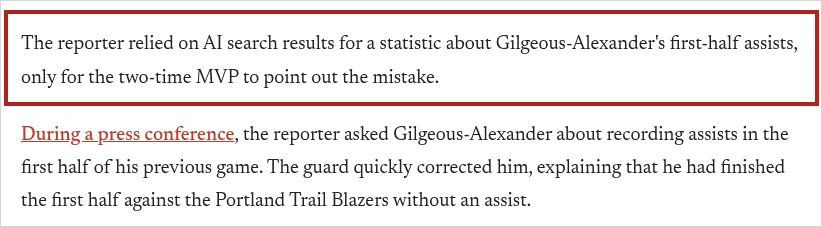
ClutchPoints published its write-up at 1:03 PM ET. According to ClutchPoints, "The reporter relied on AI search results for a statistic about Gilgeous-Alexander's first-half assists, only for the two-time MVP to point out the mistake." The outlet reports that Gilgeous-Alexander explained he had finished the first half against the Portland Trail Blazers without an assist. It also says "the reporter acknowledged that the figure came from an AI search."
Nobody has said which AI tool the reporter used, or what it said.
The Portland game was two nights earlier, a loss that ESPN lists as Trail Blazers 118, Thunder 108. Fans on X had the number ready. "The annoying thing is the fact that SGA had ZERO assists in the first half against the Portland Trail Blazers TWO FREAKING DAYS AGO," wrote the X account @MrBuckBuckNBA in a reply.
Not everyone blamed the machine. "AI was giving him the regular season stats lol," the X user @pastelETH replied. @SharonShyBrown pushed back harder: "You don't know if that person used AI or not." In ClutchPoints' account, the reporter owns up to the AI search, which settles that second objection.
What Google showed, twice
Yahoo Sports syndicated the ClutchPoints piece at 2:03 PM ET. The sports press stopped at a funny moment and a warning about checking AI. I wanted to see what the AI says when you ask it directly.
At about 3 PM ET on November 14, we checked Google for "how many assists did Shai Gilgeous-Alexander have in the first half against the Trail Blazers." The AI Overview answered: "Shai Gilgeous-Alexander finished the first half against the Portland Trail Blazers with 0 assists." It listed one reference, the Yahoo Sports copy of the ClutchPoints story about the reporter's AI error. No game recap or box score was listed.
We pulled the same query again through SerpApi at about 10:30 AM ET on November 15. The answer still said zero assists in the first half of the November 11 game. The listed references were new. Yahoo and ClutchPoints were gone. In their place were a Facebook post repeating the @MrBuckBuckNBA reply and an Instagram post about Portland's 118-108 win.
Those are two snapshots, taken a different way each time. I would not claim every user saw the same swap. What both show is the same gap. Neither answer listed the statistical record behind the number.
Why the stats page loses, in my view
My guess is that this comes down to format. A first-half split has to be worked out from a log of possessions. A news story or a fan reply says it in one plain sentence that looks like an answer to the question. Retrieval systems match questions to text. The sentence is easier to pick than the table.
I can't prove that from two checks, and I don't know what Google read and left unlisted. Retrieval and citation are different events. A page can be read and not cited this time, and cited next time.
This still fits what I keep telling people about AI search. What matters is everything the AI can find about a topic and what it concludes after reading it. Here the conclusion matched the player, and the evidence on display was coverage of a mistake, then social chatter about it.
For publishers, I think the takeaway is modest and practical. If a fact matters to your audience and only lives in a data table, write it as a sentence on a page you control. That gives the AI a clean, accurate passage to use. It does not guarantee a citation, and Yahoo's disappearance overnight shows how fast a listed reference can change.
The reporter trusted an AI answer and got burned. Hours after the clip spread, Google's answer matched the correction, with a story about that mistake as its only listed reference. I'm not sure which part of that should bother newsrooms more.
Free newsletter
The Sherpa Brief
One email a week on what changed in AI search, what it means, and what to do about it. Written for marketers, SEOs, and publishers.
Free. Unsubscribe in one click.