
You have watched your brand turn up in AI answers and wondered what any of it is worth in visits.
AI-influenced traffic is Semrush's answer. The company says it launched the metric on November 18, 2026 to estimate the website visits a brand earns from AI mentions and citations.
Semrush says the number comes from a predictive model built on aggregated behavior linking AI mentions to visits within 24 hours, not from observed traffic. I read it as a benchmark for comparing brands, with that window in mind.
Disclosure: my agency, ViewEngine, sells AI visibility work and builds its own tracking tools.
Semrush's launch post, credited to Luke Harsel and dated November 18, 2026, lays out the metric.
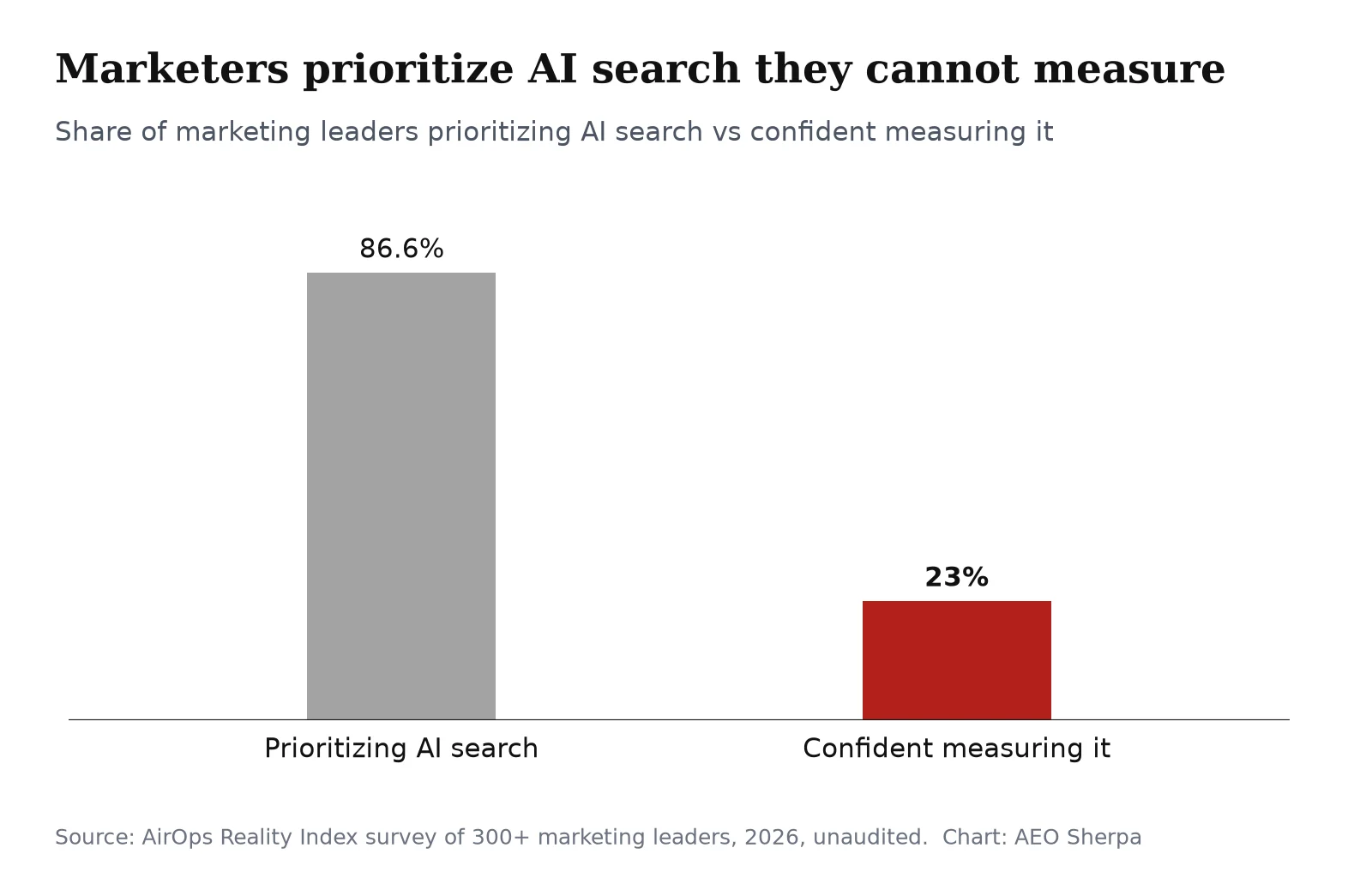
Eight days earlier, an industry group led by AirOps announced an open AI Search Measurement Standard, with Paramark, Chime, and Hitesh Wadhwani, the co-founder of Google Meridian, attached. The announcement says 86.6 percent of marketing leaders are prioritizing AI search while only 23 percent feel confident measuring it. Those figures come from AirOps's Reality Index, a survey of more than 300 marketing leaders. The full report sits behind an email gate. The 23 percent figure travels secondhand through the announcement.
Semrush says the metric counts three paths from an AI mention to a visit: direct visits, branded organic search, and clicks on citation links. The first two are the point. Analytics files those visits under direct and branded search, and AI gets no credit. Semrush says the metric sits in Organic Rankings 2.0 next to organic traffic, mentions, and citations, starting with US and UK data, and that it is rolling out now in Semrush Enterprise AIO.
Semrush describes a three-step model behind the number. It learns from aggregated web activity connecting AI brand mentions to site visits within 24 hours, checks the brand against Semrush's AI search database, and weighs topics by demand. Semrush says the system is built on more than 29.4 billion keywords and 2.18 billion observed AI responses, sampled repeatedly because answers change run to run. It calls the approach demand-led and topic-structured.
In the post, Semrush cites its own study finding that 49 percent of marketers picked AI impact on pipeline or revenue as the metric they struggled to measure most. The study surveyed 481 marketers and SEOs after an attention check, and its own wording is softer: measuring that impact is one of their top challenges. It comes from the company selling the fix. Keep that in mind when this number travels.
Early testers like the sound of it. Natalka Antoniuk, Digital Marketing Lead at Appius, is quoted in the post saying: "Building AI visibility takes time, money and resources that smaller clients often do not have. With the new AI-influenced traffic metric, we can identify the targets worth spending that time on."
Tim Soulo of Ahrefs offered a broader counterpoint on X the same day: "Did you also lose the exact same amount of leads from other channels?" He was talking about AI attribution in general, not reviewing this metric. If AI only moves demand between channels, the visits are still visits, but they are not growth.
Semrush built this metric to replace manual tracking. In an r/SEO LLM thread about tracking AI citations, ryan-moss4394 wrote that the cited pages are different every time: "I can not keep checking them manually." One thread proves nothing about the market. It is one practitioner checking by hand.
That leaves the standards question. The announcement describes AI Search Impressions as a standardized unit of AI search exposure that the group is still defining, while Semrush ships a number built on its own model. First-mover numbers set expectations before the open unit exists.
My read is simple. One disclosed method applied to every domain makes this useful for comparison, and Semrush deserves credit for publishing it. Semrush sells it as one method for every domain: "you can check your competitors too." A 24-hour window and a proprietary model are assumptions, not measurements. I would keep branded search and direct traffic beside it before spending against it. I track AI visibility every week for clients, and I will take a disclosed model over a black box while the open standard catches up. Modeled numbers beat no numbers, as long as nobody mistakes them for counting.
Free newsletter
The Sherpa Brief
One email a week on what changed in AI search, what it means, and what to do about it. Written for marketers, SEOs, and publishers.
Free. Unsubscribe in one click.