
If your AI visibility report lists Perplexity as one of the big three engines, check the traffic before your next client call.
Similarweb's September 2026 update gives Claude 9.6 percent of generative AI website traffic and Perplexity 0.9 percent. Claude now draws roughly ten times the visits. A year ago Perplexity led Claude, 2.5 percent to 2.3 percent.
My read is that Claude belongs ahead of Perplexity in any tracking set that has to stay small. The Gemini number is easy to misread.
Similarweb posted the figures on X on October 12, 2026, as a chart titled "Gen AI website traffic share update".
The reversal at the bottom of the chart
The series starts in October 2025. ChatGPT held 71.8 percent of visits then and Gemini 13.6 percent. Perplexity had 2.5 percent, Claude 2.3 percent and Copilot 2.0 percent.
September looks different. ChatGPT sits at 56.4 percent, Gemini at 25.0 percent, Claude at 9.6 percent, Copilot at 1.5 percent and Perplexity at 0.9 percent.
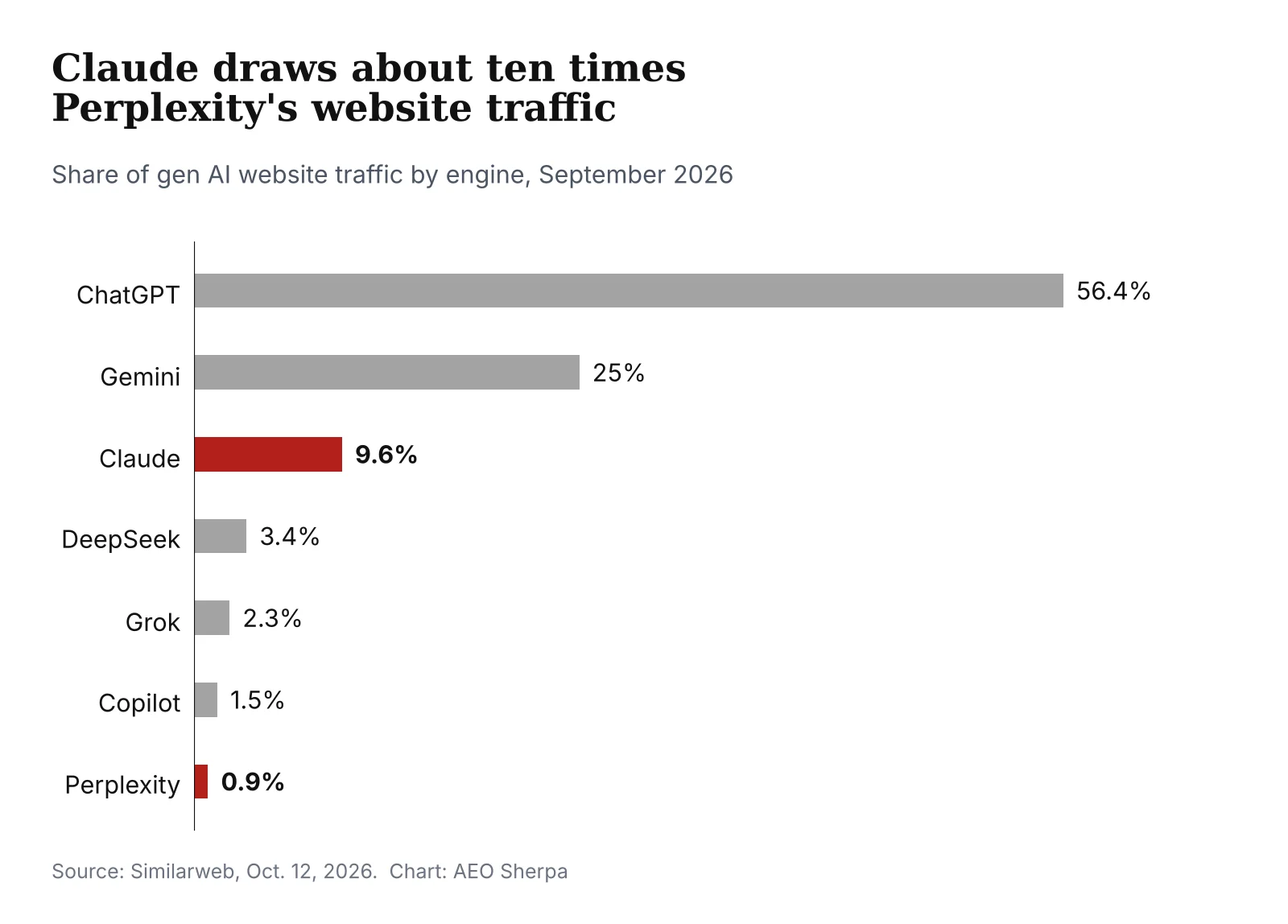
Over the year, Claude went from 2.3 percent to 9.6 percent while Perplexity went from 2.5 percent to 0.9 percent. The two swapped places and the gap is larger now than where it started.
Claude's own path was not a straight line. It had 8.0 percent in April, 9.6 percent in July, 9.3 percent in August and 9.6 percent in September. Perplexity has sat at or near 1 percent since July.
The reaction went to the horse race
Coverage so far has leaned on the ChatGPT and Gemini race. OfficeChai's write-up is framed that way, and so is much of the talk on X. The account TestingCatalog wrote that ChatGPT "seems to be on a steady growth again for the past 4 months in terms of web traffic share." It added: "Claude is definitely a sleeping beast over here."
ChatGPT's climb is real on this chart, from 54.3 percent in July to 56.4 percent in September. It is also still well below the 71.8 percent it held in October 2025. Similarweb separately posted on October 11, 2026 that ChatGPT's total website visits grew 3.35 percent in the third quarter compared with the second.
Investor Oguz Erkan took the Gemini line as bad news for Google. He wrote: "This is not good for $GOOG. $GOOG has basically infinite distribution, but Gemini has still been losing traffic share since May. Distribution is a very strong moat, but it won't save you if you botch the product."
The chart shows Gemini slipping from 26.6 percent in July to 25.0 percent in September. It does not show why, and it also has Gemini at 25.0 percent against 13.6 percent a year earlier. A recent dip from a high and a doubling over the year are both in the same numbers.
What a website count leaves out
The chart counts website visits, and that limits what marketers can conclude. Some replies under the post argued that Gemini use inside Search and Claude use through its API stay out of a website count. I treat that as a reply, not a measurement. The safer reading sticks to the chart's own title. It is a measure of where people go on the web to use a chatbot.
That is also why I would not read Gemini's dip as a verdict on Google's AI search. This chart does not measure how often AI Overviews or AI Mode reach someone who never leaves the results page.
Where this leaves a small tracking set
Visits are not citations and they are not referrals. A person chatting with Claude is not necessarily a person Claude sends to your site. Traffic shares are a reason to look again at a tracking set, and no reason to weight brand visibility by visits alone.
For a small set, I would start with ChatGPT and the Google surfaces, add Claude next, and treat Perplexity as the one to cut first when budget is tight. I make that call as a judgment, not a measurement. ChatGPT's share is the largest on this chart, and Google's AI surfaces sit outside it.
Disclosure: my agency, ViewEngine, sells AI visibility work and builds its own tracking tools.
The ranking of engines by visits will keep moving. My view is that a traffic chart should move an engine up or down your list, and the engines where your buyers ask the question decide whether it is on the list at all.
Free newsletter
The Sherpa Brief
One email a week on what changed in AI search, what it means, and what to do about it. Written for marketers, SEOs, and publishers.
Free. Unsubscribe in one click.