
You were already going to spend November explaining core update swings. Now the AI answers in Google have a second suspect.
Google says it brought Gemini 4 Hydrogen to Search for all users on November 12, 2026. Robby Stein, Google's VP of Product for Search, says it is "the new default model in AI Mode" and is "being used for your hardest questions in AI Overviews." Glenn Gabe, an SEO consultant, noted a broad core update is rolling out at the same time.
Two days earlier, AEO Sherpa reported that Carbon reached only Ultra subscribers and could not explain update swings. Hydrogen reaches everyone. My read is that any AI Mode change from November 12 on has two possible causes, and your reports should keep both in view.
Google laid out the change in a post on its Keyword blog, and Stein walked through it in a thread on X the same afternoon.
The Google post, under Stein's name is where he calls Hydrogen "the biggest model upgrade to Search yet" and says it is now available "globally in Google Search for all users." Stein promises better reading of intent for long, multi-part questions, and answers with "more images, structured responses, comparison tables, and custom tools."
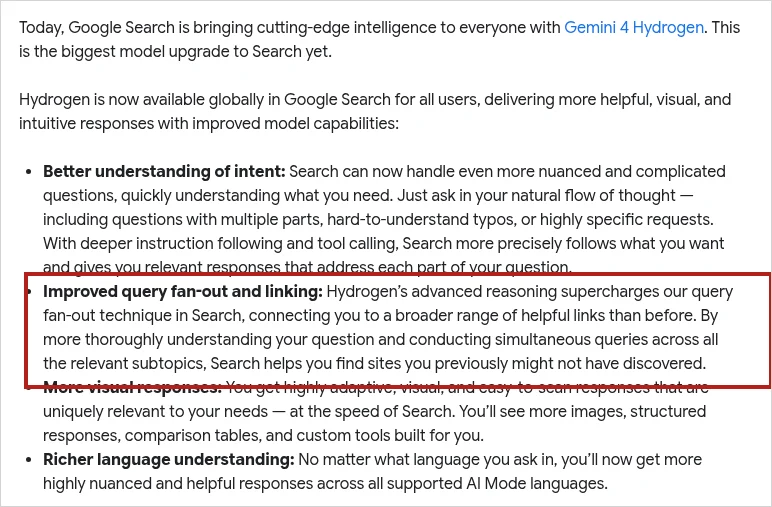
"Hydrogen's advanced reasoning supercharges our query fan-out technique in Search, connecting you to a broader range of helpful links than before," the post says. Fan-out is the set of sub-searches the engine runs behind one question, and the pages those sub-searches find are the pool AI answers cite from.
Stein gave more detail on X. Hydrogen is the AI Mode default. In AI Overviews, he says, it is used for "your hardest questions." The post itself does not mention the core update.
SEOs saw the timing problem right away
Gabe posted on X that the overlap adds "More variables for understanding what's impacting a site." Barry Schwartz of Search Engine Roundtable asked on X: "Google is rolling out this 'massive upgrade' to Google Search during the November core update - but why?"
Marie Haynes, an SEO consultant, saw both sides for publishers. "I think in some cases websites with original helpful information might be more likely to be surfaced. But also, there's less need for searchers to click through to websites if Search can now produce charts and images," she wrote on X.
Lily Ray, an SEO and AI search strategist, raised a narrower worry about spam in AI answers. "Wonder if Hydrogen will be less prone to manipulation and spam in AI answers than with the prior models used in AI Overviews. After 2 years, I'm not that confident," she posted.
The split gives you a place to start
The two changes do not reach the same places by Google's own description. AI Mode now runs on Hydrogen for every searcher. AI Overviews use it for the hardest questions, and Google has given no list of which questions count. That split does not prove anything on its own. It does show where to look first, and I start every diagnosis there.
If a tracked AI Overview on a short, plain query moves this month, I would test the core update explanation first. If AI Mode answers move, the model is the first suspect, with the core update still in play because it can change which pages the sub-searches find. Tagging prompts by surface and by how complex the question is, and marking the two changes as separate dates, keeps those explanations apart in the data.
Google also made a claim we can test. If fan-out really finds a broader range of links, AI Mode answers should cite more distinct domains per answer than before the launch. That is a count on the same prompts, on the same surface, over many runs, before and after November 12. A rolling core update still muddies it. The count can support Google's claim or undercut it, but it will not settle the cause of every move.
That count is a diagnostic. The number I care about for a brand is still how often AI answers recommend it across many runs of many prompts, because AI answers change from one run to the next even in a quiet month. I track AI visibility every week for clients across AI Overviews, AI Mode, ChatGPT, Perplexity and Gemini, and two big changes in the same month is the hardest case for that kind of report. Disclosure: my agency, ViewEngine, sells AI visibility work and builds its own tracking tools.
My guess is that the core update will explain more of the simple AI Overview movement this month, and Hydrogen more of the AI Mode movement. It is a guess until the counts come in. Find the cause before you rewrite a page for a model that may not even be answering that query.
Free newsletter
The Sherpa Brief
One email a week on what changed in AI search, what it means, and what to do about it. Written for marketers, SEOs, and publishers.
Free. Unsubscribe in one click.