
You've been told to watch two things in AI Mode: which brands get recommended, and who buys the ad beside the answer. For users who connect Gmail, both may now run on the same signal.
Google is testing ads in AI Mode for people who connect their apps through Personal Intelligence, Search Engine Land reported on October 16, 2026. In May, an iPullRank experiment found that email signals in such an account lifted seeded brands' mentions from 23.9 percent to 66.8 percent. Google's help page now says ads won't be based "directly" on the inbox. Inferences drawn from it may be used.
My read: the email that moved the answer can now move the ad.
The ads change is the newest piece. Personal Intelligence began ad-free. When it expanded to U.S. users in March, a Google spokesperson told Search Engine Land there were no ads for people who connect their apps.
The organic effect came next. iPullRank, an SEO agency, ran 1,922 AI Mode responses through three Google accounts across eight categories over 17 days. One was a blank control, one was a blank account connected to Personal Intelligence and seeded with brand signals, and one was an author's long-running personal account. Search Engine Journal covered the results.
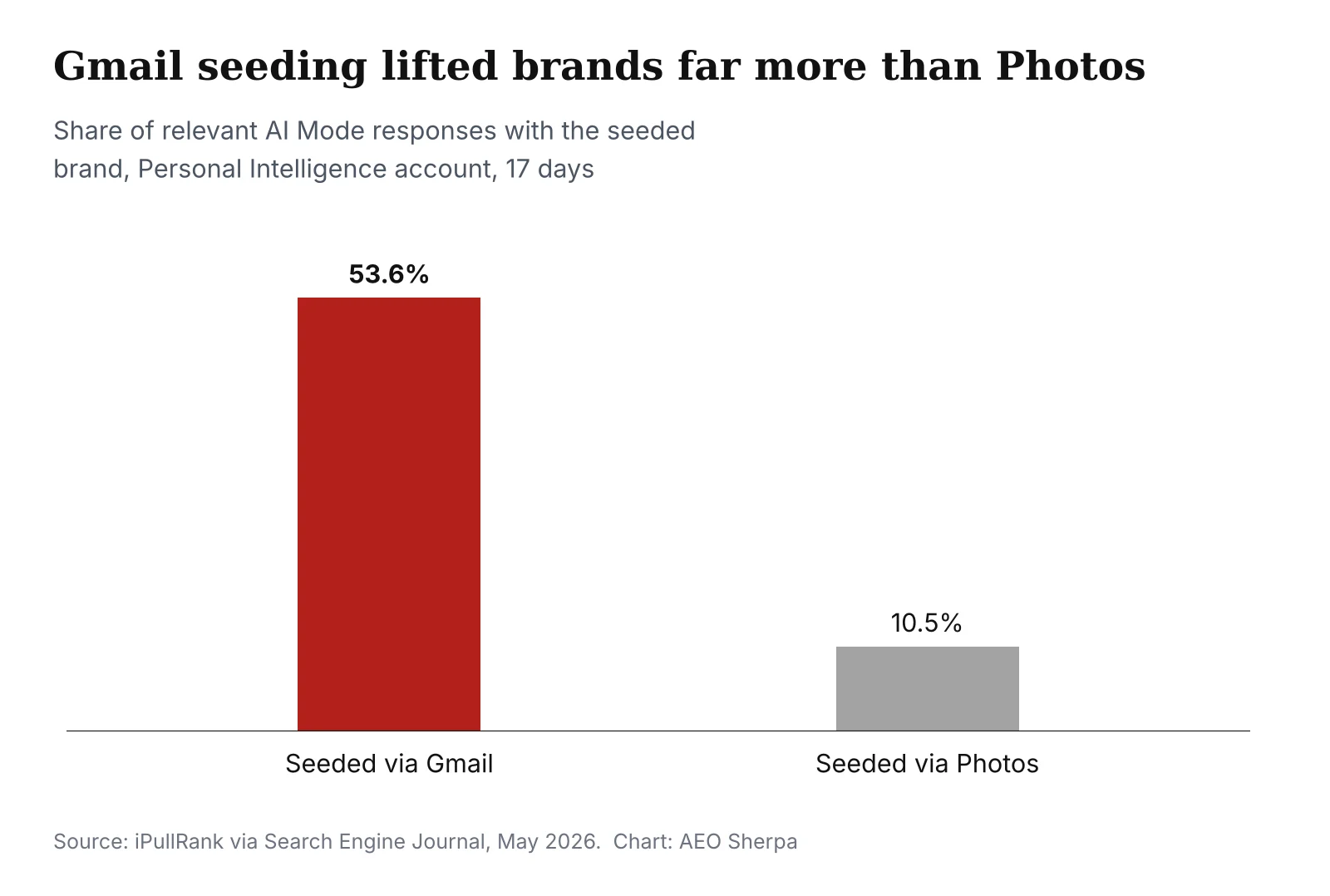
In the connected account, seeded brands appeared in 23.9 percent of responses at first and 66.8 percent afterward. Top-3 placement rose from 4.5 percent to 24.9 percent. Brands seeded through Gmail showed up in 53.6 percent of relevant responses, against 10.5 percent for brands added through Photos.
Three accounts over 17 days is a small sample. Consumer products such as coffee machines, hoodies and running shoes were easier to move than banks or SEO agencies, and the report does not prove Gmail is a universal ranking factor. Personal context also did not replace the web, since other brands' sites made up about 49 percent of the sources AI Mode used.
Then came the ads
Anu Adegbola, the paid media news editor at Search Engine Land, wrote that Google confirmed it is beginning to test ads for users who opt in. Google listed four protections. The feature is opt-in, advertisers cannot reach connected apps, sensitive information is not used, and ads are not based directly on Gmail or Photos contents. Google says ads will reflect the query, the context of the response and the user's interests. It has not announced new advertiser controls, targeting options or a wider rollout.
The help page words it in two sentences. The first: "Ads will not be based directly on your Gmail inbox or your Google Photos library." The second: "If you connect your content apps to Search Services, Search may reference summaries, excerpts and inferences from these sources to personalize your experience and do things for you. That same info may be used to show you ads, so they are even more helpful for you."
Adegbola's bottom line was that "while advertisers cannot access connected apps directly, insights from those apps may now help determine which ads users see." The help page also says AI Mode "might look into past purchases from Workspace apps, like Gmail" and use them to personalize around preferred brands, among other things.
What I make of it
The organic half is measured, within the limits above. In iPullRank's accounts, a recommendation sitting in Gmail moved the answer far more than a brand sitting in Photos. The ad half is my inference from Google's wording, because nobody has tested whether the same inbox signal moves a paid slot.
If that inference holds, order confirmations and lifecycle email are a visibility input for connected users, in the answer and beside it. A tracker that queries from a clean, logged-out account misses that personalization on both sides. I would want the Gmail test rerun with the ad slot counted. Until then I am treating transactional email as part of how a brand gets picked in AI Mode.
Free newsletter
The Sherpa Brief
One email a week on what changed in AI search, what it means, and what to do about it. Written for marketers, SEOs, and publishers.
Free. Unsubscribe in one click.