Your rank tracker showed a November 18, 2026 drop, and your first instinct blamed the core update. Check what it collected that day before you write the email.
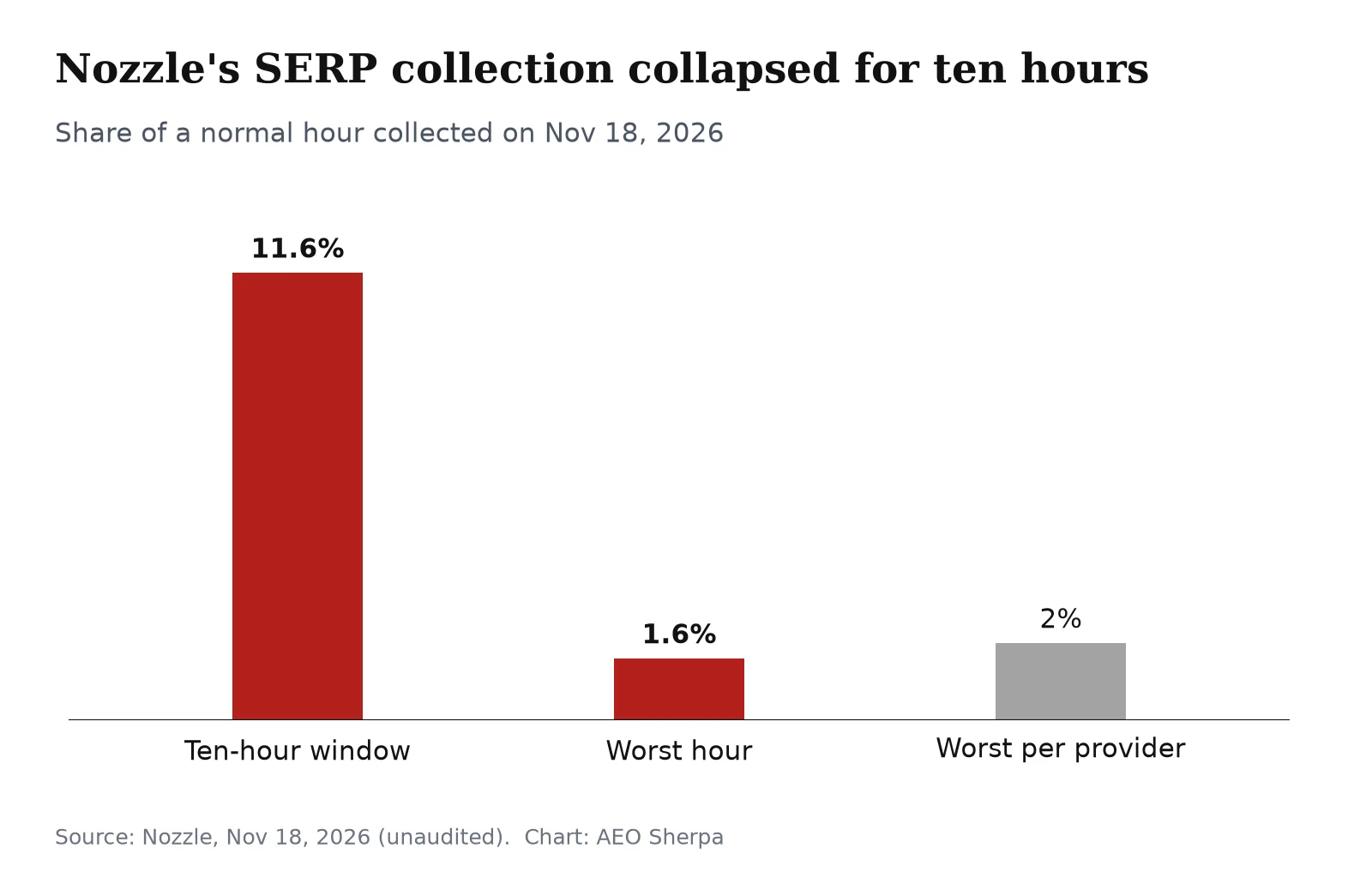
On Nov 18, from 1 PM to 11 PM UTC, Nozzle, a rank tracker, collected 11.6 percent of its normal SERP volume. The worst hour sank to 1.6 percent, and all five of its SERP providers fell to 2 percent or less of normal in their worst hour. Blocks came as CAPTCHAs, delays and a "Sign in to continue" wall.
I read Nov 18 tracker data as a collection log: it records what the tracker managed to fetch. AI Overview reports that feed on the same collection inherit the same blind spot. Audit the collection before you brief the swing.
Nozzle laid out the ten hours on its blog on Nov 18, and Search Engine Journal wrote up the warning on Nov 23.
Perkins traces the first wall sighting to Aug 2, in incognito windows, after several pages of results. On Nov 16, Brodie Clark filmed the wall landing on his first search. Rajan Patel, Google's VP of Engineering for Search, replied the next day on X: "Looking into this. I don't believe it's meant to happen on the first page of results like this but we may be testing something here" Patel limited his reply to where the wall appeared.
The same day, SerpApi opened an incident for degraded Google APIs, and Barry Schwartz wrote up the wall sightings. Then came Nov 18.
From 1 PM to 11 PM UTC, Nozzle's deliveries collapsed across all five providers. iPhone CAPTCHAs at one provider jumped from about 19 percent of requests to about 90 percent. In a sample of that provider's blocked attempts, 31 percent ended on the sign-in wall and the rest on a CAPTCHA.
Desktop searches were barely touched.
Derek Perkins, who runs Nozzle, described the wall on the company blog: "Our requests met a CAPTCHA, which can be solved, a delay, which can be waited out, and the wall, which can be neither."
Perkins reads the target as AI assistants, with rank trackers caught alongside them: "the target is AI assistants and rank trackers are caught with them." He points to Google turning down OpenAI's request for index access in 2024 and suing SerpApi in December 2025. Trackers are caught in the middle, in his account, because SERP collection has to look like ordinary traffic.
Nozzle draws a useful line between the two failure modes. A blocked request fails loudly. A poisoned SERP comes back looking like any other results page, with the keyword's usual sites silently missing.
Nozzle reads Nov 18 as a limited test step. Google tries a change on part of its traffic, watches, then decides. Perkins compares it with earlier step-ups, from about 1 percent to about 10 percent to everything, the way goto links and the end of num=100 arrived. Perkins writes that the wall could come back to stay by the end of the year if Google accepts the cost. That prediction is his, not an established rollout plan.
Separately, merchants are trying to diagnose real slides in the same week. On Nov 22, Shopify merchant ElCoolJay posted in r/TechSEO that his homepage held first place for the brand query through Nov 18, then slid to 3.1 on Nov 19 and 5.3 on Nov 20 before leaving page one. His account rests on his own Search Console data, which no collection gap touches, not on a tracker's feed.
The replies show a diagnosis in progress. One SEO suggested the domain was demoted for the query while marketplaces outranked it. Others pointed at header edits, canonicals and schema. The thread converged on waiting until the rollout ends before calling it.
Search Engine Journal's Nov 23 piece warned readers off blaming the core update, reporting that its Nov 22 check of Google's dashboard found a Nov 10 start, a rollout of up to two weeks, and no completion entry.
Disclosure: my agency, ViewEngine, sells AI visibility work and builds its own tracking tools.
My read: diagnose the data before you diagnose the site. I track AI visibility every week for clients across AI Overviews, ChatGPT and the rest, and I now check collection health the way I check the numbers themselves. Start with mobile collection, since desktop barely felt this one. Use Search Console to confirm what moved on your own site, since it only logs your pages. And give every call a full week past the end of the rollout, my own interval for letting update volatility settle, before briefing a drop.
Free newsletter
The Sherpa Brief
One email a week on what changed in AI search, what it means, and what to do about it. Written for marketers, SEOs, and publishers.
Free. Unsubscribe in one click.