
You have seen this thread before. Maybe not this exact one, but you know its shape: someone claims Google accidentally revealed how AI search picks winners, and the proof sits one click from an audit form.
The latest version comes from Alex Groberman, who sells SEO audits under the SEO Stuff name. His November 20, 2026 thread frames a year-old analysis as a fresh Google leak. It has 46 likes and 27 reposts. Every technical detail in it comes from Metehan Yesilyurt's analysis of November 2025, which Groberman cites while calling it recent.
The framing is new. The analysis is a year old, and the date printed on it gives the game away.
Groberman's thread is the wrapper around Yesilyurt's year-old analysis.
Yesilyurt spent a year inside Discovery Engine, by his own account, and wrote up what its panels expose: seven ranking signals, a 500-token cap on chunks, and a four-stage pipeline that runs Prepare, Retrieve, Signal, Serve.
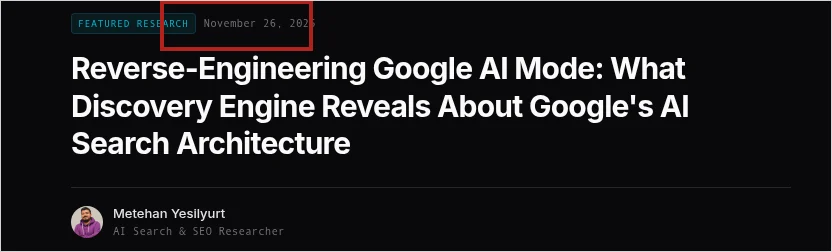
Discovery Engine is the retrieval stack Google Cloud sells as Vertex AI Search.
Yesilyurt describes the work himself: "After deep-diving into Discovery Engine's configuration panels, I've mapped the four-stage pipeline Google uses, including the seven specific ranking signals exposed in the Signal Viewer."
Yesilyurt also states the caveat the viral thread skips: "I'm not saying AI Mode uses identical code." Discovery Engine and AI Mode are different products, he writes, and his piece maps the first.
Yesilyurt also posted a shorter version on LinkedIn on November 27, 2025, the day after the blog went up. That post dates the chain from the other end: the analysis sat in public for nearly a year before this thread called it a leak. The post opens with the same thesis as the blog: Google is selling its AI search technology, and the sale reveals the infrastructure.
A year later, the same findings reappeared under a new claim: Google slipped.
"Google accidentally revealed how its AI search systems choose which sites to recommend and send traffic to," Groberman wrote on X on Nov. 20, in a thread showing 46 likes and 27 reposts.
In the same thread, Groberman calls Yesilyurt's year-old post "recent": "Metehan Yesilyurt, who previously went viral for his analysis of Perplexity's ranking factors, recently broke down Google AI ranking factors in a fascinating blog post."
The match is line by line: Base Ranking, Gecko, Jetstream, BM25, predicted click-through rate, freshness, and Boost/Bury rules all appear in both. The 500-token chunk cap, about 375 words, and the ancestor headings that travel with each chunk sit in both. So does the Prepare, Retrieve, Signal, Serve pipeline.
Practitioners should sit with the chunk cap. When answers are pulled from 500-token passages, a page earns its place one self-contained section at a time. That rewards structure over volume.
The thread also carries the sales wrapper: six links to Groberman's funnels. A free audit, an AI SEO page, a done-for-you package, a premium content bundle, and premium authority and backlink bundles.
Disclosure: my agency, ViewEngine, sells AI visibility work and builds its own tracking tools.
The two outside replies so far add material, and neither pushes back. Preferly replied that "each assistant reads different pages," citing its own study of local questions.
Another replier, Pierre Baigts, asked how much weight goes to off-site reputation, the part of the picture a brand can't write for itself.
This is the second recycle-to-sell from the same account in a week. Our November 15 piece debunked its last viral claim, a Bing AI report update that had shipped five months earlier.
The recycle part irks me more than the leak framing. A claim of accidental disclosure would mean newly exposed rules for consumer search, and nothing in the thread establishes that.
My read: keep Yesilyurt's piece in your bookmarks and check the date on anyone who cites it. Learn the seven signals, the chunk math, and the pipeline from the source. A thread selling bundles is a strange place to learn them.
Free newsletter
The Sherpa Brief
One email a week on what changed in AI search, what it means, and what to do about it. Written for marketers, SEOs, and publishers.
Free. Unsubscribe in one click.