
You may have seen the headline that traffic to the open web fell 24 percent in five years. The chart under it tells a different story.
SparkToro CEO Rand Fishkin's new report says total visits to the top million sites stayed "almost exactly the same" from 2021 to 2026, while the number of people online grew nearly 25 percent. If both hold, the average visits per user fell, and the post never says that AI answers caused it.
My read: the per-user drop is real enough to plan around, and the 24 percent is a different number from it.
Fishkin published the research on November 10, 2026, and he says it began as a theory he wanted to test.
He feared that the biggest sites, dominated by Big Tech, were hoarding the web's traffic while smaller sites got fewer visits. So he asked Similarweb, the data provider, for its global panel's total monthly traffic to the top million sites from 2021 to 2026, split by how popular each site is.
The first result eased that fear. In his words, "the distribution of traffic to the open web has not changed much in the last 5 years!" He wrote that stagnation describes the trend better than Big Tech squeezing everyone else.
He attached two limits to that. The panel counts only browser traffic, and Fishkin says consolidation and Big Tech domination in apps is likely far more prevalent. It is also worldwide, and a decline in US, UK and EU traffic could be hiding behind growth in Asia and Africa.
Fishkin says 2021 was hardly the start of the zero-click era, and his earlier research places the big shifts in Google results and in how social platforms treat links between 2012 and 2020. A five-year window that starts in 2021 therefore catches only the later part of a longer slide, if there is a slide at all.
Where the 24 percent comes from
The second chart is the one that made Fishkin nervous. He set Similarweb's total traffic against DataReportal's quarterly estimate of global web users, which runs from 4.95 billion in the fourth quarter of 2021 to 6.15 billion in the third quarter of 2026.
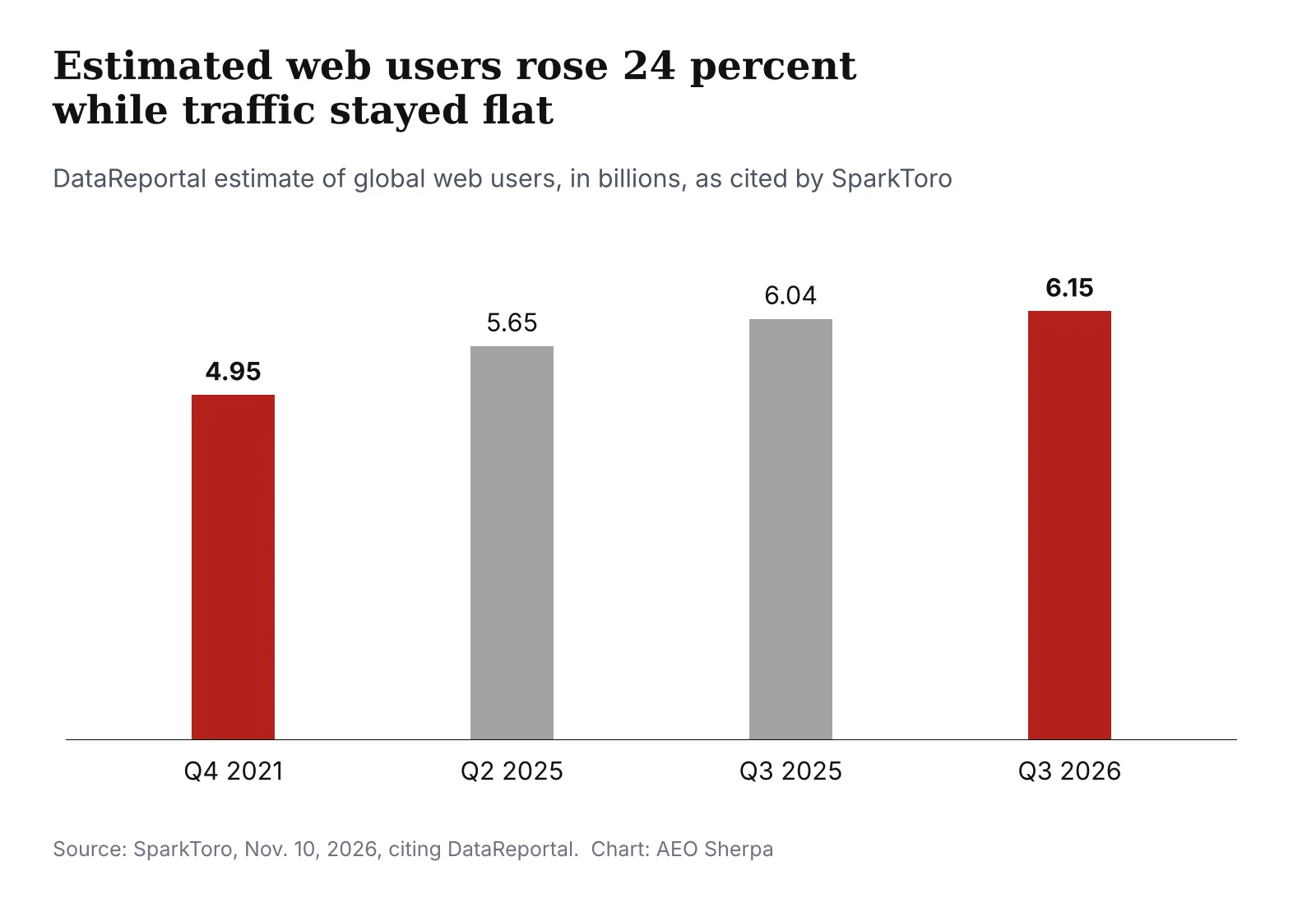
By my arithmetic that is a rise of 24.2 percent, which lines up with the headline figure. The post does not say how the 24 percent was calculated, and it describes the traffic totals only as a chart and as "almost exactly the same amount of traffic." Taking flat traffic as given, 24.2 percent more users means average visits per user fell about 19.5 percent. That is a large drop, and a different number from the headline.
The estimate is lumpy. DataReportal's table jumps from 5.65 billion in the second quarter of 2025 to 6.04 billion in the third, a gain of 6.9 percent, larger than any other step in the series. As a sensitivity check and nothing more, leave that one step out and user growth is about 16.2 percent, which puts the per-user drop near 14 percent. The direction holds either way, and the exact size depends on inputs I cannot see.
Fishkin is careful about the cause. He asks whether people now reach the internet through apps, whether search engines, AI tools and social networks mean people no longer need to visit as many sites, or whether something else is going on. Then he answers his own question: "We can't say for certain." The report does not measure AI answers at all. Anyone citing it as proof that AI took the traffic is going further than the data.
What I take from it
Within the top million sites and browser visits only, the long tail did not lose share to the giants. That is better news than the headline suggests. The harder finding sits in the denominator: the audience online keeps growing, and the average visit count per person is not keeping up.
I would not use this report as evidence for any one cause, and I would not apply a global per-user figure to a single site. My view is narrower. When visits per person fall, a ranking is worth less than it was, and being named in the answer gets more of the work done. That is my interpretation, and this report does not demonstrate it.
Free newsletter
The Sherpa Brief
One email a week on what changed in AI search, what it means, and what to do about it. Written for marketers, SEOs, and publishers.
Free. Unsubscribe in one click.