
You've probably been told AEO needs a new playbook. One SEO checked five months of Profound's advice and found an SEO precedent for every tactic in it.
David McSweeney, founder of the AI search platform QueryBurst, traced 33 execution recommendations Profound made between April 14 and September 16, 2026. His audit found a classic SEO or marketing equivalent for all 33. By his own scoring, 8 of them carry risk under Google's spam or freshness policies.
The second number worries me more. Advice with an SEO pedigree can still break Google's rules, and the part of AEO that really is different sits outside his audit: measurement.
McSweeney published the audit on QueryBurst's blog on November 16, as a test of a line Profound's CEO wrote two months earlier.
He opens with two quotes from James Cadwallader. On Sequoia's Training Data podcast in April, Cadwallader called creating and distributing content "very similar levers to what we've seen with SEO." In Profound's Series D announcement on September 16, Cadwallader wrote: "AEO rhymes with SEO, but that's pretty much where the similarities end." McSweeney reads that as a change of position and set out to see whether the advice changed with it.
He collected Profound's talks, articles, interviews and product posts from those months, pulled out 33 concrete recommendations, and traced each one back through the company's earlier advice. Of the 33, 24 fully matched earlier Profound advice and 8 matched partially.
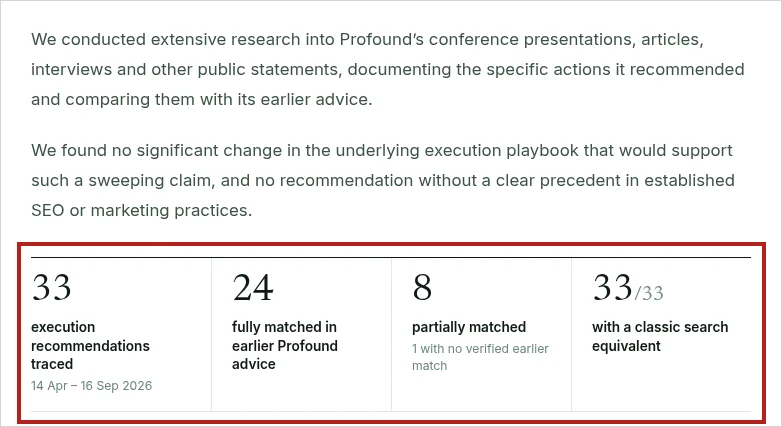
One had no verified earlier match, which McSweeney identifies as engaging with negative or influential reviews. The median gap between the earliest evidence he found and the in-period advice was 7 months.
McSweeney's conclusion was blunt. "We found no significant change in the underlying execution playbook that would support such a sweeping claim, and no recommendation without a clear precedent in established SEO or marketing practices," he wrote.
He also noticed which way the advice moved. By his account, the tactics Profound walked back were the AI-specific ones, such as llms.txt, schema's claimed citation benefits and Markdown copies of HTML pages. "Interestingly, the clearest changes involved Profound reducing its claims about AI-specific optimization techniques, rather than introducing fundamentally new execution practices," McSweeney wrote.
The column most people skipped
The reaction on X split along familiar lines. Joe Youngblood, an SEO, shared the audit on November 16 and summed it up: "AEO isn't real, it's all SEO."
That is a fair read of the headline number, and it skips McSweeney's "Effect on Google" column. He scored 17 of the 33 tactics as a plain benefit, 6 as a quality risk and 8 as a policy risk, which he defines as "risk under Google spam or freshness policies."
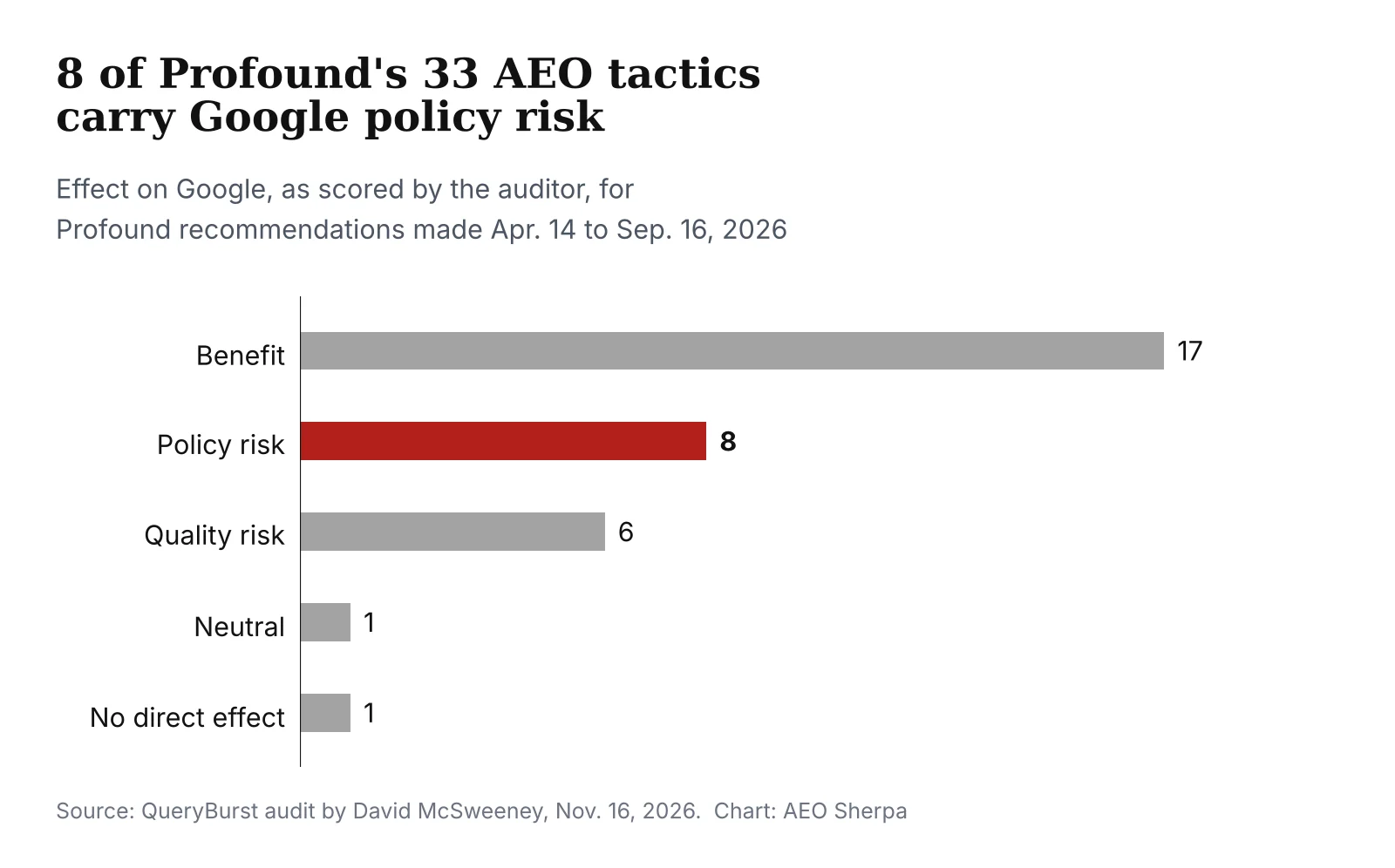
He says the flag marks risk, with no observed penalty, and each card pairs it with a benefit.
He spells out the conditions. Putting years in titles can tip into misleading dates. Writing pages for the searches the model runs, or building use-case landing pages, can turn into scaled content abuse or thin pages when the volume outruns the quality. Refreshing content without real changes risks what he calls artificial freshness, and translating articles at scale risks low-value variants.
The rest touch links and reviews. He flags paid-link risk in content distribution where money changes hands, and in outreach built on a "fixed-price placement or a reverse mention." A Profound post from July told shops to "Encourage/Incentivize customers to leave more positive reviews on your product pages," which he marks as a review-policy risk.
Every one of those has an SEO precedent. That is my problem with "it's all SEO" as reassurance. Done carelessly, part of this playbook is the same SEO advice Google's spam policies were written to catch.
Where the work actually splits
McSweeney left one category out on purpose. "Analytics, prompt tracking and workflow automation were excluded because measuring or automating an activity is distinct from the intervention itself," the audit says.
That is where some practitioners say the difference lives. Replying to McSweeney on X, Pankaj Gupta agreed on the fixes and added that "a rank report won't tell you whether ChatGPT names you".
The audit has its own limits. QueryBurst is an AI search optimization platform that McSweeney founded. It sells into the same market as Profound, and the 33-for-33 match is his own classification. Disclosure: my agency, ViewEngine, sells AI visibility work and builds its own tracking tools.
I agree with McSweeney on the tasks. Content, distribution, reviews and reputation are work an SEO would recognize, and I'm glad to see llms.txt fall out of the playbook.
Where I part ways with Youngblood is the scoreboard. I track AI visibility every week across AI Overviews, AI Mode, ChatGPT, Perplexity and Gemini, and a rank report can't show that work. The answer changes from run to run. You only see where you stand after running many prompts many times.
From a citation you learn which page the model used. From a mention you learn it knows your name. The outcome I care about is the recommendation, when someone asks who to hire or what to buy and the answer is you. A brand can be cited and praised and still rarely get picked.
That measurement job is the one part of AEO I'd call new. The tactics are old, and I'd read McSweeney's eight risk flags before copying any of them.
Free newsletter
The Sherpa Brief
One email a week on what changed in AI search, what it means, and what to do about it. Written for marketers, SEOs, and publishers.
Free. Unsubscribe in one click.