
You may have heard that AEO software is stalling and that Ramp's numbers prove it. Ramp's public data gives two answers. Clearscope's adoption rate is 10 percent, down 15 percentage points in a year. Profound's is 51 percent, up 11 percentage points, and still first in the category.
SEO consultant Harpreet Chatha made the stalling claim in a post on X on November 9, 2026. Ramp backs part of it. But the figures are buyer share among businesses that spend through Ramp. Revenue is not in the data.
My read: all this chart shows is who is winning buyers.
Chatha laid out his case in a single post. He wrote that "AEO companies are not seeing their revenue grow as fast as it should." His first piece of evidence was "According to Ramp, Profound's adoption rate has barely increased since January." He called AirOps declining and said "Clearscope collapsed."
Ramp defines adoption rate as the share of businesses that purchased from a vendor, of all businesses that made purchases in that software category, over the past 12 months. The pool is businesses that spend through Ramp, and the pages give no count of how many that is. A share of buyers leaves out what those buyers pay.
On that measure, Ramp backs Chatha on two vendors. Clearscope sits at 10 percent, fourth in the category, and its fall of 15 percentage points is the steepest of the four vendors here. AirOps is at 16 percent, down 2 percentage points, third. Peec AI is at 22 percent, up 9 percentage points, second.
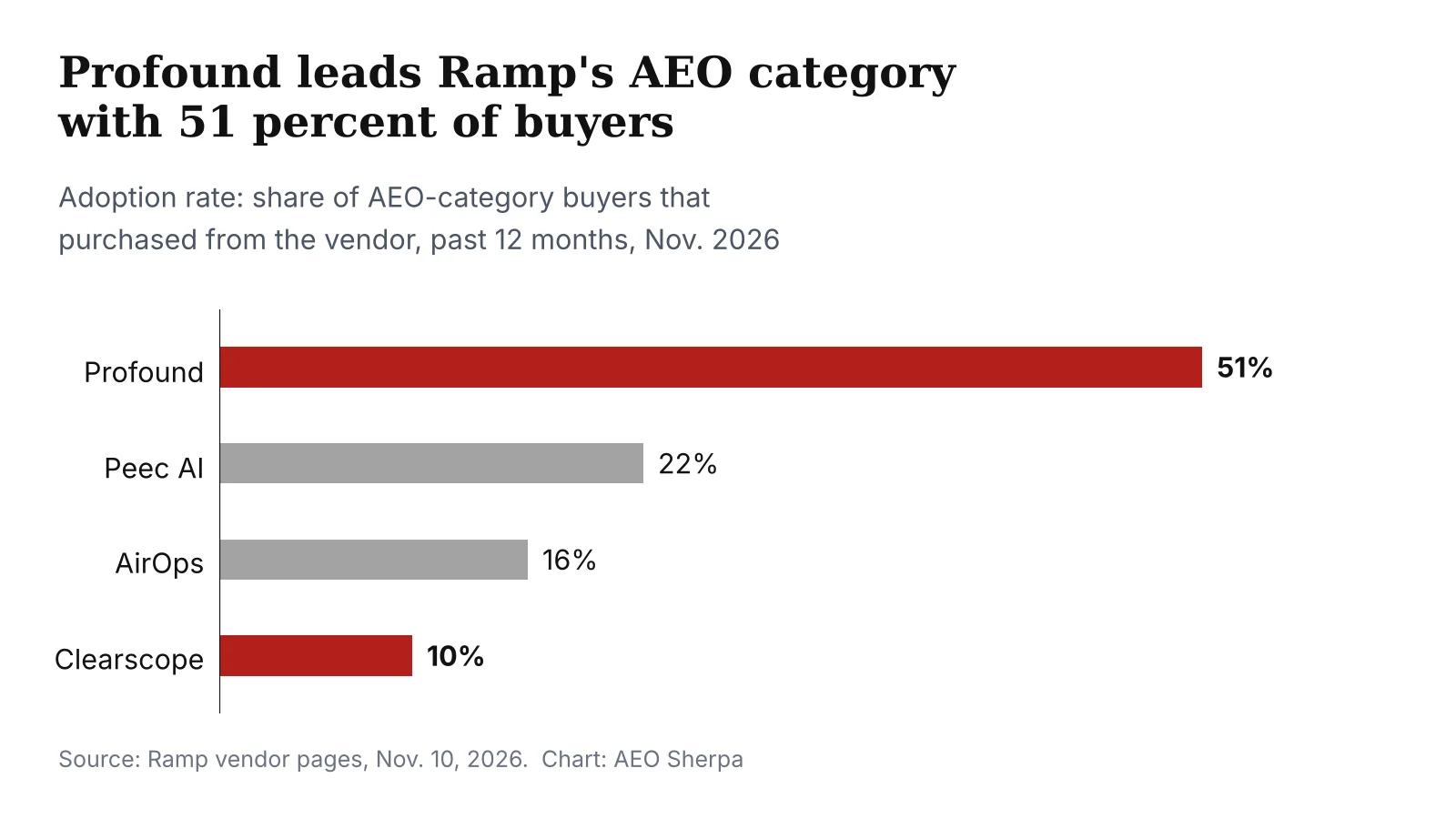
Profound is harder to call. Those figures are year over year, and Chatha's claim is about the time since January. The closest check is Ramp's size breakdown for Profound. From January to October 2026, its adoption rate went from 50 percent to 52 percent among small businesses and from 46 percent to 49 percent in mid-market. Enterprise went from 50 percent to 66 percent.
That is a mixed picture. Two of three size bands barely moved, and one jumped. Ramp's pages don't show which view Chatha used. I can't say whether he was looking at a flat band.
The thread went past Ramp. Chatha's post also says some prompt trackers are moving into other work, including ad agents. Benji Hyam, co-founder of Grow and Convert, replied on X that "The most curious move is Profound moving into ads."
Others argued about whether the tools are worth buying at all. The account @b2bvic wrote that "its gonna be worse when these people realize you can build your own prompt tracking for pennies on the dollar." Malte Landwehr, who is chief product officer and chief marketing officer at Peec AI according to the company's press release, took the other side in the same thread. He wrote that "Semrush is a legacy product and did not built an AI search solution that is even remotely comparable to the leading AI search platforms."
Disclosure: my agency, ViewEngine, sells AI visibility work and builds its own tracking tools.
Neither camp can use Ramp's chart. Share of buyers can rise in a shrinking market and fall in a growing one, and a vendor that loses share may still sell more than it did last year. What I can say is narrow. Among Ramp's AEO-category buyers, Clearscope is losing share and Profound is gaining it. Whether any of them is growing revenue is a question for renewals and sales figures, and I would treat every post that settles it from this chart as a guess.
Free newsletter
The Sherpa Brief
One email a week on what changed in AI search, what it means, and what to do about it. Written for marketers, SEOs, and publishers.
Free. Unsubscribe in one click.