
If you've been told AI coding agents default to Resend for email, the number behind that claim is from February. Claude Code picked Resend first in 64 of 102 extractable email recommendations in a report by Amplifying, run on Sonnet 4.5, Opus 4.5 and Opus 4.6.
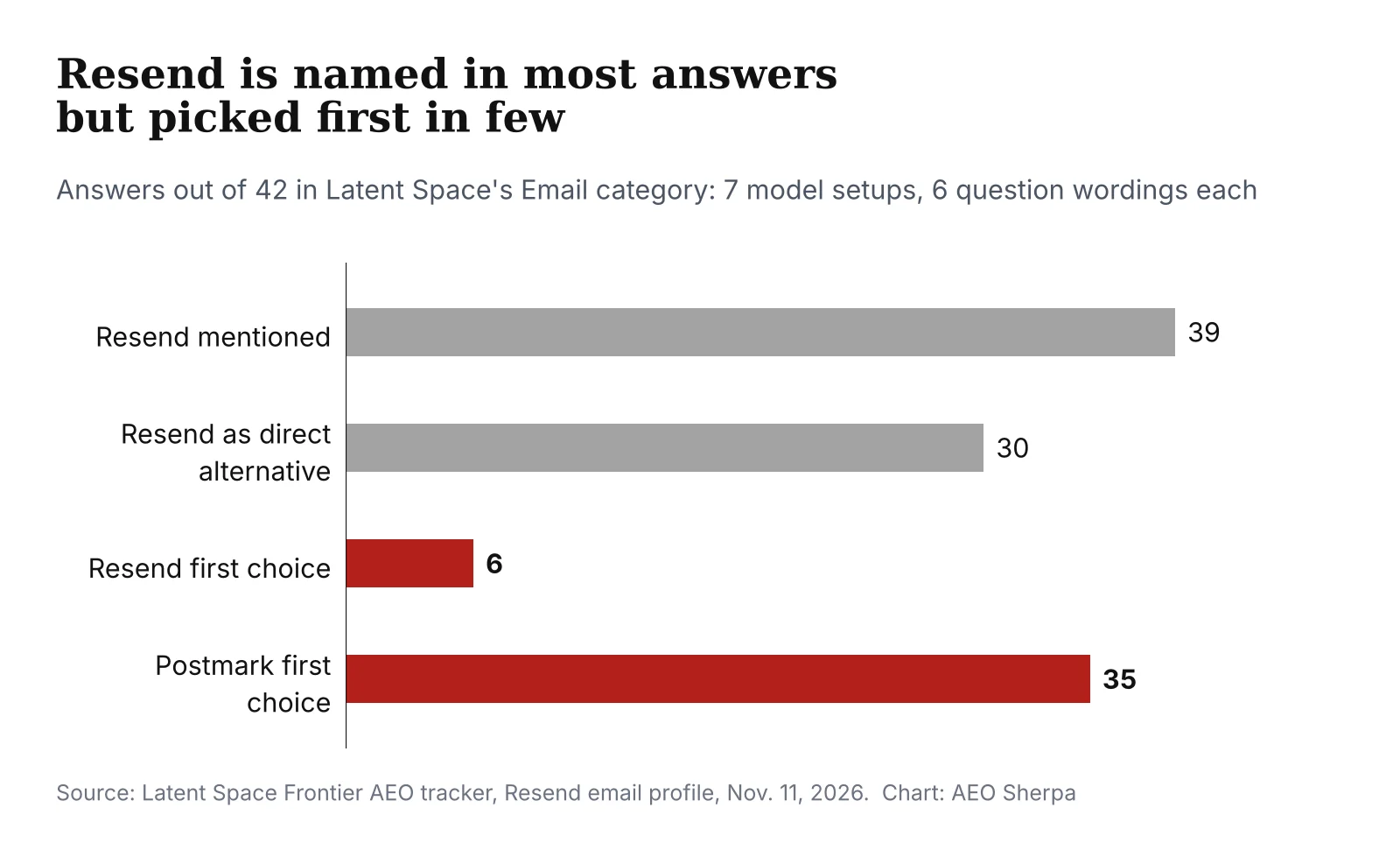
Latent Space, whose episode set the number loose, runs a newer tracker that reports something else. By its count, Resend is named in 39 of 42 answers and is the first choice in 6. Postmark is the first choice in 35.
My read: an old result is circulating as a current one, and the newer data shows how far a mention can sit from a pick.
It started with a podcast. Latent Space published its episode with Resend co-founder and CEO Zeno Rocha on November 10, 2026, and host swyx promoted it on X with a complaint many developers recognized: "I finally asked @zenorocha, the CEO of AEO, why tf my agents keep choosing Resend even when I don't want them to."
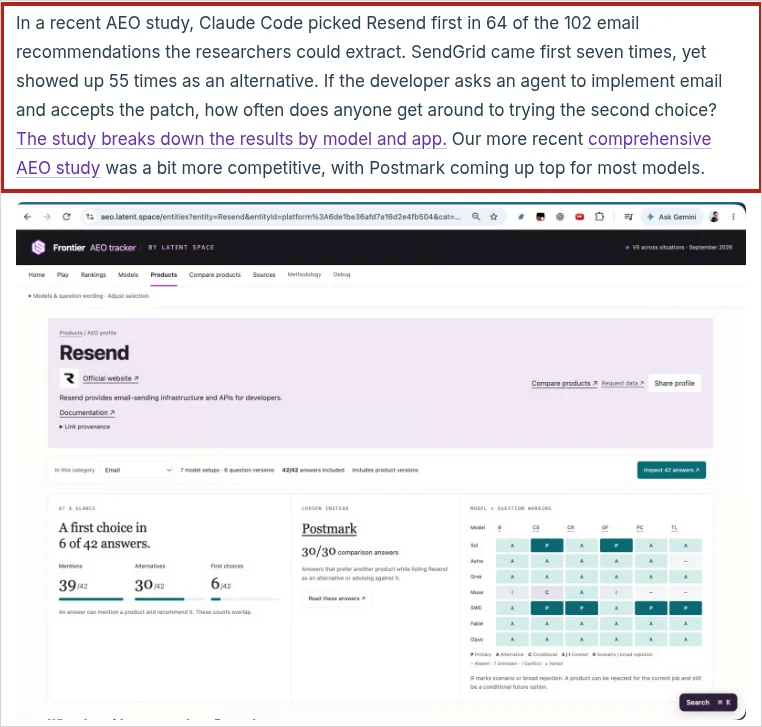
The show notes answered with a study. In what they called a recent AEO study, Claude Code picked Resend first in 64 of the 102 email recommendations the researchers could extract. SendGrid came first seven times but showed up 55 times as an alternative.
That line traveled. Reposts on X and aggregator summaries led with 64 of 102, and the ones circulating on November 10 and 11 gave it as a current finding, without the study's date or the models it tested.
The number has a date on it
The study behind it is Amplifying's "What Claude Code Actually Chooses," by Edwin Ong and Alex Vikati. They sent Claude Code 2,430 open-ended prompts inside real project repos, across 20 tool categories, four project types and three models, three runs each. No prompt named a tool. They recorded what the agent installed.
Email was one of those categories. Of 135 responses, 102 named a provider the researchers could extract, or 75.6 percent. Resend took 64 of them, 62.7 percent.
In the Python project, Resend's share rose from 21.4 percent with Sonnet to 50 percent with Opus 4.6. My guess is that a pick moving that much between two model versions tells you more about the models than about the product.
Ong and Vikati date their own results. The report opens with "This study covers February 2026. Read our newer tool-choice studies," and its limitations section calls the results a "Snapshot in time" that reflects "early 2026 model versions."
A newer test, built differently
Latent Space's tracker asks current models which product to use. In its Email category it covers seven model setups, from Claude Fable 5.1 and GPT-6 Astra to Grok 4.6, each asked six versions of the question, for 42 answers. Beyond the counts above, it reports Postmark as the product chosen in all 30 answers that list Resend as the alternative.
The episode page flags this itself, one line below the 64 of 102 figure, even as it calls the February study recent: "Our more recent comprehensive AEO study was a bit more competitive, with Postmark coming up top for most models."
The two tests measure different things. Amplifying watched Claude Code pick a package inside a codebase. Latent Space asks models six wordings of a recommendation question and records the answers. You cannot subtract one from the other and call it a drop. What the February number cannot do is stand in for current performance.
The fix Latent Space describes
The episode's write-up also describes a small change on Resend's site. Its pricing page uses a slider a person can drag to read off a price. "Add .md to the URL and the agent gets a table it can read in one request," Latent Space writes, and it links the markdown version of the pricing page.
That fix makes a page easier for a model to read. Nothing in either study shows it changed how often Resend gets picked.
Some readers worry about who is watching. "Once the agent picks the vendor, procurement has moved into the docs, and nobody in finance has read them," @alemsah wrote in a reply on X.
Disclosure: my agency, ViewEngine, sells AI visibility work and builds its own tracking tools.
Mentions are a signal, picks are the outcome
This story is a useful illustration of the gap between being mentioned and being chosen. A visibility dashboard that counts mentions would show Resend nearly everywhere in Latent Space's tracker. The first-choice count shows who the model recommends.
Quoting a February result about older models as current is the AI-era version of screenshotting a ranking from last season. AI answers are probabilistic and model versions move them, as Amplifying's own Python split shows. The standard I would hold a report to is first-choice share across many runs on current models, with the models named. A single snapshot, from either study, does not meet it.
If a model is misreading your pricing, a plain markdown page is a cheap thing to try. The 64 of 102 figure is a different matter. I would not quote it to anyone without the date next to it.
Free newsletter
The Sherpa Brief
One email a week on what changed in AI search, what it means, and what to do about it. Written for marketers, SEOs, and publishers.
Free. Unsubscribe in one click.