
You've probably seen an llms.txt adoption number this month, and you may have repeated it. SE Ranking, an SEO software company, says 10.13 percent of nearly 300,000 domains have the file. Before you cite that or any other figure, find out how it was counted.
MachineWitness reports that of 128,315 domains with EU endings, 20,804 answered the /llms.txt path with status 200 and only 9,035 served a text file in the form the proposal describes. Another 10,138 served an HTML page, most often their error page. Our own spot check found more than half of its 200 answers were HTML.
In that data, a status check more than doubles the adoption rate. My read is that any audit tool reporting "llms.txt present" from a 200 alone can be counting error pages, and you should find out which kind yours is.
MachineWitness published the count on October 17, 2026, and its operator posted the figures to r/TechSEO the next day.
MachineWitness fetches the /llms.txt path at the root of every domain it observes, every day, on two independently operated witnesses. For this count it took the Tranco list of the most visited domains worldwide, limited to the top one million, and kept those with one of the 27 EU country endings or .eu. The window ran from October 10 to 17.
It counts a file only when its first line is a Markdown heading, the one element the proposal requires. That rule gives 9,035 domains, or 7.04 percent. HTML under the path is left out, whether it shows up by content type or by content.
That leaves the 200s that are not heading-format files. Of the 20,804 domains that answered with status 200, 664 were empty and 10,138 returned HTML, which is 7.90 percent of all the domains checked.
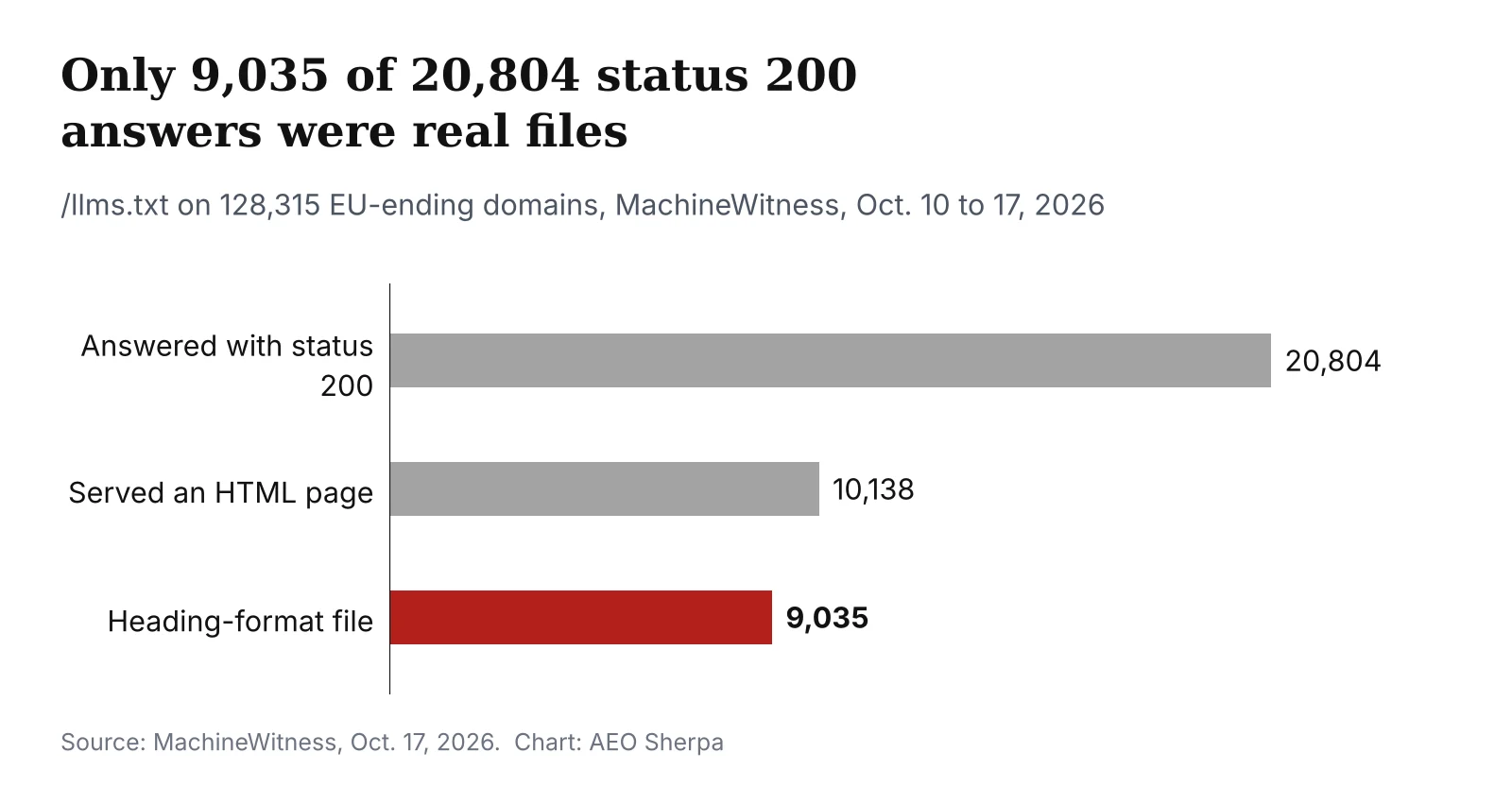
The operator, u/ma8nk, wrote on r/TechSEO that "a status check alone would report 20,804 domains (16.2 %) as "has llms.txt"".
The study page defines the number: "Counted is the format, not the content: whether a file is accurate, complete, or read by any model is not part of the figure."
Our own spot check points the same way
We ran a small version of the same test. On October 18, we fetched /llms.txt once over HTTPS for each of the top 500 domains on the Tranco list, from a cloud IP, following redirects. 125 returned status 200. Of those, 70 were HTML pages, 50 began with a Markdown heading and 5 were other text or non-HTML. That is more than half of the 200s as HTML pages, against 50 heading-format files.
Most of the rest returned an HTTP error or failed to connect, and many of those are infrastructure domains with no website. One fetch from one cloud network describes what that network received, since a site that treats cloud traffic differently could serve it a page a browser would not get. Within that limit, it points the same way as the archive, where 10,138 of the 20,804 answers were HTML.
The number most people quote
SE Ranking, which sells SEO software, updated its study on October 15, 2026. Its author, Yulia Deda, wrote that "In our dataset of nearly 300,000 domains, just 10.13% had an LLMs.txt file in place."
The study page lists the presence or absence of the file as one of the things it captured. It does not say how HTML responses were handled, and its sample covers different domains than the EU archive. The two percentages cannot be set side by side.
On citations, the SE Ranking blog reports that "Removing this variable from our XGBoost model actually improved its accuracy. This means that LLMs.txt might currently introduce more noise than value." That is a result about one model and one dataset. It is not proof that the file never matters.
Clients should stop asking whether llms.txt will get them cited, because nothing in this data says it will. A tool that tells you the file is there may never have read it. If an audit says your llms.txt is present, my read is that you should confirm the content type and the first line before you believe it. AEO Sherpa publishes one anyway because it costs nothing, and I want to know that mine is a file and not an error page.
Disclosure: my agency, ViewEngine, sells AI visibility work and builds its own tracking tools.
Free newsletter
The Sherpa Brief
One email a week on what changed in AI search, what it means, and what to do about it. Written for marketers, SEOs, and publishers.
Free. Unsubscribe in one click.