If your AI Overview reports come from scraped SERPs, two rank trackers are telling you different things about them.
AccuRanker says Google's poisoned pages still show AI Overviews and that only the organic listings change. Nozzle, which judged 27.0 million SERPs since September 13, 2026, finds an AI Overview on 45.9 percent of poisoned pages against 53.6 percent in the baseline. The sources those AI Overviews keep from the keyword's previous SERP fall from 68.1 percent to 38.7 percent.
Neither vendor has shown its samples are comparable, and I would not call either one right. I would treat September and October AI Overview numbers from scraped data as unsettled.
Both accounts landed in the same 24 hours, and the first is a statement about rankings only.
On October 19, 2026, Nick LeRoy posted an official Semrush statement. Semrush said it had been seeing the problem since late summer and had added checks. "The impact on the rankings our users track has been limited, and we haven't seen any service interruptions. Individual cases can still appear, with most showing up beyond the first page of results."
The same day, AccuRanker published its own account. More than a quarter of the keywords in its monitored sample came back swapped on the first day. Within two days it had pushed that below 2 percent, and stricter checks in mid-October took it under 1 percent. Google tightened its detection again on October 15, mostly on mobile. AccuRanker's Peter Emil Tybirk describes what a bad page looks like: "A poisoned SERP does not look suspicious on its own. You still see the familiar layout, ads, and AI Overviews. Only the organic listings are different."
Nozzle's study draws on a cross-section of the SERPs it collects for customers, across 52 countries and all three device types. A SERP counts as poisoned when fewer than half of a keyword's usual sites appear anywhere on it, and the baseline is the keyword's results from August 20 to September 9. Nozzle sells SERP data, as AccuRanker does. It reads the poisoning as Google's response to AI scraping, with rank trackers caught in it.
Its numbers put the AI Overview in a more complicated place than Tybirk's line suggests. Poisoned pages show one less often, 45.9 percent against 53.6 percent. When both pages show one, the AI Overview sources keep 38.7 percent of the previous SERP's sources, against 68.1 percent in the baseline. Organic results keep 22.0 percent of their sites, against 88.1 percent. Ads keep more than usual, 83.7 percent against 70.5 percent.
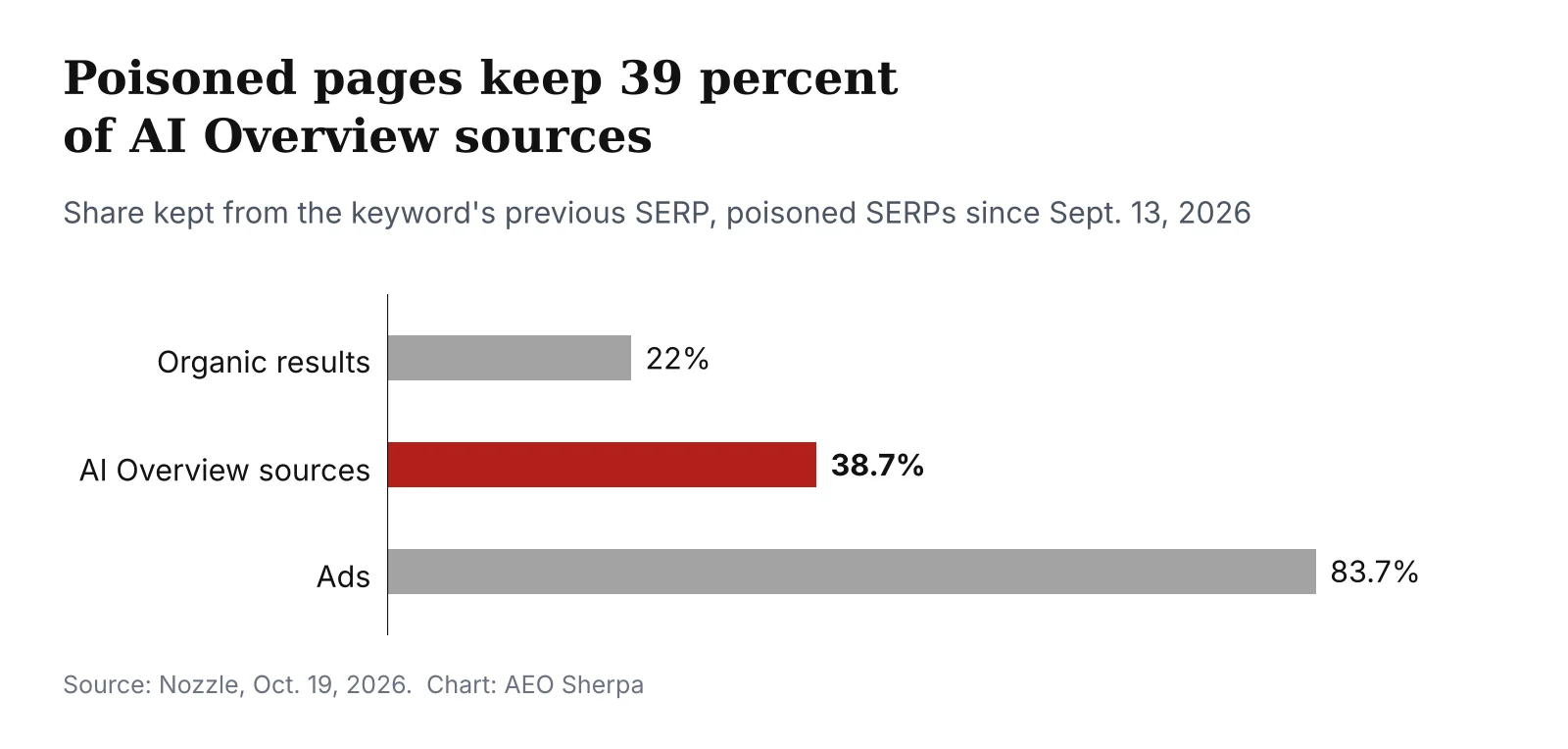
That is overlap with the previous SERP, not a score for whether an AI Overview citation is right. An AI Overview citation report is built on that kind of comparison.
The damage does not last. Nozzle finds 68.9 percent of poisoned SERPs have their usual sites back within three days, and a tracked site misses the top 10 on 60.2 percent of poisoned SERPs, against 2.7 percent normally. Mike King, founder of iPullRank, wrote on October 19 that he sees no way to "reliably verify your pipeline without storage and multiple scrapes anymore." Glenn Gabe, an SEO consultant, suggests a practical check: compare tools on surges or drops you have already confirmed by other means.
SISTRIX has published that since September 2026 it has released only results that passed multiple checks. The same page says it measures how websites appear in generated answers on Google and other AI assistants.
Disclosure: my agency, ViewEngine, sells AI visibility work and builds its own tracking tools.
The two accounts may differ because of sampling, detection or both, and I can't tell which from outside. My read is narrower. A one-day swing in AI Overview presence or citations from scraped data is more likely a collection artifact than a ranking change, until the data has been checked against a second source.
Free newsletter
The Sherpa Brief
One email a week on what changed in AI search, what it means, and what to do about it. Written for marketers, SEOs, and publishers.
Free. Unsubscribe in one click.