
You probably track a list of prompts and read each answer as if ChatGPT searched those exact words. In two recent ChatGPT models, a new study says it never did.
In an arXiv preprint posted on October 11, 2026, researchers at the National University of Singapore and Xi'an Jiaotong University recorded ChatGPT's own web sessions. In the GPT-5.3 Instant and GPT-5.5 Instant runs where searches were visible, the exact wording of the user's question was never the query. Both models predate GPT-6 and GPT-5.6 Luna.
My read is that your dashboard prompt is a label for a search ChatGPT runs under other words. Track prompts that carry a buyer's requirements instead, and run them many times.
The authors laid out the method in the paper, and Search Engine Journal's Matt G. Southern covered it on October 18.
The team recorded the data ChatGPT's web app received in their own signed-in sessions. That trace shows the searches ChatGPT ran, the pages those searches returned and the pages it chose as sources. They sampled 80 questions from Search Arena, a public set of real user conversations with search chatbots, and ran each one 20 times on GPT-5.3 Instant and GPT-5.5 Instant. Most of the data was collected between March 29 and July 29, 2026.
The rewriting was consistent. An exact match to the original question showed up in 5.5 percent of GPT-5.2 Instant runs and in none of the observed GPT-5.3 or GPT-5.5 Instant runs. For Chinese questions, 67.0 percent of GPT-5.3 Instant runs and 69.6 percent of GPT-5.5 Instant runs searched only in English. Lead author Yunxuan Jiang and the other authors write in the paper that "GEO monitoring should therefore consider the executed queries rather than only the user-facing query."
The sources moved between runs too. For GPT-5.3 Instant, 40.8 percent of URL candidates appeared in only one of the 20 runs, and for GPT-5.5 Instant it was 44.5 percent. Overlap was higher at the level of the site than the page, which is why the authors suggest watching both.
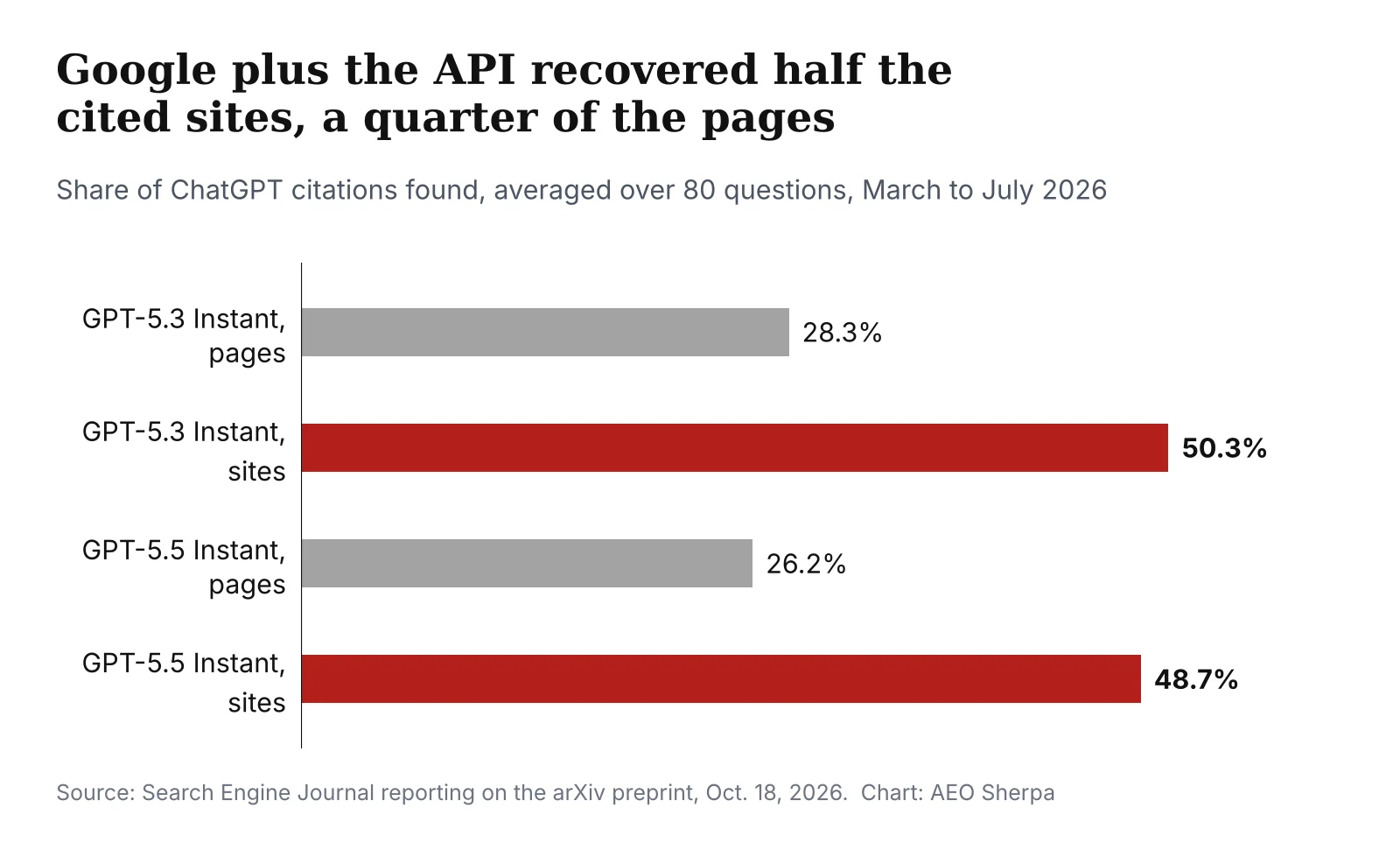
The team also tested whether Google results and the Responses API could approximate ChatGPT's cited pages and sites. Combined, Google results and the Responses API found 28.3 percent of the pages GPT-5.3 Instant cited and 26.2 percent for GPT-5.5 Instant. For cited sites the figures were 50.3 percent and 48.7 percent.
Southern points out that the paper tested no commercial tracking tool. Southern suggests asking whether a tool's data comes from the API or from the ChatGPT app.
The limits are real. This is a preprint, and arXiv does not peer review. In the limitations, the authors say the results are observational and do not show that publishing more pages, or appearing more often in retrieval, raises the odds of being cited.
A separate test shows the buyer's side of the problem. On October 17, 2026, Mat Golubovic described an experiment on X across five B2B software categories. Golubovic added three requirements to a generic best-of prompt, such as a 200-person company based in Germany with several legal entities. The original number one pick stayed first in 9 of 25 answers, dropped in 8 and disappeared in 8. In the same post Golubovic wrote that "Being visible for a category and being selected for a specific requirement are very different things." Golubovic also wrote that the experiment is small. I treat it as a hint about selection.
Disclosure: my agency, ViewEngine, sells AI visibility work and builds its own tracking tools.
What the study changes for me is how much weight one tracked prompt can carry. AI visibility is probabilistic. The paper records part of the reason: the question is rewritten, and the pages returned shift from run to run.
One answer or one cited URL is too thin a measure. I would run each prompt many times and include the site along with the page. I would write the prompts the way a buyer states requirements, because Golubovic's result suggests that is where leaders lose ground. Citations help me diagnose retrieval, but the outcome I want measured is whether the brand gets recommended or mentioned, and the paper did not test that. It also does not show that publishing more pages raises your odds. My guess is that the tools that survive this will be the ones that report the spread across runs, not a single clean number.
Free newsletter
The Sherpa Brief
One email a week on what changed in AI search, what it means, and what to do about it. Written for marketers, SEOs, and publishers.
Free. Unsubscribe in one click.